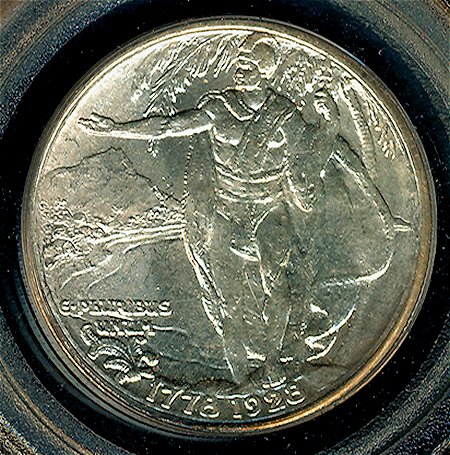
I've long had an issue with the generic description of the standing figure on the reverse of the 1928 Captain Cook - (European) Discovery of Hawaii Sesquicentennial half dollar that is found in the reference works on the US commemorative coin series.
In 1928, in the May issue of the American Numismatic Association's
The Numismatist, it states: "The reverse shows a Hawaiian warrior chief in full regalia gaining the summit of a hill. This represents Hawaii arising from obscurity. The chief holds out his right hand in welcome."
In 1938, David Bullowa in his
The Commemorative Coinage of the United States 1892-1938 describes the reverse as a: "Standing native chief in full regalia; his left hand holding an erect spear, his right arm raised in welcome."
in 1991, Q. David Bowers in his
Commemorative Coins of the United States - A Complete Encyclopedia includes the following simple description of the reverse: "Standing Hawaiian chieftain." (He also included the description found in
The Numismatist, as quoted above.)
I've read in each reference about Honolulu artist Juliette May Fraser being the designer of the coin, but I haven't ever seen a full discussion of her reference sources for the design. (Of course, such a discussion may be out there somewhere, but I have not yet come across it.)
I've never believed the "chieftain" on the coin was a generic conception. To me, it seemed most likely it was based on a depiction of a real person in Hawaii's past. After finally getting around to doing a bit of research on my beliefs, I submit that the chief figure on the coin is King Kamehameha I and that Miss Fraser used the statue of him that was sculpted by Thomas R. Gould as her primary reference for the standing figure on the coin.
Gould was commissioned by the Kingdom of Hawaii Legislature in 1879. Though an American, the sculptor worked from his studio in Rome, Italy to create the statue; the statue was cast in bronze in Paris, France. The first bronze statue was lost in a shipwreck near Cape Horn, but a second was cast from the original sculpture (still in Europe) and successfully made it to Hawaii. The statue was erected in front of the Judiciary Building in Honolulu.
King Kamehameha I in Front of Judiciary Building, Honolulu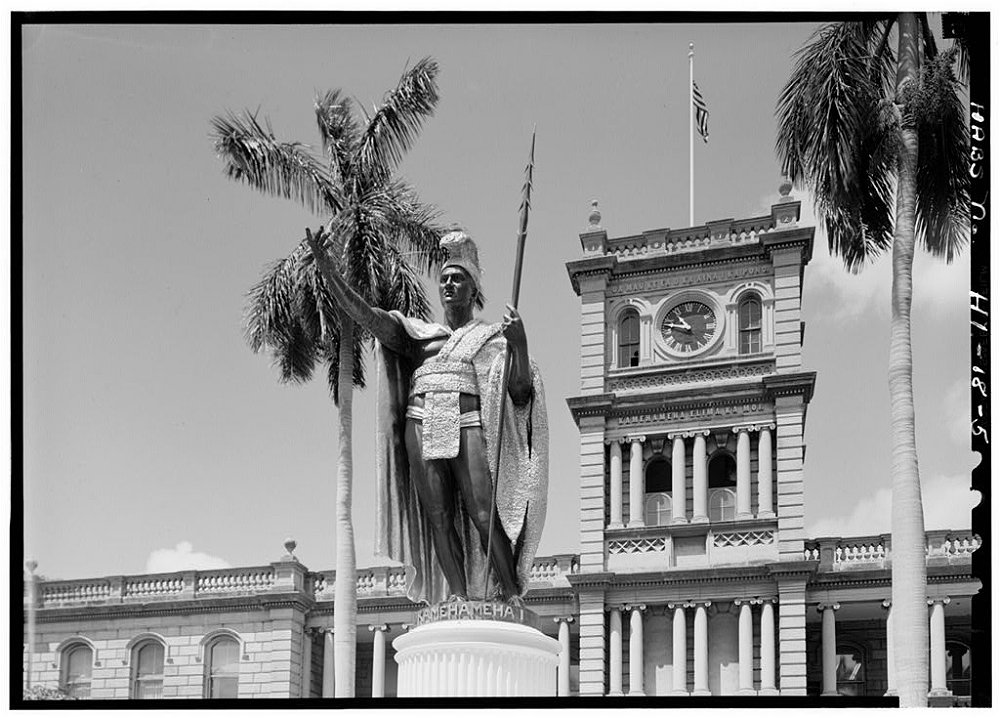 (Image Credit: Library of Congress, Prints and Photographs Division. Public Domain.)
The statue that was lost at sea was eventually recovered and erected, first, in a schoolyard in Ainakea in Halawa in 1883 - Kamehameha was born and raised in the Ainekea area - and then moved to in front of the Kohala Court House in Kapa'au in 1912 (both locations are on the Island of Hawaii); it is still there today.
At the time Miss Fraser was sketching the designs for the coin, the King Kamehameha I statue was available to view and study in two different and accessible locations in Hawaii. Fraser would have had unlimited access to either of the statues from which she could make her drawings.
In 1969, molds were made from the statue in Honolulu and a new statue was created. It was presented to the National Statuary Hall in the US Capitol as one of Hawaii's two statues.
Fraser's chieftain on the coin and the statue of King Kamehameha I bear a striking resemblance to each other. Far too much so for it to be a matter of coincidence (at least to me!). So, from my perspective, the 1928 Hawaiian commemorative half dollar features King Kamehameha I and not some generic island chieftain.
King Kamehameha I's Statue in National Statuary Hall, US Capitol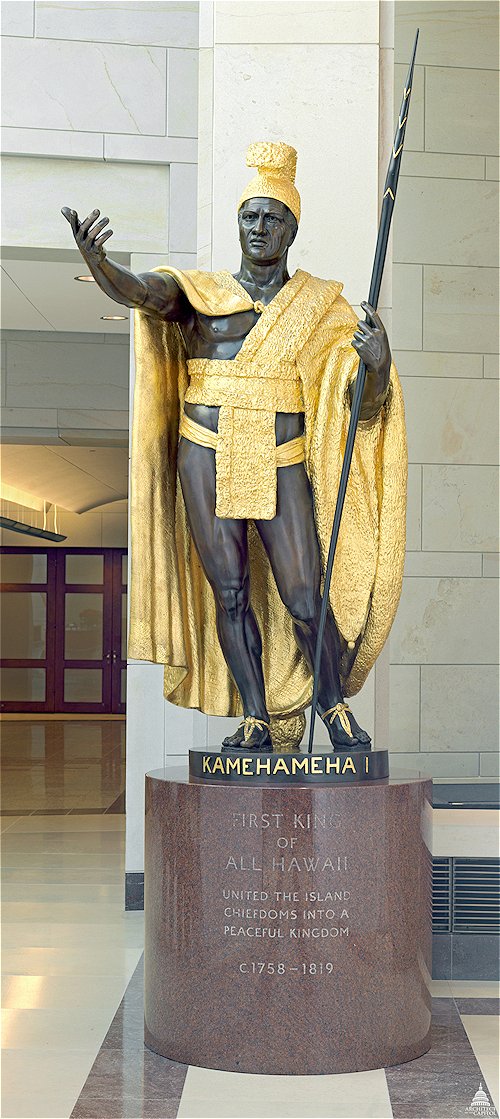 (Image Credit: Architect of the Capitol web site. Public Domain.)
(FYI: The other Hawaii statue is one of Father Damien, a priest who devoted his life to living among and helping those suffering from leprosy. He was elevated to sainthood by Pope Benedict XVI in 2009.)
1928 Hawaiian Discovery Half Dollar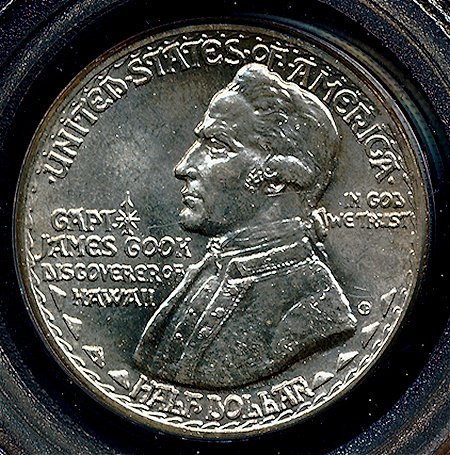
You can learn more about the Hawaiian commemorative coin by checking out:
-
1928 Hawaiian Discovery Sesquicentennial-
1928 Hawaiian Discovery Sesquicentennial - Revisited-
1928 Hawaiian Discovery Sesquicentennial - Bank of Hawaii AuctionOther of my posts about commemorative coins and medals can be found here:
Read More: Commems Collection.





 Posted 03/23/2021 11:21 am





