The Royal Canadian Mint (R C M) issued a silver 36 millimeter $10 coin in 2006 to celebrate Canada's National Historic Sites, with the Fortress of Louisbourg on Cape Breton Island, Nova Scotia being the subject.
Louisbourg, the fortress city, began life in 1713 when it was built as a French fishing port and import/export center. It also served as the administrative center of France's Ile Royale colony (present-day Cape Breton Island, Nova Scotia), which included Ile-St-Jean (present-day Prince Edward Island). In this role, it was the location of France's local government offices and a military garrison.
Between 1713 and 1768, Louisbourg thrived economically but was attacked by the British on more than one occasion as they did not appreciate France being in control of a fortress of such strategic importance seeing as it was capable of protecting against unwanted passage in the St. Lawrence River (i.e., hampering Britain's freedom of navigation on the river - to use a modern phrase) and controlling the entry point for the trade with the rich interior settlements of North America. The British first attacked and captured the fortress in 1745, but returned it to France in 1748 as part of the Treaty of Aix-la-Chapelle, which ended the War of the Austrian Succession. France received Louisbourg back in exchange for its return of territory it captured in Austrian Netherlands and India.
The British attacked and captured Louisbourg again in 1758 as part of the Seven Years War. After initially occupying the fortress city, the British began a systematic destruction of it to ensure it would not be of use to the French should it be returned to them as part of a future peace treaty. In 1768, the British abandoned the garrison they had established at Louisbourg and did not return; the city fell into ruins.
Parks Canada initiated hands-on reconstruction of about one-quarter of the original Fortress in 1964 (the project was approved by the Canadian Government in 1961) and work continued for 15+ years until 1980. Where possible, original foundations were used for the new construction. Today, the reconstructed Fortress represents the largest reconstruction of a French settlement in all of North America and is open to the public as a National Historic Site within the Parks Canada system.
Here's a link to the Parks Canada web site for Louisbourg to learn more about it and see a variety of images:
https://www.pc.gc.ca/en/lhn-nhs/ns/louisbourgThe 2006 Louisbourg $10 coin has, for years, been one of those
mystery coins for me. I couldn't match the 2006 issue year of the coin to any milestone anniversary or to a contemporary event. But I continued to dig and eventually discovered what I believe was the catalyst for the coin's release in 2006.
In 2001. Canada's Federal, Provincial and Territorial (F/T/P) Governments began collaborating on the Canadian Register of Historic Places (CRHP) which was created to provide "a single source of information about all historic places recognized for their heritage value at the local, provincial, territorial and national levels throughout Canada."
(Canada's Historic Places web site, historicplaces.ca.) A few years later, on January 17, 2006, the Fortress of Louisbourg was added to the Register due to it being "a place of profound significance in the great France-British struggle for empire."
(Canada's Historic Places web site) And with that, the R C M had a current event to mark with a commemorative coin!
2006 National Historic Sites - Louisbourg Silver $10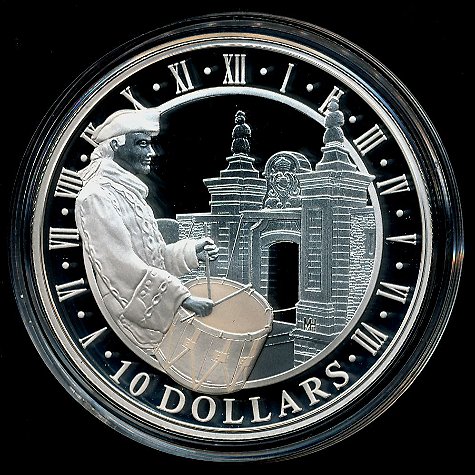
The commemorative reverse design of the coin is dominated by the city's famous Dauphin Gate (the gate guarding the primary land entrances to the fortress) and a drummer (based on those who take part in modern-day recreations of life at the fortress). Around the rim of the coin is seen a series of Roman numerals which are meant to represent a sun dial fashioned after one found during an archaeological dig at the site. The design is the work of Marcos Hallam. The coin's obverse features the standard Susanna Blunt portrait of Queen Elizabeth II.
The Mint's 2006
Annual Report listed 7,846 units sold with the 2007
AR adding 215 more for a total distribution/sales total of 8,061. The coin had its maximum mintage listed as 15,000. So, sales amounted to 54% of the total available. Such lackluster results could explain why the Louisbourg coin was the only release in what could have been an interesting National Historic Sites series.
I also took the plunge and purchased the 2013 Louisbourg $20 silver coin produced by the R C M. I made the purchase because I am intrigued by the history of the fortress city and its role in the early development of Canada. I also like how it presented a different aspect of the fortress and focused on its commercial role as a seaport vs. its military role. For reference, I'm including an image of my 2013 coin.
2013 Louisbourg Silver $20 Coin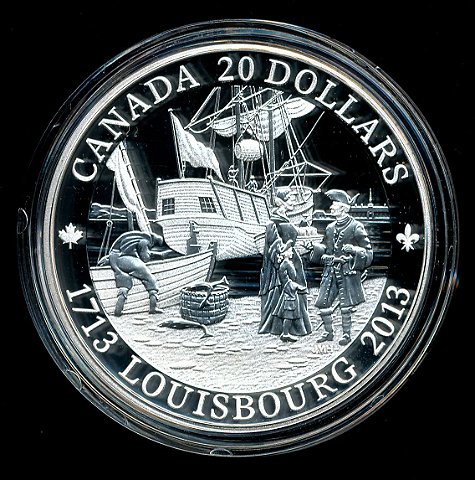
For other of my posts about Canadian commemorative coins and medals, check out:
Read More: Commems Collection.






 Posted 06/21/2021 09:06 am