Coin Community Family of Web Sites
Royal Canadian Mint products, Canadian, Polish, American, and world coins and banknotes. Shop CCF Members on eBay! 300,000 items to help build your collection! Vancouvers #1 Coin and Paper Money Dealer Coin, Banknote and Medal Collectors's Online Mall Specializing in Modern Numismatics Shop for APMEX Bullion on eBay!


Username:
Password:
Save Password
Forgot your Password?


This page may contain links that result in small commissions to keep this free site up and running.

Welcome Guest! Registering and/or logging in will remove the anchor (bottom) ads. It's Free!

Counterfeit Detection: 1893 South Africa 2½ Shillings Repeating Depression On A Pair Of Counterfeits

To participate in the forum you must log in or register.
Author Previous TopicReplies: 1 / Views: 814Next Topic  
Press Manager
Learn More...
CCFPress's Avatar
United States
1420 Posts
 Posted 03/13/2022  3:26 pm Show Profile   Bookmark this topic Add CCFPress to your friends list Get a Link to this Message Number of Subscribers
NGC - Repeat marks on multiple coins is an indication of counterfeiting.

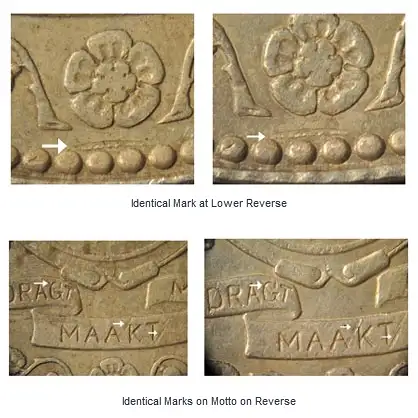
Authenticators often look for characteristics (such as marks) that repeat on multiple coins to assist in identifying counterfeits. It is virtually impossible for two genuine coins to have marks in the exact same locations, so if two coins show identical abrasions there is a very good chance that they are fake. NGC recently received two 1893 South African 2½ shillings that showed a number of repeating depressions that helped prove these coins were counterfeit.

When counterfeiters make fakes, they frequently make a die using a genuine example. The details of this coin, including all of its marks and other imperfections, are then transferred onto the die or mold. The counterfeits that are subsequently struck will all show the exact same marks. While it is true that there is one genuine example that has all of these abrasions, every other coin that shows those flaws will be a fake. Depressions (a term used by authenticators to describe marks on counterfeits) that repeat on two or more coins are evidence that the coins are counterfeit.
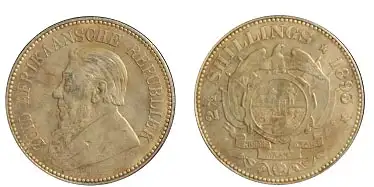
Counterfeit-Detection:-1893-South-Africa-2½-Shillings-Repeating-Depression-On-A-Pair-Of-Counterfeits
1893 South Africa 2½ Shillings, Second Example

The two counterfeit 1893 South African 2½ shillings submitted to NGC possess many identical depressions. Rather than point out every flaw with these two coins, in this article we highlight two areas of the lower reverse that show particularly obvious marks. The first pair of magnified images shows a long depression below the flower that appears on both examples. The second set shows three prominent marks in the banner that are seen in the same areas on each coin.
Counterfeit-Detection:-1893-South-Africa-2½-Shillings-Repeating-Depression-On-A-Pair-Of-Counterfeits

Repeating depressions are common features of counterfeits, and many of the ones that appear on different United States issues are well documented. Several Counterfeit Detection books show some of the most commonly seen fakes and what marks a numismatist should look out for. NGC also maintains its own internal database of these characteristics as they are identified.

Read More: Counterfeit Detection Series
Check out 1893 South African coins on ebay.

Bedrock of the Community
sel_69l's Avatar
Australia
21786 Posts
 Posted 03/13/2022  7:02 pm  Show Profile   Bookmark this reply Add sel_69l to your friends list Get a Link to this Reply
Harder to detect this sort of higher quality counterfeit in a situation where there may be only one example tp look at, and with nothing with which it may be compared.
A dead giveaway with two or more examples, as pictures show.

In my experience, I have seen high quality counterfeits made from copy dies or the products of pressure die casting. Edge milling put on after strike or casting also looks convincing.

Nevertheless, I have seen a few counterfeit coins of different designs in single examples that have these short line depressions in them, which can still be enough to raise a red flag.

High quality counterfeit and fake copies can be made from re cycled 90% coin gold and silver alloys, sourced from worn common coins.
  Previous TopicReplies: 1 / Views: 814Next Topic  

To participate in the forum you must log in or register.


Disclaimer: While a tremendous amount of effort goes into ensuring the accuracy of the information contained in this site, Coin Community assumes no liability for errors. Copyright 2005 - 2026 Coin Community Family- all rights reserved worldwide. Use of any images or content on this website without prior written permission of Coin Community or the original lender is strictly prohibited.
Contact Us  |  Advertise Here  |  Privacy Policy / Terms of Use

Coin Community Forum © 2005 - 2026 Coin Community Forums
It took 0.2 seconds to rattle this change. Forums