Be forewarned! I used all 10 fingers on this one, so it runs a little long! 
In January 1926, Representative Harry Irving Thayer (R-MA) introduced a bill calling for what would have been a unique coin within the classic US commemorative series -- a commemorative large cent!
Representative Thayer, acting on behalf of the International Longfellow Society, requested up to one million copper 1-cent coins "of the standard troy weight, composition, and diameter as the
large copper coins of a century ago" to help preserve and maintain the birthplace of Henry Wadsworth Longfellow. The Society's plan was to sell the cent coins to school children for five or ten cents each. A successful implementation of the plan would have raised between $50,000 and $100,000 to support the Society's objectives. The House Committee on Coinage, Weights and Measures supported Thayer's bill, only asking that a reference to Longfellow in the title of the bill be changed from "world's best loved poet" to "America's best loved poet."
Longfellow was an American novelist and poet, born in present-day Portland, Maine on February 27, 1807 (at the time, his birth location was considered to be part of Massachusetts); he died in Cambridge, Massachusetts on March 24, 1882. He achieved widespread domestic and international popularity for his work during his lifetime -- though not always the approval of the critics -- and is best known for such works as
The Song of Hiawatha, Paul Revere's Ride and
Evangeline. He was also known for his translation work, including the first American translation of Dante's
The Divine Comedy.
Two of my favorite Longfellow quotes are "Into each life some rain must fall." -- it doesn't get any more real than that -- and "In character, in manner, in style, in all things, supreme excellence is simplicity." I am definitely a supporter of the KISS approach - "keep it simple, stupid." (The length of this post notwithstanding!)
The internet has several excellent biographies for Longfellow, each of which present the story of his life far better than I can summarize here. I would suggest those with interest search out these other biographies for a more complete look at Longfellow's life. A brief yet thorough bio can be found at
https://www.biography.com.
The International Longfellow Society was established in 1914 by Arthur Charles Jackson. The Society's purpose was "To secure and preserve the birthplace of America's greatest poet, Henry W. Longfellow, to collect, exhibit and preserve printed or other matter and material relating to him; to encourage a world-wide observance of each succeeding anniversary of his birth; to promote the study of his writings and other literature."
The birthplace house, located at the corner of Fore and Hancock Streets in Portland, was not one in which Longfellow spent much time. In fact, he and his family lived in the house for just a few months after his birth, soon moving to another house in Portland. Today, that second house is known as the Wadsworth-Longfellow House (it was built by General Peleg Wadsworth). It was in this house that Longfellow grew up. The Wadsworth-Longfellow house was bequeathed to the Maine Historical Society in 1901 by Anne Longfellow Pierce, his sister; it has served as a Longfellow museum since 1901.
The Society actively sought help with the purchase of the birthplace house (i.e., the house at Fore and Hancock Streets) in 1914. It sent out an appeal through the newspapers owned by Randolph Hearst that outlined the situation they faced and the money that was needed. The price of the house was set at $12,000. The Society had an option on the property, but faced a deadline of August 1, 1914 to come up with money. It reported that it had $7,000 but needed $5,000 more to prevent the property from being sold to a local manufacturing company that would tear the house down and replace it with a building suited to its needs. The appeal appears to have worked, at least partially, as the Society was able to move forward with its purchase of the house.
Longfellow Birthplace House - Portland, ME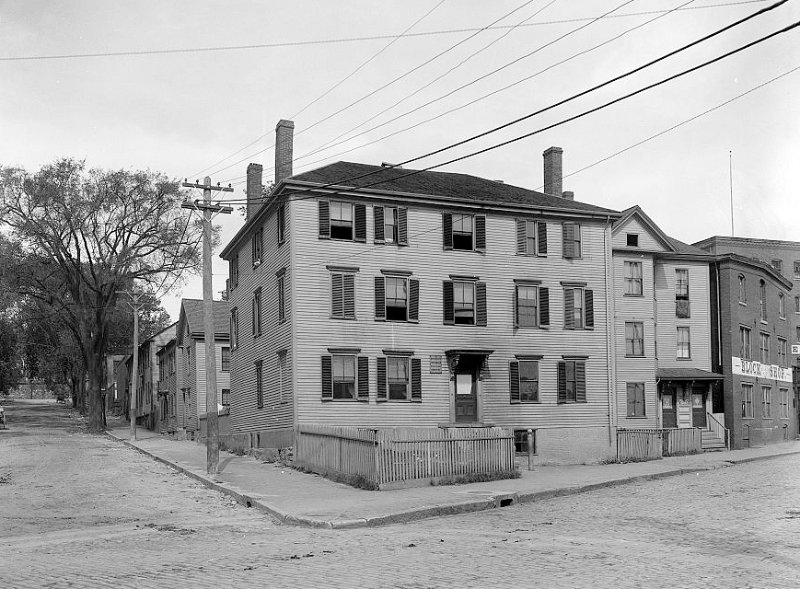 (Image Credit: Image courtesy of the Libary of Congress: Prints and Photographs Division. https://www.loc.gov/pictures/ Public Domain.
Prior to the Society's involvement, the house was being used as a tenement house. The Longfellow Society was able to partially restore the house and furnish it with period pieces in time for a grand opening celebration on October 28, 1914. At the dedication ceremony, Society president Arthur Jackson spoke as did Maine Governor Haines and Augustus H. Moulton from the Maine Historical Society.
Rooms were made available in the house for those wishing to stay overnight with the fees collected helping support the Society's mortgage payments on the property. Tours of the house were also given to raise funds.
It is unclear how active or successful the International Longfellow Society was regarding its objectives. The Annual Report (December 31, 1916) of the American Scenic and Historic Preservation Society states that the International Longfellow Society "is in danger of losing it [the house] unless money is raised to pay off the mortgage upon it and secure its preservation." There are records indicating that a membership/recruitment campaign was run in an attempt to raise the needed funds, but it does not appear that the effort was successful enough; the dilapidated structure was torn down in 1955. The Society disbanded in the 1970s at which time it donated the remaining funds (~$2,000) in its treasury to Westbrook College in order for them to purchase books either by Henry, about Henry or by other Maine authors.
Returning to the proposed coin...The Treasury Department quickly objected to the coinage proposal, causing its sponsor to rethink its approach to securing a Congressionally-authorized commemorative piece. The Society soon altered their request and switched from that of a commemorative large cent to a commemorative medal. A bill that would have authorized up to 500,000 medals was introduced in April, 1926; it did not explicitly reference a size, shape or metallic composition for the medal, leaving such details to be worked out between the Treasury and the Society.
The bill met with near-instant approval from the Treasury. Andrew Mellon, Secretary of the Treasury, wrote to Congress and stated the Treasury would "be ready to cooperate with the Longfellow Society in issuing a medal should Congress authorize the same." He also noted that "every assistance possible would be rendered by the [Treasury] to expedite its production."
The medal bill was favorably reported out of the Senate Committee on Banking and Currency and passed by the full Senate. It met opposition in the House, however, and failed to pass. As such, no bill was ever ever agreed to by both chambers and presented to the president for signature.
In the end, neither a commemorative large nor a commemorative medal would be struck by the US Mint in honor of Longfellow.
Below are images of the Longfellow medal issued as part of the Hall of Fame for Great Americans housed on the campus of what was once New York University (Bronx, NY); The HoF remains at the same location today, but the campus is now part of the Bronx Community College.
The obverse of the medal features a three-quarter, left-facing bust of Longfellow. The reverse includes several images that call to mind the works of Longfellow: Paul Revere, a Village blacksmith, Hiawatha and Evangeline. It was designed/sculpted by Anthony Notaro; the medal was issued in 1970.
NYU Hall of Fame Medal: Henry Wadswoth Longfellow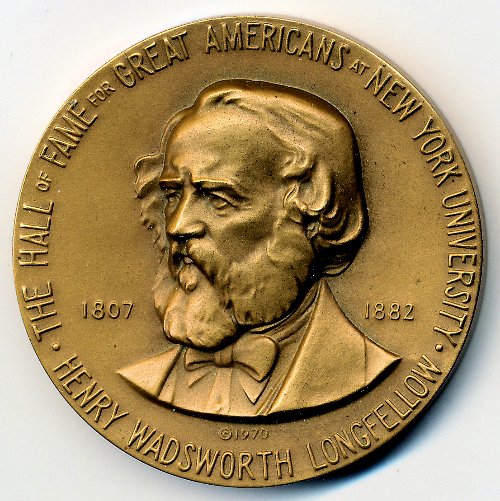
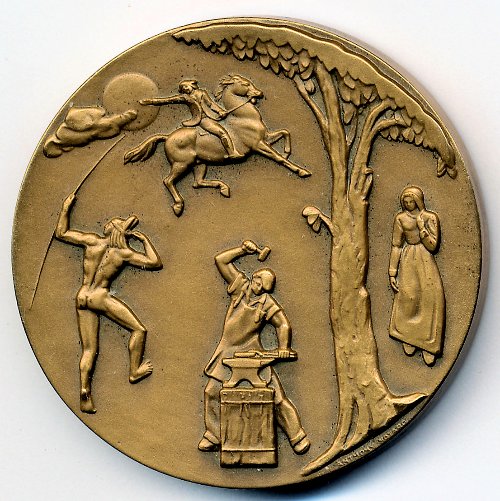 Postscript:
As an end note to the story, Representative Thayer died on March 10, 1926 (less than two months after introducing the bill) and did not live long enough to see the path it would follow in Congress.
Can you imagine the potential chaos within the US monetary system if up to one million "obsolete" large cent pieces had been distributed to children?
At the time of the proposed legislation, the small cent had been in circulation for over 60 years; the first type of US small cent was introduced in 1864. 






 Posted 12/09/2021 12:44 pm





