The 1925 Battle of Lexington-Concord Sesquicentennial Half Dollar has several elements in its history that, in combination, make it one of only two US commemorative coins to follow such a path:

It was proposed in a Joint Resolution vs. a Bill. (See link below for a discussion of others.)
It was included in a Joint Resolution whose primary purpose was to create a Federal Commission to participate in the observance of a national historic event - the 150th anniversary of the Lexington-Concord Battle.
The coin proposal was reviewed and recommended by the Committee on the Library vs. the Committee on Coinage, Weights, and Measures.
Note: The 1926 American Independence Sesquicentennial gold and silver coins have the same distinctions.In May 1924, three identical House Joint Resolutions (H. J. Res 255, H. J. Res 256 and H. J. Res 259) were introduced in the House for the purpose of "establishing a commission for the participation of the United States in the observance of the one hundred and fiftieth anniversary of the Battle of Lexington and Concord, authorizing an appropriation to be utilized in connection with such observance, and for other purposes." Among the "other purposes" was the issuing of a special postage stamp series and the striking of a commemorative half dollar. The Resolutions were introduced by Representatives John Jacob Rogers (R-MA), Frederick William Dallinger (R-MA) and Robert Luce (R-MA), respectively.
Due to their primary purpose (i.e., creation of a Commission). the Joint Resolutions were referred to the Committee on the Library. The Committee held a Hearing on the Resolutions (as they were identical, the Hearing applied to all of three Resolutions, though H.J. Res 259 later became the Committee's focus). During the Hearing, Representative Rogers reviewed each section of the Resolution for the Committee and indicated that its commemorative coin provisions were based on the approved bill for the 1920 Pilgrim Tercentenary coin. He also stated, "These specially issued coins are quickly absorbed by the people, who keep them in the family as souvenirs, so that these sections of the bill [i.e., stamp and coin sections] are really a matter of profit to the Government rather than an expense."
Following the Hearing, the Committee on the Library reported the Resolution favorably and recommended that it be passed. The Whole House considered H. J. Res 259, and was about to pass it when Representative Otis Theodore Wingo (D-AR) rose and derailed the House proceedings while he expounded on the plight of the "embattled farmers," a phrase from the Committee on the Library Report that "triggered" him. The phrase had previously appeared in an article published by the New York Chamber of Commerce on July 3, 1923 and was referenced (and made part of the
Congressional Record) during Congress' extended debate over the alleged benefits of the Fordney-McCumber tariff law - specifically when American farmers were being discussed; Representative Wingo apparently wanted one more opportunity to take a shot at the tariff law. After his long and off-topic oration, the House quickly passed the Resolution and sent it on to the Senate where it was referred to its Committee on Appropriations.
It was reported out of Committee without amendments along with a recommendation to be passed. It passed the Senate without debate; the House was notified of its actions. After being examined and signed in each chamber, the Resolution was sent to the President for approval. US President Calvin Coolidge signed the Resolution into law on January 14, 1925 - the 1925 Battle of Lexington-Concord Sesquicentennial Half Dollar was born!
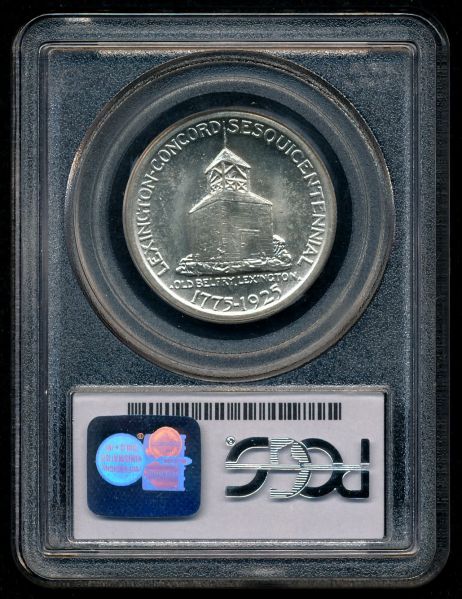
1925 Battle of Lexington-Concord Sesquicentennial Half Dollar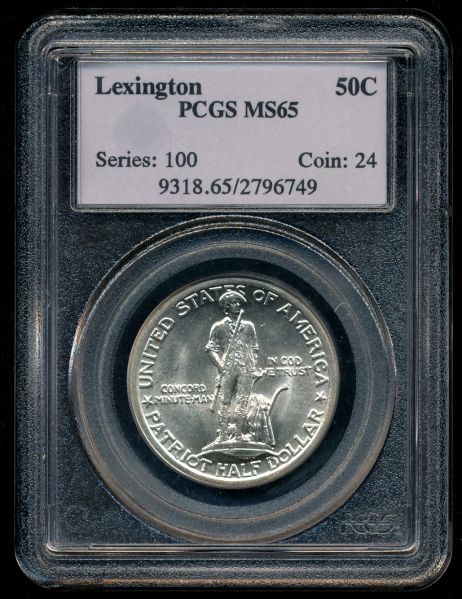
For a look at the other US commemorative coins authorized via Resolution vs. Bill, see:
-
Resolution vs. BillFor more on the Lexington-Concord half dollar, check out:
-
1925 Battle of Lexington-Concord Sesquicentennial -
1925 Battle of Lexington-Concord Sesquicentennial - EphemeraFor other of my posts about commemorative coins and medals, check out:
Commems Collection. 









 Posted 02/23/2022 4:07 pm