I've written previously about the multiple historical inaccuracies Lyman William ("LW") Hoffecker created and promoted to gain support for his pet project - the Old Spanish Trail Half Dollar. (See link below.) I wanted to circle back to present the story of how the Old Spanish Trail half dollar came to be and how Congress was deceived during its consideration.
The bill calling for a half dollar "to indicate the interest of the Government of the United States in commemorating the four hundredth anniversary of the Expedition of Caheza de Vaca and the opening of the Old Spanish Trail" was introduced in the House of Representatives by Robert Ewing Thomason (D-TX) in March 1935.
For background: Alvar Nunez Cabeza de Vaca was part of a Spanish Expedition that came to the New World in 1527. He was not the expedition's leader, but rather its treasurer. The leader of the ill-fated expedition was Panfilo de Narvaez. The expedition met with much hardship - storms, shipwrecks, disease, unfriendly Native Americans - and ultimately was reduced from its initial complement of roughly 700 men to just four or five. Alvar Nunez Cabeza de Vaca was one of the few survivors. He subsequently traveled (for approximately eight years) through portions of the US Southwest, trading and interacting with local Native Americans until he was able to reconnect with Spanish authorities in Mexico.Map of the Expedition of Panfilo de Narvaez and Subsequent Journey of Cabeza de Vaca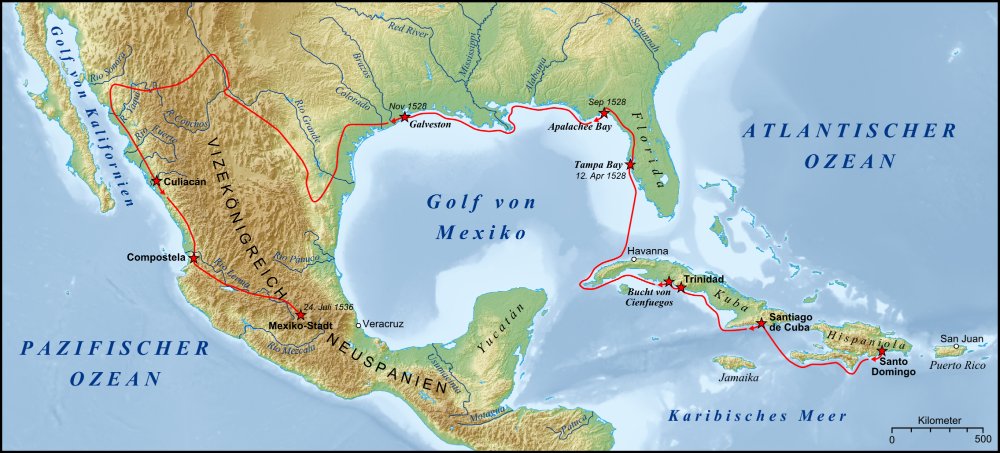 (Image Credit: Lencer, CC BY-SA 3.0 http://creativecommons.org/licenses/by-sa/3.0/, via Wikimedia Commons.
The map traces the known path of of the Narvaez expedition into November 1528 at Galveston Island, and then presents a historical reconstruction of Cabeza de Vaca's subsequent journey. (Note that his journey did not take him near what would become El Paso, Texas vs. what is shown on the map on the coin.)
The coin bill requested just 10,000 50-cent pieces "be coined by the Director of the Mint," without specification as to if coinage was to be restricted to one Mint facility or if multiple locations were to be allowed.
The bill was referred to the House Committee on Coinage, Weights, and Measures. I haven't found record of a public Hearing on the bill, though the Committee appears to have considered the bill in a Hearing-like session that included Representative Thomason. At the session, Thomason assured the Committee that the El Paso Museum Committee, the theoretical sponsor of the coin, financially guaranteed the coin and promised that none of the coins would be returned to the Mint. Representative Thomason also provided historical background on the Cabeza de Vaca Expedition; the information was included in the Committee's Report and, subsequently, in the
Congressional Record.If anyone on the Committee had been familiar with the history of the Old Spanish Trail, they would have immediately been able to recognize that Cabeza de Vaca's journey in the 1500s had nothing to do with the trade route that came to be known as the "Old Spanish Trail;" that trail connected Santa Fe, New Mexico with southern California and developed in the 1820s/1830s - long after Cabeza was dead and buried in Spain. The partially known and partially theoretical path that de Vaca followed in the 1520s-30s was/is not referred to as the "Spanish Trail."
If the coin proposal stopped at marking the (approximate) 400th anniversary of Cabeza de Vaca's journey in the American Southwest, it would have been fine. The addition of the "the opening of the Old Spanish Trail" language, however, completely derailed the honesty of the measure. The romance of the tale weaved by Hoffecker through Thomason proved too enticing, and the facts of history were ignored. The Committee reported the bill favorably, with a recommendation to pass.
The bill was considered by the House and passed without issue once it was confirmed that the coins would be produced at no cost to the Government. The bill was then sent to the Senate where it was referred to the Senate Committee on Banking and Currency; the Committee favorably reported the bill without amendment. When considered in the Senate, the bill passed with only minor discussion (i.e., without objection or debate).
The bill was then examined and signed in each chamber and presented to the President for approval. US President Franklin Delano Roosevelt signed the bill into law on June 5, 1935.
I encourage you to check out my "Redux" post (Link below.) for additional discussion of the coin's inaccurate portrayal of history. I'll leave things here with a mention of the El Paso Museum that was identified as the coin's sponsor...
There is a distinct possibility that no El Paso Museum existed in 1935. Their had been talk locally of starting a museum for at least 15 years, but, until the El Paso Centennial Museum initiated construction in 1936 as a Texas Centennial project, using state-supplied funds, I find no published record of an established museum in El Paso. In addition, I haven't yet found a documented connection between Hoffecker and the Centennial Museum.
Per Q. David Bowers, Hoffecker wrote that he purchased the coins from the US Mint using his own money (as provided for in the bill's language) and therefore owned them; he claimed that the only coins received by the El Paso Museum were the two examples he gave them as a gift (but I have to wonder if even that is true - which museum received the coins?).
In 1936, while appearing before the Senate Committee on Banking and Currency on behalf of the American Numismatic Association, Hoffecker was asked (regarding his past involvement with the Old Spanish Trail half dollar): "But you had no ownership of them?" He responded, "No, sir; none whatever." Such a statement is a blatant contradiction of his previous, self-stated, position. This willingness to deceive and contradict makes it very difficult to know for sure what Hoffecker's "game" truly was. I feel confident in saying, however, that the "Old Spanish Trail" half dollar endeavor was a personal project for personal profit vs. an altruistic project to support a local museum. (I believe the Museum Committee was really just a "front" for Hoffecker himself.)
1935 Old Spanish Trail Half Dollar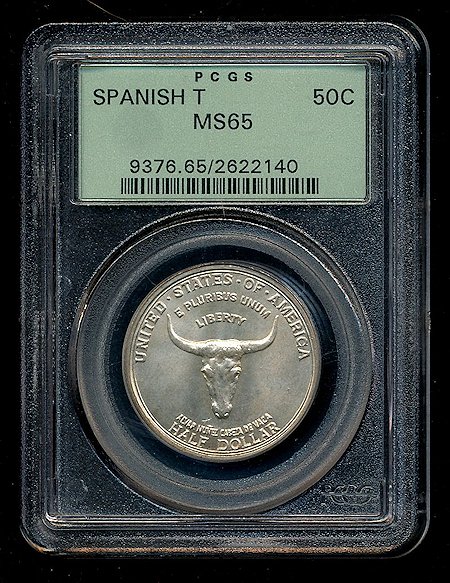
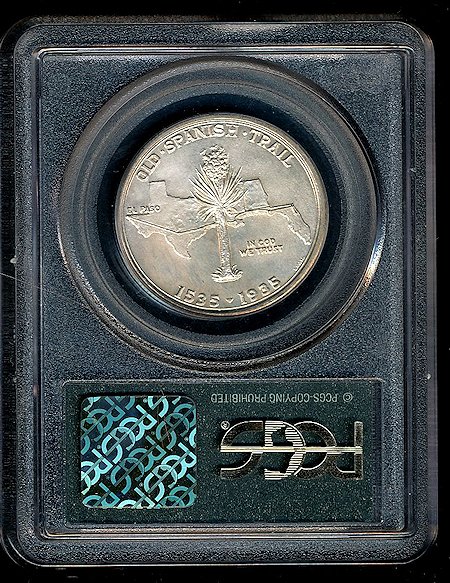
For more on the Old Spanish Trail half dollar, check out:
-
1935 Old Spanish Trail 400th Anniversary-
1935 Old Spanish Trail 400th Anniversary - Redux - Historical Inaccuracies Discussion
-
Quick BBits #20 - 1935 Old Spanish Trail 400th Anniversary - DesignersFor other of my posts about commemorative coins and medals, see:
Commems Collection.






 Posted 03/08/2022 12:18 pm





