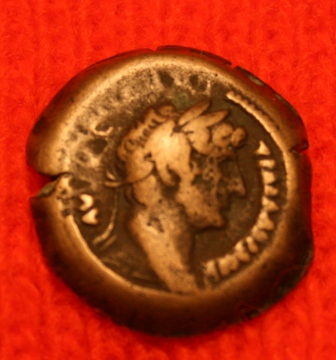
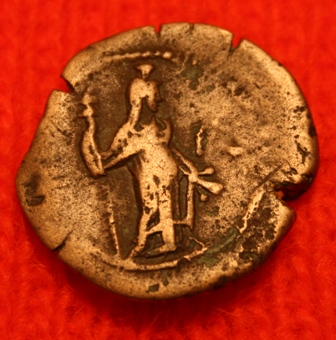
It is a coin; the denomination is a "hemiobol", or half an obol. In the ancient Greek monetary system used in Roman Egypt, there were six obols to a drachm, and four drachms to a tetradrachm. The mint city is most likely to be Alexandria, the capital of Roman Egypt.
It's difficult to get an ancient coin with a "more precise" date than this one has; for most ancient coins, you have to settle for a much wider date range. Hadrian became emperor on August 9th, 117 AD. His "First Year" didn't last long in Egypt, because the Egyptian New Year was on 29th August; his Year 2 went from 29th August 117 to 28th August 118. The 11th year of his reign therefore goes from August 29th, 126 AD to August 28th, 127 AD. Your coin would have been struck sometime during that year-long period.
As for value, the millennium edition Sear catalogue of Roman coins also includes a comprehensive list of coins of Roman Egypt, which is where I obtained the catalogue number from (Sear #3821). The volume of the catalogue that includes coins of emperor Hadrian dates from 2002, and gives a catalogue value for this coin of £15 in Fine, £30 in Very Fine. Catalogue values may have gone up slightly since this edition was printed, but not by much; for most ancient coins, the values change only very slowly, but do tend to adhere to the price in British pounds rather than US dollars.
Some of the inscriptions (such as the date) on your coin are either worn away or were weakly struck to begin with. As such, I would grade your coin at less than Fine (say, VG), giving it a "book value" somewhere around £10 to £12. At current exchange rates, that gives somewhere around US$15. But coins generally, and ancient coins in particular, are always difficult to fix a price to. Ultimately, a coin is worth what someone is prepared to pay for it.
Don't say "infinitely" when you mean "very"; otherwise, you'll have no word left when you want to talk about something really infinite. - C. S. Lewis










 1bronzecoinFRT.jpg
 1bronzecoinBCK.jpg


 Posted 02/02/2009 12:35 pm


