Wayte Raymond was born in South Norwalk, CT on November 9, 1886. He began his professional career as a teller at the City National Bank of South Norwalk; it was at the bank that he developed his rest-of-life interest in coins and related items. He joined the American Numismatic Association (
ANA) in 1902 and began his professional numismatic career by becoming a part-time coin dealer at about the same time.
He borrowed $500 from his father and moved to New York City to open a full-time coin business - the United States Coin Co. He focused his business specifically on coins (vs. including stamps, antiquities, etc.), generated fixed price lists (FPLs) for his inventory and managed coin auctions with material from around the world. He was very successful and his business grew with many advanced collectors becoming regular customers.
In the early 1930s, Raymond went to work for the Scott Stamp & Coin Co. as the manager of its numismatic department. After working with Scott for several years, he went back out on his own and remained an independent dealer for the rest of his career.
In addition to being a noteworthy buyer/seller/auctioneer of US and World coins, Raymond is also known within the numismatic community for his many important numismatic publications (e.g., his
Standard Catalogue of United States coins, first published in 1934, was the forerunner of the
Guide Book of United States coins, aka "The
Red Book" ), and his
National Album coin boards set the standard for coin storage from the 1930s into the 1960s.
The roots of Wayte Raymond's coin boards can be traced to Martin Luther "ML" Beistle and his "Unique Coin Holder." Beistle invented his holder/coin board in 1927 and received a patent for his efforts in 1929. He was granted Patent Number 1,719,962 - the number was later printed on the boards produced by Wayte Raymond. In 1930, Beistle sold his coin holder design (and patent) to Wayte Raymond who transformed Beistle's holders into his National Coin Albums product line; Raymond had been a seller of Beistle's coin boards before acquiring the rights to them.
Raymond expanded Beistle's coin holders product line (originally created for US half dollar and dollar coins) by creating coin boards for all of the US coin series, including the commemorative coin series. The boards encouraged and promoted the collecting of complete coin series vs. just a few examples from a series. The boards were a popular tool for coin storage for decades; they are the forerunner of today's Dansco, Whitman, Littleton and any other similar albums sold.
Wayte Raymond coin boards are thick cardboard pages that have circular openings for individual coins (the openings match the diameter of the intended coin). Raymond's small-size boards measure 5.5" tall by 8.0" wide; they are ~1/4" thick. Each page incorporates plastic slides that cover the coin openings in each row (think Dansco albums or most any other modern coin album). There is a slide in front of and behind each coin, with a separate slide for each row. The paper facing of the boards is a medium tan with a dark brown tape used to seal each edge. All boards have two drilled holes near the left edge of the board for placement in the Wayte Raymond - National Coin Album (binder). Raymond sold these albums with and without series-specific labeling on their front cover. (Examples of each are presented in the "National Coin Albums" entry.)
Raymond died on September 23, 1956 from delayed complications after abdominal surgery in the fall of 1955; it was a difficult procedure and Raymond required an extended hospital stay to (it was believed) recover. His business partner, Alan Faxon took over as producer/distributor of the WR coin boards in 1957; Faxon died in 1960, but his wife continued the business for the next decade.
M. Meghrig & Sons, a distributor of Wayte Raymond products, produced its own series of very similar (read: essentially duplicate) boards and albums, beginning in the mid 1940s. These boards have a different stock number and carry the Meghrig logo and trademark notice. It sold/distributed both product lines until its supply of original WR products was exhausted; it then continued with its Meghrig brand of boards and albums.
I've included a Meghrig board from my collection within the "Commemorative Coins and Medals" entry and one of the company's American Coin Albums in the "National Coin Albums" entry.
Collecting Note #1: If you want to collect original Raymond boards, make sure the pages you purchase have the Wayte Raymond Inc. stock number and notice on the back - both Raymond and Meghrig boards are found in the marketplace. Collecting Note #2: The high sulfur content of the Raymond boards is famous for creating attractive toning on coins stored in them for extended periods (though not all coins developed attractive toning). Nicely toned, genuine "Wayte Raymond Coin Board" coins often fetch a premium in the modern marketplace. Today, the boards themselves are considered collectibles and are frequently sought after by collectors of specific series - in my case, I searched for the various US commemorative coin series boards. Some collectors - incorrectly - believe that the decades-old boards can still be used to tone coins stored in them. David Lange, the undisputed expert in coin boards of all types, has conducted experiments on this belief and has proven definitively that it is an urban (numismatic) myth. (See USA Coin Album: Something of a Different Tone.)The small-size Wayte Raymond commemorative coin boards generally match the format of his small-size regular US half dollar board - i.e., a layout of two rows, five coins per row - the difference being found in the labeling of each opening. Some of the series-specific commemorative boards (e.g., those specifically for the Texas Centennial set) have a differing number of openings on a page due to the number of coins in the set). The last page of each multi-board series evolved over time (i.e., early print runs vs, later print runs) as new coin issues were released; the commemorative boards were introduced in the mid- to late-1930s, with updates released into the 1950s. As available, I have included examples of "early" and "late" pages.
For a baseline comparative reference:
US Half Dollars: Franklin Set, Board 1 - 348-A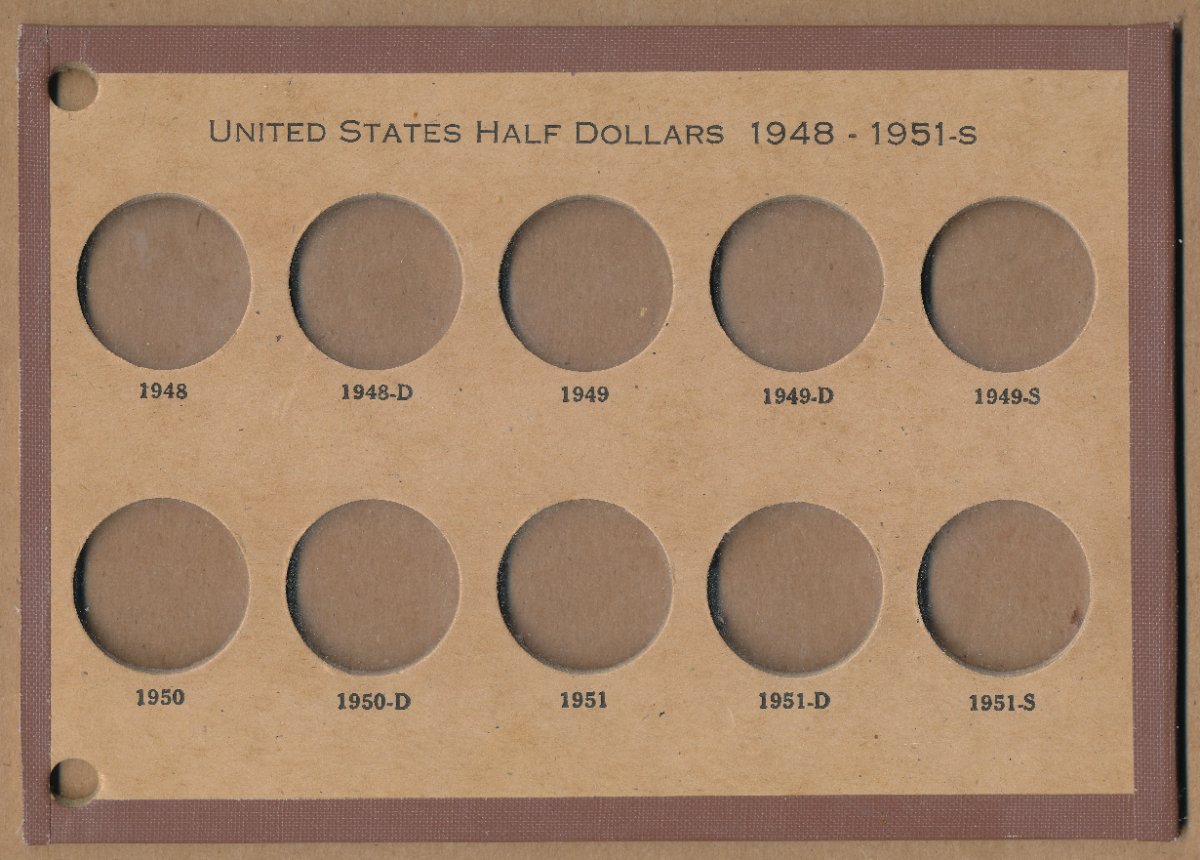 References Consulted:
Ford, John J. "Wayte Raymond: The Man and the Era,"
The Numismatist, February, 1957; p. 157-161.
Kenney, Richard D. "Wayte Raymond - A Tribute,"
The Numismatist, November, 1956; p. 1231.
For other of my posts on commemorative coins and medals, have a look at:
Commems Collection.Return to Table of Contents








 Posted 03/22/2022 6:50 pm


