About nine years ago, I posted a follow-up to my first post on the 1924 Huguenot-Walloon Tercentenary Half Dollar - it included several "tidbits" about the coin. (You can read it here:
1924 Huguenot-Walloon Tercentenary - Revisited.)
1924 Huguenot-Walloon Tercentenary Half Dollar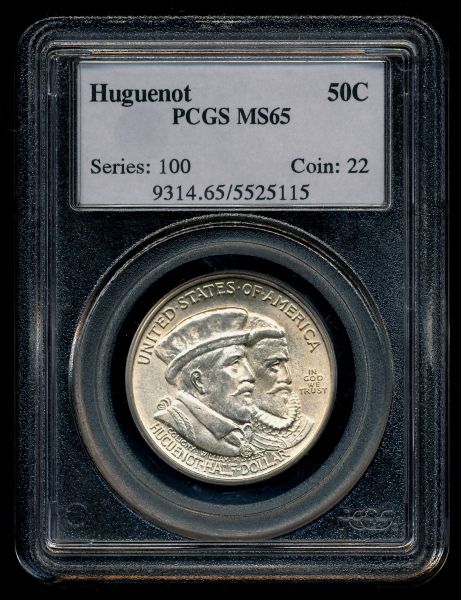
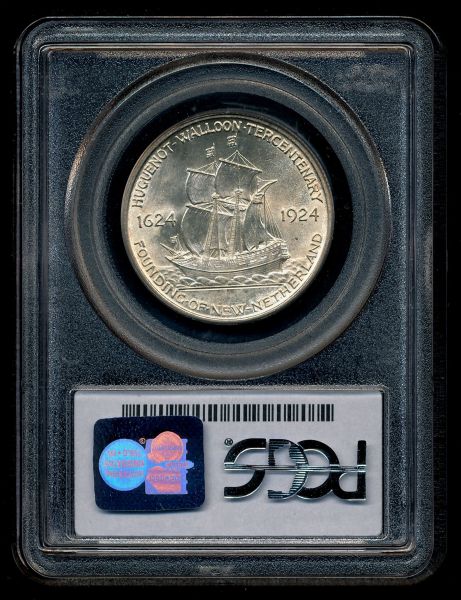
I've decided to use the same format for another round of brief notes about the coin.
Tidbit #4At the time of its release, there were multiple criticisms levied against the 1924 Huguenot-Walloon Tercentenary half dollar, including claims of historical inaccuracy.
Dr. Frederick J. Zwerlein, professor of history at St. Bernard's Theological Seminary and author of
Religion in New Netherland referred to the half dollar as a "historic falsehood" and claimed it to be "a shameful abuse of United States currency."
During an address at the Church of the Sacred Heart in Rochester, NY, Dr. Zwerlein stated, "As the inscriptions entirely ignore the nation to whom the colony belongs, Americans of Dutch extraction have a grievance which is hardly set aside by the bust of the founder of the Dutch Republic on the coin. Even here, the Dutchman, William the Silent, is forced to play second fiddle to the Frenchman, the Huguenot Coligny." He continued, "Both these men had absolutely nothing to do with the founding of New Netherland."
In contrast, Dr. John Baer Stoudt, historian and Director of the Huguenot-Walloon New Netherland Commission, offered "It was William the Silent, the George Washington of Holland, who first sheltered the Huguenots and Walloons when they were driven from France and Belgium by religious persecution. Coligny was the first of the great leaders of Europe to suggest America as a place of refuge for those seeking religious freedom."
To me, the design's historical accuracy is a matter of perspective. It appears Dr. Zwerlein would have preferred a design that linked its subjects specifically and literally to the colony's founding, while Dr. Stoudt and the Commission preferred to reach back further and highlight the roots and drivers behind the colonization efforts. IMO, a case for the validity of either perspective can be made.
It should also be noted that Dr. Zwerlein was not a member of the New Netherland Commission and was not involved in the coin's development. It's always easier to criticize from the
outside looking in and
after the fact vs. being an active original contributor. I've seen such behavior more than once!
Tidbit #5One of the important events planned for the New Netherland 300th anniversary celebration was a pilgrimage to Europe by descendants of the European founders of the original settlements of New York and the Middle Atlantic states. Those making the pilgrimage visited churches, battlefields and other historic sites in Belgium, France, Germany, Holland, Italy and Switzerland.
During their visit, they presented examples of the Huguenot-Walloon coin to Queen Wilhelmina, the Queen of Holland, Albert I, the King of Belgium, and Gaston Doumergue, the President of France. A nod to the role each of the countries played in the settlement of America. (The first coin struck was presented to US President Calvin Coolidge. You can read my post about it here:
Quick Bits #29 - 1924 Huguenot - Walloon Coin 1.
Tidbit #6Secretary of the Treasury Andrew W. Mellon approved the designs for the Huguenot-Walloon half dollar in January 1924; the coins were struck at the Philadelphia Mint in February and April 1924.
Original word from the coin's sponsor, the Huguenot-Walloon New Netherland Commission, Inc., indicated that 20,000 coins would be struck initially, and then batches of 4,000 coins would be struck as needed based on sales. This was not to be, however, as 84,000 coins were struck by the Mint in February 1924 and 58,000 more in April (162,000 in total). Ultimately, 55,000 were returned to the Mint which reported releasing them into circulation at face value. The infrequency with which the Huguenot-Walloon half dollar appears in the marketplace in true circulated condition seems to belie this report, but is not definite evidence against it.
Tidbit #7To help secure its credibility, give it more prestige and help support its success, the H-W New Netherland Commission engaged then
ANA President, Moritz Wormser, to serve as a consultant to help the Commission with coin-related decisions/sales plans; Wormser was also a member of the Commission. Per Wormser, the Commission was looking for guidance "as to selling methods that would protect the purchasers who buy these coins at a premium over face."
He was certainly an enthusiastic supporter of the coin, going so far as to exclaim, "I believe this coin will surpass all previous US commemorative coins in both attractiveness and historical significance." I wonder if he would have said the same if the H-W half dollar had followed the Oregon Trail Memorial coin vs. preceded it?
For other of my posts about commemorative coins and medals, including more on the history of the Huguenot-Walloon half dollar and other Design Discussion Index posts, see:
Commems Collection.





 Posted 05/26/2022 09:50 am





