My very first "Quick Bits" post (
Quick Bits #01 - Columbian Half Dollar) included excerpts from a syndicated news piece that was published in papers across the country. I decided to circle back and present the entire article as I find it an interesting glimpse into the earliest days of the US commemorative coin program.
I pulled the complete article reprinted below as it appeared in
The Galveston Daily News of Galveston, Texas on Saturday, January 7, 1893. The author of the article (not identified) was clearly not a fan of the Columbus souvenir half dollar that was struck for the benefit of the World's Columbian Exposition.
I've inserted a few inline comments/corrections in italics and enclosed them within parentheses:
FAVORS SITTING BULLHow Columbus Appears on the New Half-DollarFifty of the Columbian half-dollar pieces have been received in this city from the world's fair association in Chicago. These coins are ugly enough.
The front side of the coin has an elegant likeness of the late Sitting Bull. This, however, is said to be meant for Columbus. The patriotic American can take his choice and the knownothings certainly will claim the head to be intended for Sitting Bull, because of that gentleman being an American. On the right shoulder appears the letter B. This certainly indicates the location of either a boil or a barnacle.
(Of course, the "B" on the coin is meant to credit Charles Barber, the coin's designer/engraver.)In the circle around the head are the words, "United States of America. Columbian Half Dollar."
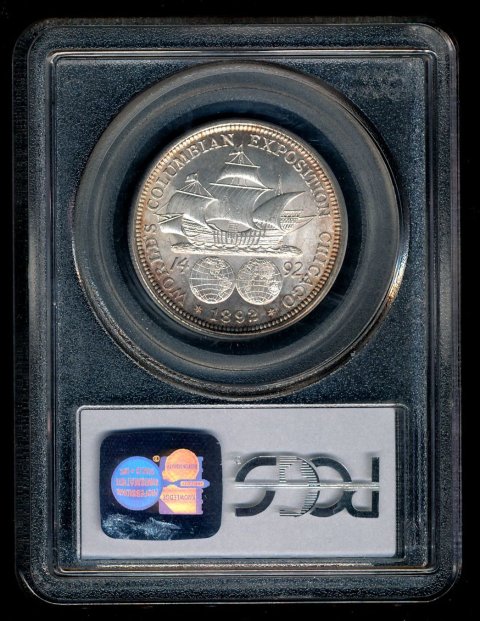
The obverse side of the coin bears the legend, "World's Columbian Exposition, Chicago, 1892."
(I think the article meant to state "reverse" rather than "obverse.")There is also a likeness of Columbus' ship, under sail. At first blush the ship seems to be on wheels, but closer examination shows that the two wheels are the eastern and western hemispheres. The ship seems to be surrounded by a herd of porpoises, but probably this is meant for waves.
There is a fishing pole rigged out of an after port in the cabin of the ship, and one gathers an idea that the venturesome mariner is either baiting his hook and lying like a thief about a bite he just had, or has hauled in a fish, for the line is taken aboard ship. The figures 1492 appear beneath the vessel.
The coin is of the same size and weight as the old run of half dollars, and for all they are sold at a heavy premium, the purchasing power is but ten beers.
While I find the article's descriptions of the coin humorous, I also find it enlightening for the following reasons:
1. I learned that sarcasm was fully functional among journalists in 1893.
2. The article is very likely the source for the catchy phrase "Ship on Wheels" that has been used to describe the design found on the reverse of the half dollar.
3. The article appears to be the source of the "fishing pole" jokes I've occasionally heard about the coin.
4. Fifty cents had significant purchasing power in 1892 - 10 beers!
5. Criticizing the designs of US commemorative coins is a time-honored tradition that extends back 130 years!
1892 World's Columbian Exposition Half Dollar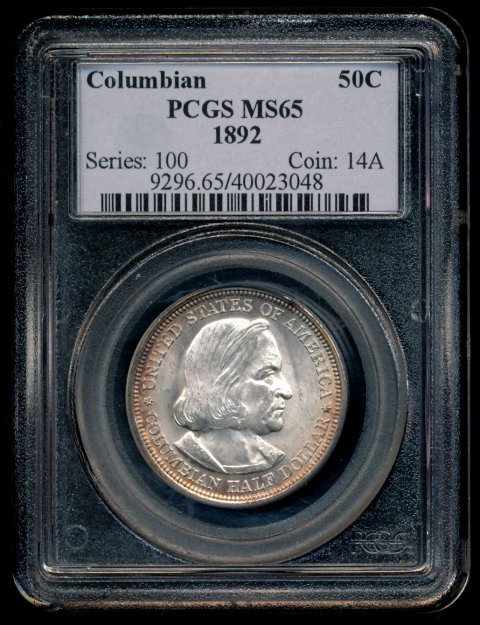
For other of my posts about commemorative coins and medals, including more on the history of the Columbian half dollar, see:
Commems Collection.









 Posted 07/07/2022 11:16 am


