NGC -
Lest you think spotting fakes is easy, take a look at this 1884-S Morgan dollar.Each month in this column, we discuss some of the fundamentals of
Counterfeit Detection, using counterfeit coins as illustrations. To date, the examples shown have not been deceptive. By that, we mean that they would never fool a professional coin dealer or a specialist collector. Before we give the impression that
Counterfeit Detection is a simple matter, we need to introduce the superfake.
It should be stated at the outset that superfake is not standard numismatic vernacular. In fact, we may have introduced the word just now for the first time. It is borrowed from the term supernote (or superdollar), widely used to describe very deceptive counterfeit US currency. By superfake, we mean a coin that is a deceptive counterfeit that could potentially fool professionals and advanced collectors.
There are a great number of counterfeit coins that fall into this category. Their weight and level of design detail closely match authentic examples. Instead, specific die characteristics are used to identify them as counterfeits. A die characteristic is a tooling mark or depression on a coin that is shared commonly by all fake coins struck from that particular die. A number of documented counterfeits share specific flaws, called "repeating depressions," that are used by authenticators to identify them as fakes.
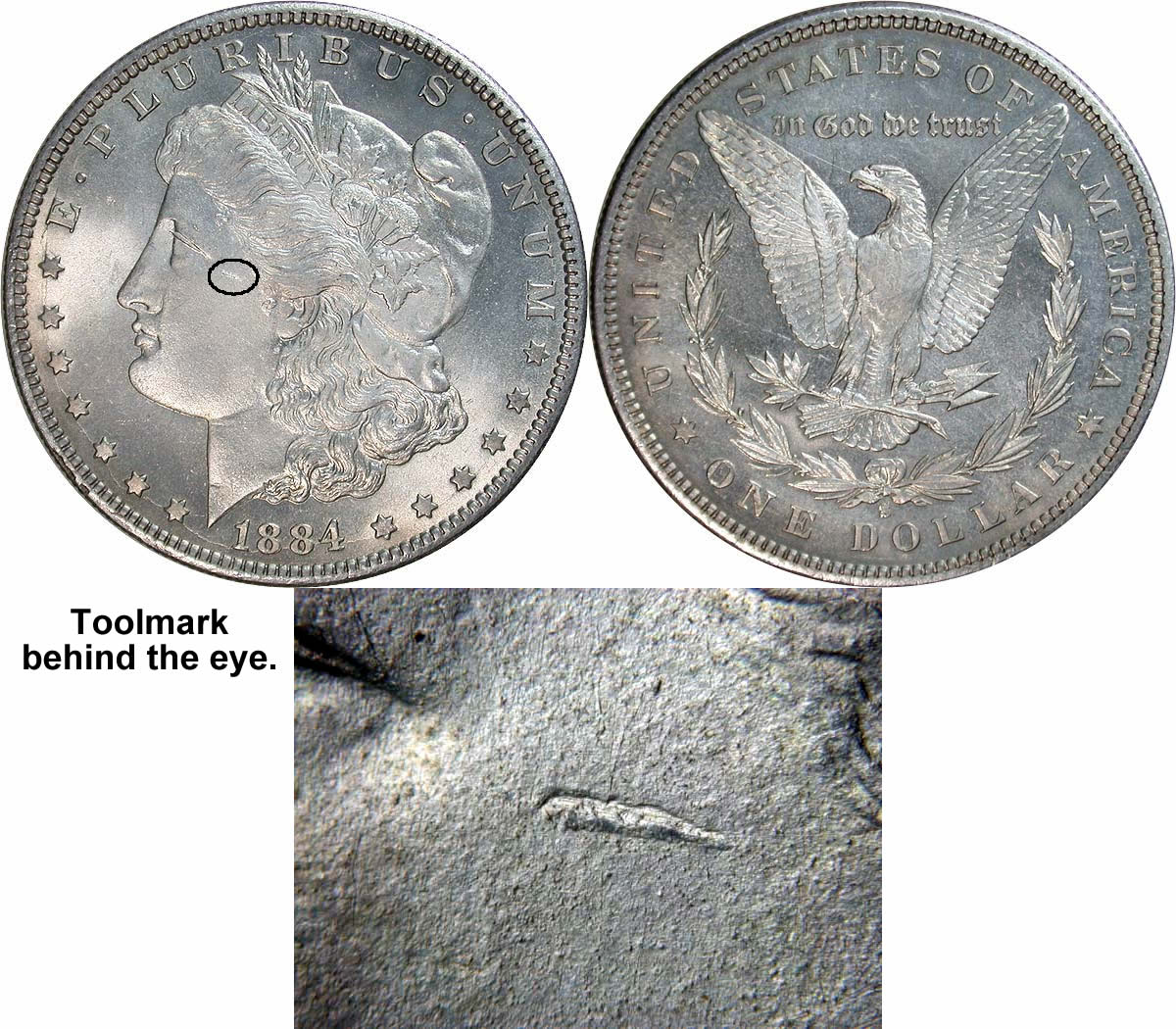 Counterfeit 1884-S Morgan dollar with Close Up of Toolmark Behind the Eye.
Shown here is a deceptive counterfeit 1884-S dollar. Other than the obvious fact that it is a gem uncirculated example of an impossible key issue in higher grades, there may not be much to suggest that this coin is fake. To many, the overall look of the coin will be good. Weighing the coin also tells us that its weight is within standard tolerance for the issue (~26.7g). Few professional numismatists and even fewer collectors have seen such a high-grade 1884-S
Morgan dollar to compare it to, and most will not know how to conclusively authenticate a coin that passes the basic tests.
Fortunately, in this instance, the cheek of Liberty displays a tooling mark that identifies this coin as a fake. The long slender line on Liberty's cheek is not present on genuine examples of this issue. In fact, some specialists will recognized that this exact die gouge appears on genuine 1884-CC
Morgan dollars, obviously the coin that served as the model for this counterfeit's obverse. The mark, shown here in magnification, is a blemish on the dies that was struck onto the coin. Its size and position suggests that this characteristic mark will be visible on lightly worn examples or in cases where this counterfeit coin is falsely abraded to appear bagmarked. File this characteristic away in your memory bank for when you look at an 1884-S dollar and you might save yourself a lot of pain caused by purchasing a fake.
Die characteristics also reveal the true complexity of coin authentication. Here we've talked about one characteristic that appears on one fake 1884-S dollar. But there are thousands upon thousands of different counterfeit coins. NGC has an extensive library of characteristic marks on fake coins that we use for reference, and senior graders have thousands of them committed to memory. Truly, the only way to develop that kind of mental resource is to look at hundreds of coins every day for decades. Even still, new superfakes with their own sets of characteristics, like this 1884-S dollar, are being made today.
Read More: Counterfeit Detection Series Check out 1884-S Morgan Dollars on ebay
.










 Posted 08/07/2023 1:23 pm





