I would suggest a quick read of: 1923 Monroe Doctrine Centennial - Origin Story to set the stage for the following... The House debate regarding the 1923 Monroe Doctrine Half Dollar was possibly the most contentious of the classic series.
The bill for the Monroe Doctrine half dollar was introduced in the House by Representatives in December 1922 by Walter Franklin Lineberger (R-CA); it was immediately referred to the House Committee on Coinage, Weights, and Measures. The Committee quickly held a Hearing regarding the coinage proposal, meeting just a week later. At the Hearing, Representative Lineberger made a few opening remarks about the proposed coin and then introduced Frank B. Davison, who was there to represent the Los Angeles Clearing House, the distributor of the coin on behalf of the American Historical Revue and Motion Picture Historical Exposition.
Mr. Davison outlined what was being planned for the Exposition and touted the strong educational ties the Exposition would have via serious academic teams at universities and colleges within California and Latin America. He stated, "The purpose of this is to commemorate the one hundredth anniversary of the enunciation of the Monroe Doctrine in 1923 by means of an American Historical Review and Motion Picture Industrial Exposition. The American historical review part of this program will be created and produced under the direction of the universities, colleges, and secondary schools of California, aided by the universities of South and Central America."
He also informed the Committee that the neither the State of California, the City of Los Angeles nor the motion picture industry will approach Congress for an appropriation for the Exposition, just the loan of the "standard" Government exhibits presented at other Expositions.
Mr. Davison proved to be a great salesman, and impressed the Committee enough for it to report the coin bill favorably and to recommend its passage. The Report also made note of the fact that the Treasury
did not oppose the bill. The real challenge for the bill came when it was considered by the Whole House.
It was brought up for consideration in the House as part of the chamber's Unanimous Consent Calender. Representative Allen Towner Treadway (R-MA), while reserving the right to object, rose to ask for more information on the bill and requested that "the gentleman interested in this measure kindly explain some reason why this legislation should be adopted?." Walter Franklin Lineberger (R-CA), the Representative who introduced the bill in the House, responded with a description of the coin and its objectives, including a brief mention of the plan to host a Monroe Doctrine Centennial Exposition in Los Angeles with which the issue of the half dollar would coincide.
(Note: Unanimous Consent is a method of expediting matters before Congress, including bills, by which debate is generally limited and individual voting is bypassed; if a single Senator or Representative objects to a bill, however, consideration of the bill does not continue.) Louis Convers Cramton (R-MI) then rose to question why the coins were to be exclusively handled by a local clearing house (in Los Angeles), and suggested that such a method was unique. Lineberger explained that it was not unique and stated "the locality in which the commemorative event is held is usually permitted to distribute the coin. That is as it should be; that is the only reason for their asking for this."
Cramton next questioned the connection between Los Angeles and the enunciation of the Monroe Doctrine, adding "Which I do not understand took place in Los Angeles." Lineberger again responded, this time with a much longer statement of how the Monroe Doctrine helped prevent California from acquisition attempts by England, France and/or Russia, and how the Doctrine led to California's annexation by the United States. For this reason, Lineberger argued, California was a very appropriate place to celebrate the 100th anniversary of the Doctrine.
Cramton did not appear to be convinced, however, and followed Lineberger's address with the question: "Is the gentleman willing to cut Section 2 from the bill?" (Section 2 identified the Los Angeles Clearing House as the exclusive requester/receiver of the commemorative coins.) Lineberger pleaded with Cramton that he not push such a request, but Cramton responded by stating "with Section 2 remaining in the bill, I will be obliged to object." An objection at that point would have ended the House's consideration of the bill.
Lineberger then asked Cramton from where he thought the coins should be distributed. Cramton responded with an offer to engage "patriotic towns in Michigan" - IMO, a "convenient" offer for the US Representative from Michigan.
William Henry Stafford (R-WI) joined the debate next and appeared to come to the aid of Lineberger. He changed the direction of the debate by bringing up the Exposition's funding, and how the US Government was not to receive a request for funding from the Exposition organizers. Lineberger confirmed this, but when Stafford posited that money raised by sale of the coins was "to defray some of the expenses of the exposition," Lineberger responded "Not at all." and added that Los Angeles simply was "the natural place from which they should be distributed in view of the exposition." With such a response, Lineberger was either attempting to deceive his colleagues in the House or he clearly did not understand the true purpose of the coin bill he introduced. (See discussion below.)
The House's discussion then returned to the coins being handled exclusively by the Los Angeles Clearing House. Thomas Lindsay Blanton (D-TX) spoke up to voice his support for the coin being used as a financial support tool for the Exposition. Cramton rejoined the debate at that point and stated his opposition to financing the fair/exposition via coins sales. Regarding the coin, Lineberger stated "It is not financing the fair. It [the Exposition] will cost millions."
Lineberger then relented and asked Cramton if he would withdraw his objection if Section 2 was removed from the bill. Cramton questioned whether Lineberger could guarantee that the Senate would not add it back in. Lineberger indicated that he could not guarantee it, but that he would make Cramton's objection known in the Senate. With this, Cramton backed down and withdrew his objection.
Frank Lester Greene (R-VT) then spoke up and expressed his general opposition to ongoing commemorative coins. In one of my favorite quotes from Congressional proceedings, Greene remarked: "The question is whether the United States Government is going to go on from year to year submitting its coinage to this - well - harlotry. It is a question whether the dignity of the Government's coinage is going to be maintained by the Government or be let out to every ballyhoo organization to prop up somebody's fair." Greene did not have any specific objection to the Monroe bill, however, so the bill's consideration continued.
Representative Treadway was not convinced, however, and stated his objection to the bill. Lineberger then requested that the bill remain on the House Unanimous Consent Calendar "without prejudice." This was not objected to, and the House moved on to other matters. The bill would live to fight another day!
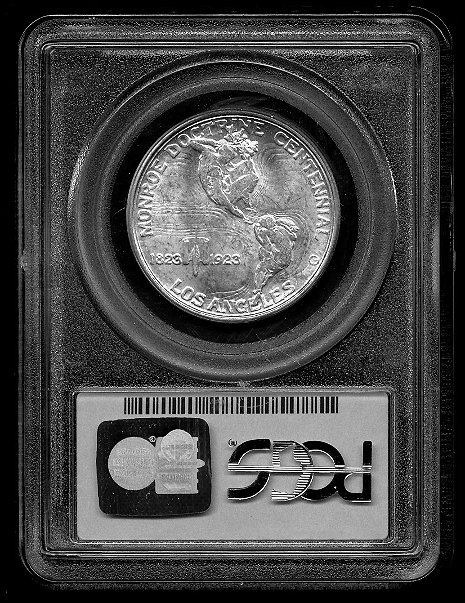
1923 Monroe Doctrine Centennial Half Dollar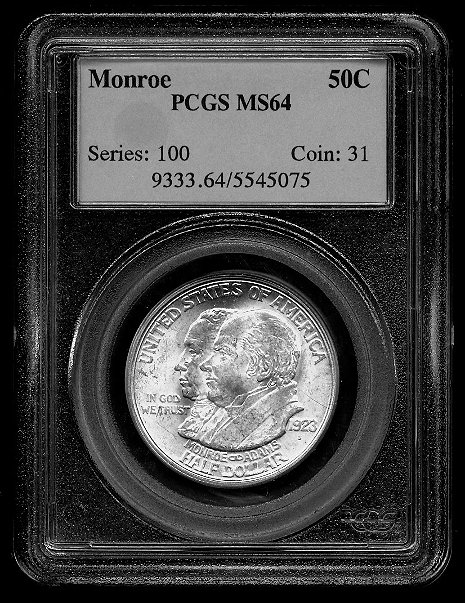
The conclusion to this story can be found here:
1923 Monroe Doctrine - A Lengthy Debate - Part IIFor more of my topics on commemorative coins and medals, including more on the history and design of the Monroe Doctrine half dollar, see:
Commems Collection.










 Posted 10/12/2022 08:32 am


