In August 1939, during the First Session of the 76th Congress, President Franklin Delano Roosevelt signed into law the bill that prohibited "the issuance and coinage of certain commemorative coins." The "certain" referred to coins that were authorized/approved prior to March 1, 1939. (To read more about Congress' efforts in this area, see:
Regulating US Commemorative Coins and
Prohibiting Certain US Commemorative Coins.)
In the opening days of the Third Session of the 76th Congress, in January 1940, Albert Elmer Austin (R-CT) introduced a bill in the House of Representatives that called for a medal "in commemoration of the three-hundredth anniversary of the establishment of Greenwich, Connecticut, as a town." The direct introduction of a commemorative medal bill (i.e., one that did not first attempt to be a coin bill) was a move sensitive to the new law that put a stop to ongoing, multi-year commemorative coin programs, new policies adopted by the House Committee on Coinage, Weights, and Measures and the Treasury's ongoing objections to commemorative coins coupled with its simultanseous support for the striking of commemorative medals.
Greenwich is located on the Long Island Sound in the far southwestern section of Connecticutl it occupies ~50 square miles and borders New York State. It was founded by English and Dutch settlers in 1640 - they came from the nearby Massachusetts Colony; it was named after Greenwich, England. Acting on behalf of Governor Theophilus Eaton of New Haven Colony, agents Robert Freake and Captain Daniel Patrick scouted for a settlement site and selected one between the Asamuck and Patomuck Rivers. The land was purchased from the local Siwanoy Native Americans for 25 English coats - the local tribes referred to the area as "Monakewego," The Native Americans viewed the transaction as a "rental agreement" to use the land, while the Europeans considered it a "bill of sale."
As more Europeans settled in the area and they began to reshape the land to meet their needs (and destroy native farmlands), tensions rose and the new settlement was raided multiple times by members of the local tribes - this led to retaliations and the Greenwich settlers seeking an alliance with, and protection by, the Dutch. The area officially became a Dutch "manor" in July 1641.
In 1644, an organized Dutch attack on the Native American village of Petuquapaen, a local base of operations used to stage raids in the area, resulted in the village being burned to the ground and many of those who tried to defend it being killed. The Dutch victory effectively ended the raids on the European settlers.
The relationship between the governing Dutch and the English residents was uneasy. Eventually, the Dutch influence faded and the settlement was absorbed by the Connecticut Colony in 1650.
Greenwich's Tercentenary Celebration was a fairly low-key event; no fair or exposision with entertainment midway was staged. The week-long celebration began with special services in Greenwich churches on Sunday, June 23, 1940 and continued through Saturday, June 29. A free outdoor concert, performed by the visiting Bridgeport WPA Symphony Orchestra, was held on Sunday evening to help launch the celebration.
On Tuesday, June 25th, the landing of the town's first settlers was re-enacted at Tod's Point, Old Greenwich. During the town's week-long tercentenary celebration, the historical play "Under Three Flags" (Dutch-British-United States) was performed. A commemorative stone with plaque was placed during the Tercentenary, it marked the the site of the first Greenwich settlement; the stone was a private donation made by A. Lincoln Ford (the Fords were a prominent family in the area).
Upon its introduction, the Greenwich medal bill was referred to the House Committee on Coinage, Weights, and Measures and was quickly reported out with a recommendation that it pass. The brief Report concluded with the statement: "Mention should be made that this bill provides for the striking of commemorative medals rather than coins and is in direct line with the policy of this Committee as well as the official expression of the President and the Treasury Department."
The bill called for 50,000 medals of a single design at a single US Mint facility. The medals were sponsored by the Greewich Tercentenary Committee. The bill did not specify a metallic composion for the medals - they were produced in copper. In addition, the bill lacked an expiration date for the striking of the medals; the Committee, however, only requested/ordered medals in 1940.
The House acted quickly on the Committee's recommendation and approved the bill without debate via Unanimous Consent rules. The bill was subsequently sent to the Senate for its consideration. The bill was referred to the Senate Committee on Banking and Currency. The Committee reported the bill favorably and recommended its passage. As did the House, the Senate passed the bill without debate via Unanimous Consent.
With both chambers in agreement, the bill was signed and presented to the President for his review and approval. President Franklin Delano Roosevelt signed the bill into law on May 13, 1940 - just four months after the bill's introduction!
(Side Note: In April 1940, a local newspaper mistakenly published a brief notice about an approved commemorative half dollar for Greenwich - old habits die hard!)The obverse of the 30 millimeter medal presents a scene of Greenwich's original settlers being welcomed by the local Native Americans. The inscription "TERCENTENARY OF THE TOWN OF GREENWICH CONNECTICUT" (with bullets or interpuncts between each word) encircles at the rim. The medal's reverse is all inscriptions, and reads "AUTHORIZED / BY / THE CONGRESS / OF THE / UNITED STATES / OF / AMERICA / MAY 13, 1940".
1940 Greenwich, CT Tercentenary Medal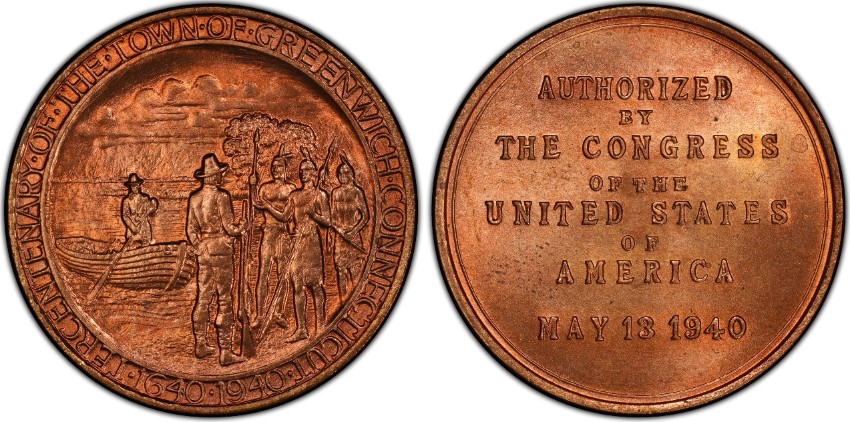 (Image Credit: PCGS CoinFacts.)
(I will post one of my examples as soon as I can.)
For other of my posts about commemorative coins and medals, as well as other classic-era commemorative medals, see:
Commems Collection.






 Posted 02/23/2023 3:26 pm





