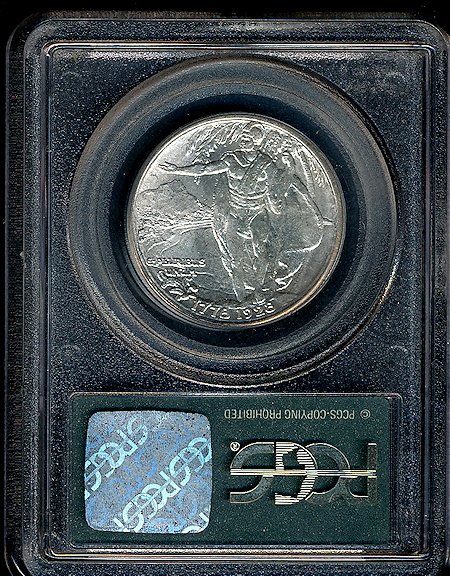
I've mentioned before how the 1928 Hawaiian (European) Discovery Half Dollar traces its roots to the Legislature of the Territory of Hawaii and its Concurrent Resolution regarding its planned sesquicentennial celebration. The Resolution made three requests: 1) Invitation to Great Britain to join the celebration and send a man-of-war to particpate in the festivities , 2) Issue of a Commemorative Stamp series, and 3) Issue of a Commemorative Half Dollar.
The pertinent portions of the Resolution read as follows:
Resolved by the Senate of the Legislature of the Territory of Hawaii (the House of Representatives concurring),
That a sesquicentennial celebration of the discovery of these islands be held during the week of August 15-19, 1928; and that the governor of the Territory respectfully request the President of the United States to extend a formal invitation to the Government of Great Britain, asking their participation by sending a man-of-war with delegates representing the Dominions most interested, and that the Federal Government be asked to send representatives for the occasion, with the presence of such units of the United States Fleet as may be spared; and be it further
Resolved,
That the governor request the proper authorities of the Federal Government to provide for the issuance of a suitable series of postage stamps commemorating the discovery of these islands, and the issuance of a commemorative 50-cent coin.The Governor of Hawaii, Wallace Farrington, acted upon the Concurrent Resolution and engaged the appropriate Federal resources to make it all happen.
The Hawaii Legislature Resolution led to two resolutions and one bill being introduced in the US Congress, one for each request. A House Joint Resolution authorized the President to extend an invitation to Great Britain on behalf of Hawaii, a House Bill proposed a commemorative 50-cent piece and a House Joint Resolution called for a Hawaiian commemorative stamp.
The Invitation Resolution was successful, as was the bill for the commemorative half dollar - both were signed into law by President Calvin Coolidge.
1928 Hawaiian (European) Discovery Half Dollar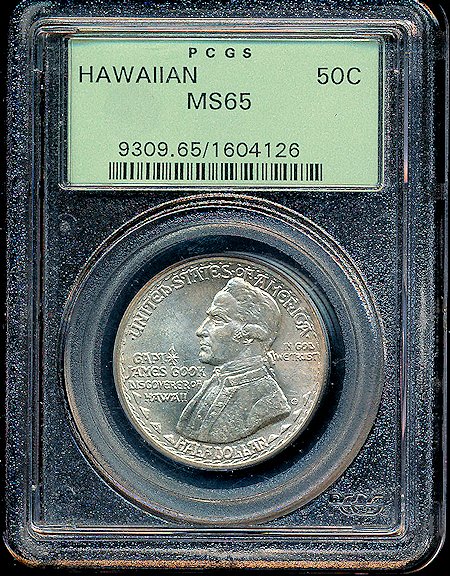
The stamp Resolution did not make it beyond the House, but as the US Postmaster had/has the ultimate authority regarding the issuing of US commemorative stamps, Coolidge's signature was not necessary to get a Hawaii commemorative stamp. The obstacle was Postmaster General Harry S. New who was opposed to the stamp issue as he viewed it as being too much of a local theme - he preferred issues of more national significance.
Governor Farrington and Victor S. (Kaleoaloha) Houston, the Hawaii Delegate to the House of Representatives of the US Congress, worked together to develop a novel idea for a Hawaii anniversary commemorative stamp. Eventually, Postmaster General New relented and approved the alternative approach proposed by Farrington and Houston.
Rather than issue a distinct commemorative design, Farrington and Houston proposed using existing, regular issue US stamp designs with "HAWAII" and "1778 - 1928" added in two lines as a "commemorative overprint." The 1922 definitive issues of two cents (George Washington portrait) and five cents (Theodore Roosevelt portrait) were selected for the overprint.
1928 Hawaii Commemorative Stamp - Two Cents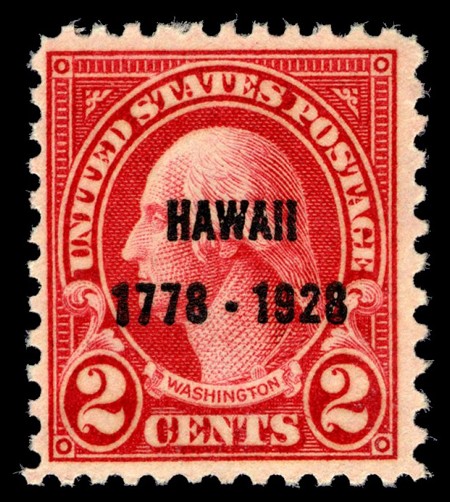 (Image Credit: Smithsonian National Postal Museum. Fair use, education.)1928 Hawaii Commemorative Stamp - Five Cents
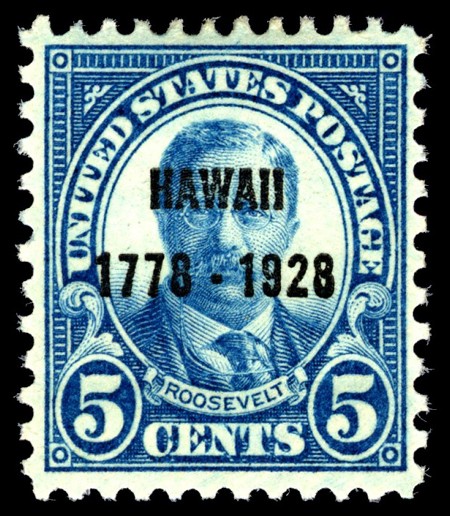 (Image Credit: Smithsonian National Postal Museum. Fair use, education.)
And so, the Territory of Hawaii marked the 150th anniversary of the 1778 sighting of the islands by Captain James Cook and his crew with official Federal commemorative recognition. Numismatic and philatelic collectors have been thankful ever since!
Note: Though the Resolution of the Hawaii Legislature referenced August 15-19, 1928 as the time frame for the celebration, it was actually held August 13-20, 1928.For other of my posts about commemorative coins and medals, including more stories about the Hawaiian half dollar, see:
Commems Collection.





 Posted 02/28/2023 11:36 am





