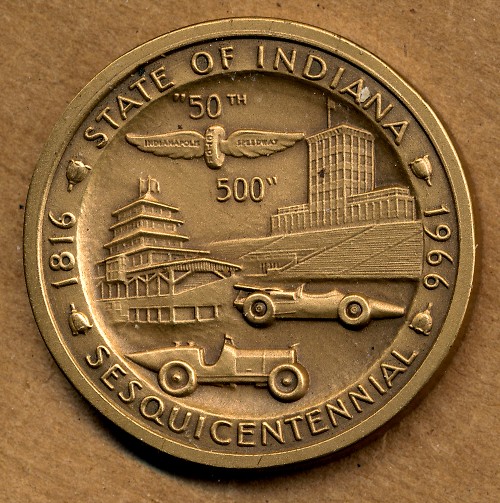
By the 1960s, Congress was firmly in the Treasury Department's camp and no longer approving commemorative coinage proposals. At the same time, sponsors were finally accepting the fact that if they wanted a US Mint struck commemorative piece, it was going to be a commemorative medal. In some cases, after going through the full process to get a medal authorized, the sponsor decided to have the piece s truck by a private company vs. pursuing the project with the US Mint. The medal for the 1966 Sesquicentennial of Indiana Statehood is one such example.
The Congressional journey for the Indiana Statehood medal began in February 1963 when William Gilmer Bray (R-IN) introduced a bill in the House of Representatives that called for "medals in commemoration of the 150th anniversary of the statehood of the State of Indiana." Representative Bray introduced a bill calling for a special postage stamp at the same time. The bill called for the striking of up to 100,000 medals for the benefit of the Indiana Sesquicentennial Commission. The medals were to be considered national medals, and included an expiration of striking authority of December 31, 1966. The bill was referred to the House Committee on Banking and Currency.
Six companion bills calling for Indiana Statehood commemorative medals were introduced in the same Congress, each from a US Representative from Indiana. Each of the bills was referred to Committee. The Bray bill, the first to be introduced, was the one that moved forward.
The Committee reported on the medal bill favorably, without amendment, and recommended that the bill pass. When it was brought up for consideration in the House, it was passed without debate or objection and sent to the Senate for its consideration.
Received in the Senate, the bill was referred to the Senate Committee on Banking and Currency. As in the House, the Senate Committee reported on the bill favorably and recommended that it pass. When considered in the Senate, it was passed quickly via Unanimous Consent.
Each of the Committee Reports on the bill included confirmation that the Treasury Department did not have objections to the striking of the medals.
With the bill passed in both chambers, it was examined, signed and sent to the President. US President John Fitzgerald Kennedy signed the bill into law on November 20, 1963. It was among the last bills he signed before his assassination on November 22, 1963.
In the end, however, the Indiana Sesquicentennial Commission decided to have Medallic Art Company of New York strike its commemorative medals vs. the US Mint. Medals were struck in two sizes (1-3/4" and 2-1/2") with both sizes available in silver and bronze.
The obverse presents a circa-1816 log cabin with a modern (circa-1966) architectural scene (grain silos, office buildings, factory smokestacks) in the background. The medal's reverse presents the Seal of Indiana, first officially adopted in 1816. The Seal features (at right) a lumberman felling a tree, a bison running away in the foreground and a sun setting over hills in the background.
Culver, Indiana-based artist-sculptor Warner Williams (1903-1982) was the designer of the medal..
1966 Indiana Statehood Sesquicentennial Medal

For other of my posts about commemorative coins and medals, see:
Commems Collection.










 Posted 05/02/2023 3:57 pm


 ..
..