The Alaska-Yukon-Pacific Exposition (AYPE) was held between June 1, 1909 and October 16, 1909; the Exposition was held in Seattle, Washington. Original plans for the Exposition called for holding it in 1907 - the 10th anniversary of the Yukon Gold Rush - but the sponsors/organizers changed the Exposition's dates so as not to conflict/compete with the 1907 Jamestown Ter-Centennial Exposition in Virginia. (You can read more about the Jamestown Exposition here:
1907 Jamestown Exposition.)
The delay allowed organizers to expand the scope of the Exposition to be more forward-looking, and to promote Seattle as a leading trading center among nations of the Pacific Rim and to promote trade among such countries. The Exposition did, however, continue to celebrate the recent gold discoveries in Alaska and Canada's Yukon Territory - hence "Alaska-Yukon-Pacific Exposition."
Funding for the Exposition came from a variety of public and private sources, including the City of Seattle, the State of Washington and the US Government; Congress authorized a $600,000 appropriation and arranged for a Government Building to be constructed on site to house the Government's exhibits. The Exposition was constructed on ~250 acres of undeveloped land owned by the University of Washington (the grounds remain part of the University's campus to the present).
Aerial View of AYPE Grounds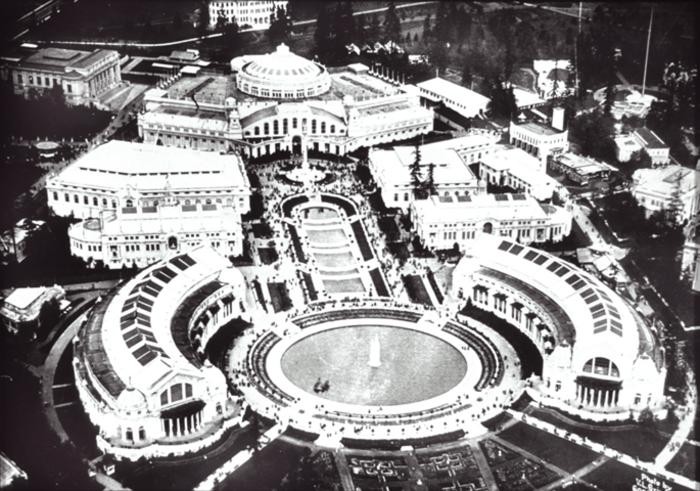 (Image Credit: Seattle Municipal Archives, Image 111187. Public Domain.)
The Exposition had a stated mission of education and the raising of commercial awareness regarding the benefits and potential of the region. The focus on promoting trade among the countries of the Pacific Rim brought participation from "Rim" countries such as Canada, Japan, China and the US Territory of the Philippines, as well as from France, Germany, Great Britain, Greece, San Marino, Sweden, Syria and Turkey (and potentially others).
Multiple States participated as well, with dedicated exhibits. These included Alaska, Oregon, New York and Washington.
Pure entertainment for visitors was not forgotten, however, as the AYPE created the "Pay Streak" area that featured scientific and historical exhibits (e.g., a Battle of the
Monitor and
Merrimac exhibit), international cultural presentations (e.g., live entertainment, food items, artifact exhibits), rides and amusements, an Eskimo village with "genuine" imitation igloos, an opportunity to pan for gold and even a chance to enjoy a bit of moose meat!
The Exposition had an attendance of about 3.7 million (~2.7 million paid); adult admission (ages 13 and older) was $0.50; for children between 5 and 12 it was $0.25 and free for those under 5.
AYPE Official Logo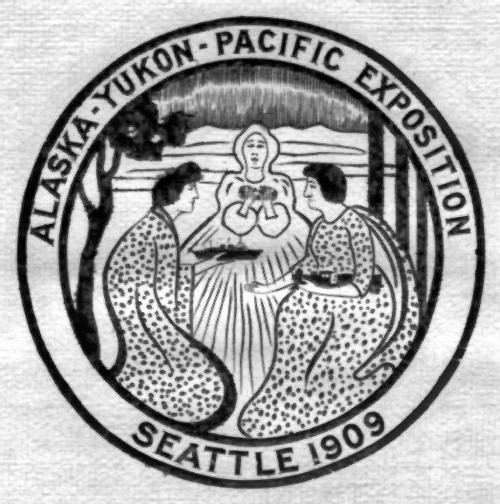 (Image Credit: Seattle Municipal Archives, Image 37233. Public Domain.)
The AYPE had an Official Medal that was struck within the US Mint Exhibit housed in the US Government Building. Joseph Mayer & Brothers Company of Seattle had the concession contract to sell the medals at the Exposition. The Company was a designer and manufacturer of such items as souvenir spoons, jewelry items and street clocks. The medal was struck in silver, bronze, copper and gilt (gold-plated bronze) - all with the same designs. Design credit for the medal is often given to George Morgan, but his role was much more that of a sculptor/engraver vs. designer considering the medal's use of established logos/emblems. The medal is 32 mm in diameter (just over 1-1/4"). Here's one of mine:
1909 Alaska-Yukon-Pacific Exposition Offical Medal - Copper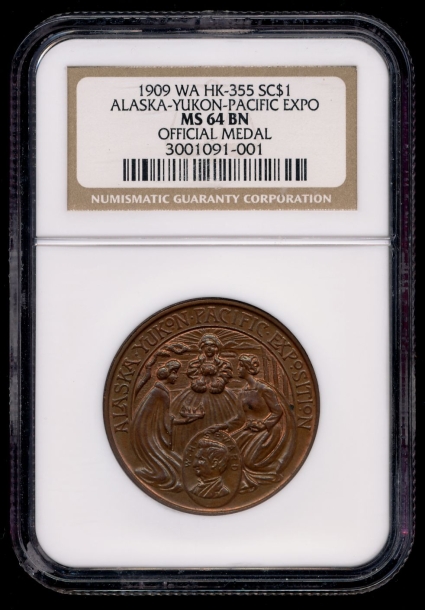
The medal's obverse presents the Official Logo of the AYPE as designed by Adelaide Hanscomb. It presents three allegorical female figures (at right, under fir trees, is presented the figure of
Pacific Slope which represents land-based Commerce - she is shown holding a train locomotive. The figure at left, under a Dwarf tree of Japan, is the
Orient who is holding a ship representing sea-based Commerce. The figure at the center is
Alaska who is depicted holding gold nuggets in her hands which represents the riches of the North and how such riches can support East and West commerce/trade.
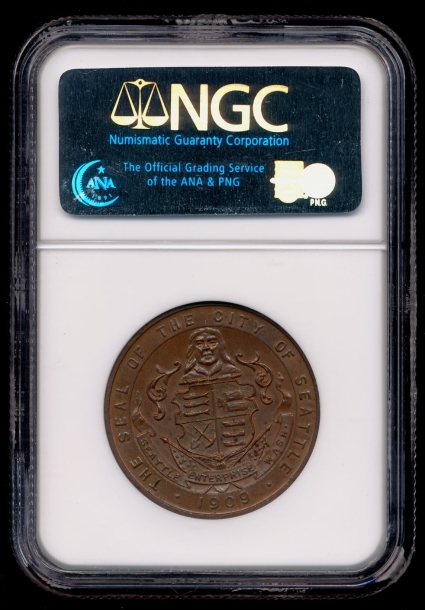
The reverse of the medal depicts
Chief Seattle atop a shield divided into quarters with ornamental flourishes flanking. The design is the City of Seattle Seal (circa 1909). The shield depicts important aspects of Seattle's economy (past and present): three fish (NW quadrant) representing the fishing industry, three logs representing the timber/lumber industry (NE), a pick axe and shovel representing mining (SW) and three merchant ships/freighters representing the maritime industry (SE). Below the shield is a bald eagle with flanking US flags. Also seen below the shield is a ribbon with "ENTERPRISE - SEATTLE WASH." inscribed.
For other of my posts about commemorative coins and medals, including more on US Mint Official Exposition Medals, see:
Commems Collection.









 Posted 06/11/2023 11:19 am


