| Author |
 Replies: 17 / Views: 1,490 Replies: 17 / Views: 1,490 |
|
CCF Master Historian of Commemorative Coins
 United States
12578 Posts |
The Oregon Trail Memorial Association secured the largest commemorative coin authorization from Congress of all issues in the series - 6 million coins! The coins were issued in multiple, but not all, years between 1926 and 1939. Coins were struck by all three active US Mint facilities of the time - Philadelphia, Denver and San Francisco - but not always in the same year. The 1928 Philadelphia issue was a unique case within the Oregon Trail Memorial program, and (IMO) is worthy of a "Melting Pot" story. Optimistic after achieving reasonable initial sales success with its 1926-(P) issue, the Oregon Trail Memorial Association placed an order for 100,000 1926-S coins from San Francisco. Unfortunately, financial issues prevented the Association from paying for the entire order and it was forced to leave 17,000 of the coins with the Mint. Later, the Association placed an order for 50,000 1928-dated coins; the Mint struck the coins in Philadelphia in June 1928 even though it had 1926-S coin in inventory. The Mint held on to the 1928 coins, however, and refused to release them until the Association's account was made current and the previous coin order of 1926-S coins was paid. Years later, in 1933, the Association and the Mint agreed that the remaining inventory of 1926-S half dollars was to be held and melted by the Mint, and that the Association would pay for the 1928-dated coins to get them released. The Association found, however, that even though collectors had clamored for the 1928 coins, only a small number stepped up to purchase them in 1933. (The bloom was off the rose!) As a result, 44,000 of the 50,000 coins struck in 1928 were returned to the Mint to be melted. The return percentage was a whopping 88%! Did the Association learn a lesson? It does seem so, as its coin orders over the rest of its program's years were decidedly lower - the 12,000 Denver Mint coins ordered for 1937 and the 10,000 Philadelphia coins for 1936 represented the highest request totals - all other coin orders were for 7,000 or fewer, including just 3,000 from each Mint in 1939. There are five coins within the series that have lower net mintage figures vs. the 1928 issue (1933-D, 1936-S, 1939-P/D/S) and three that equal it (1938-P/D/S). The low net mintage of these other coins, however, is tied to low initial mintages vs. large-scale melting. In fact, none of the other low-net-mintage coins had any coins returned/melted. 1928 Oregon Trail Memorial Half Dollar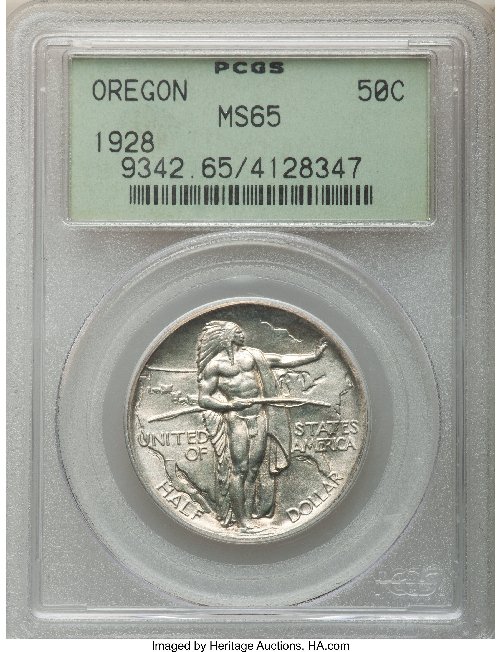 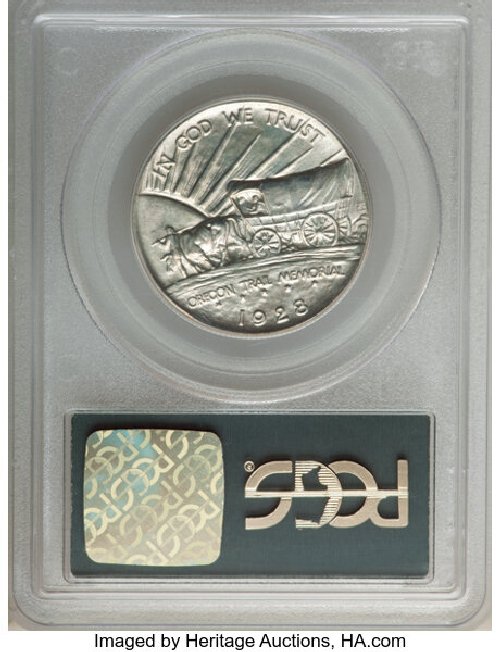 For other of my posts about commemorative coins and medals, including other Melting Pot stories, see: Commems Collection. Collecting history one coin or medal at a time! (c) commems. All rights reserved.
|
|
|
|
Valued Member
United States
301 Posts |
This is of a very beautiful design, I really like this indeed.
Thank you for posting this .
|
|
Moderator
United States
107686 Posts |
Yes, I love this commemorative, I place a high grade one in my type set...  |
|
Bedrock of the Community
United States
94367 Posts |
Thanks as always. Agree, a top10 design for me!
|
|
Moderator
United States
196219 Posts |
Quote:
As a result, 44,000 of the 50,000 coins struck in 1928 were returned to the Mint to be melted. The return percentage was a whopping 88%!  Thank you for sharing. |
|
Bedrock of the Community
United States
27514 Posts |
Quote:
The coins were issued in multiple, but not all, years between 1926 and 1939. commems, you've addressed these multi-year issues in other posts, but really - why did they feel the need for 13 years of commemoration? Inordinately fascinated by bits of metal with strange markings and figures
|
|
CCF Master Historian of Commemorative Coins
 United States
12578 Posts |
Quote:
why did they feel the need for 13 years of commemoration? In the case of the Oregon Trail Memorial coin, it wasn't so much continued commemorations as it was a source of funding. It took money to continue to pay for markers for the Oregon Trail and to help fund their placement at key historic sites along the trail. So, the coins were one source of needed funds. Granted, by the end of the program only small amounts were being raised via coin sales, but the net proceeds from the sales were a positive addition to the pot! At the time, the Association reported that it restricted proceeds from coin sales to the erecting of trail markers/monuments vs. use in covering its administrative overhead. In 1940, the Memorial Association was succeeded by the American Pioneer Trails Association (APTA), which was organized in 1938. The APTA also sought to preserve the trail and erected markers/monuments on it. An interesting side note: Harold Roscoe Diggs, the man who had succeeded Ezra Meeks as president of the Oregon Trail Memorial Association following Meeks' death in December 1928, also went on to serve as president of the APTA. Collecting history one coin or medal at a time! (c) commems. All rights reserved.
|
|
Pillar of the Community
United States
3821 Posts |
Thanks, commems. I was going to share with our coin club some of my favorite classic commemoratives tonight, and of course the Oregon Trail is one of those. I have a hard time naming my #1 favorite of this series, but this one is definitely in the top few.
You've mentioned this before, but I still find it interesting that the Conestoga wagon is actually the obverse of the coin, though the majority of the time the grading companies have the reverse on the front of the holder. Out of my complete 14-coin set, only 1 is oriented with the obverse displayed on the front of the holder.
|
|
Moderator
United States
15948 Posts |
Quote:
As a result, 44,000 of the 50,000 coins struck in 1928 were returned to the Mint to be melted. The return percentage was a whopping 88%! Wow - I had no idea! Take a look at my other hobby ... http://www.jk-dk.art |
|
CCF Master Historian of Commemorative Coins
United States
12578 Posts |
Quote:
I still find it interesting that the Conestoga wagon is actually the obverse of the coin Here's another interesting tidbit for you... Based on the depiction, it can be questioned whether the wagon shown on the coin is actually a Conestoga wagon vs. the smaller - and more common on the Trail - praire schooner wagon. The wagon on the coin is being pulled by two oxen. A larger and heavier Conestoga wagon would typically be pulled by 6-12 oxen - depending on how heavy its cargo load was - two oxen wouldn't really work! Also, the number of bows/braces seen supporting the wagon's cover appears to be five - the larger Conestoga wagon typically had eight or more due to its longer length. Collecting history one coin or medal at a time! (c) commems. All rights reserved.
|
|
Bedrock of the Community
United States
27514 Posts |
No detail escapes commems' eye!
Inordinately fascinated by bits of metal with strange markings and figures
|
|
Moderator
United States
196219 Posts |
Quote:
Based on the depiction, it can be questioned whether the wagon shown on the coin is actually a Conestoga wagon vs. the smaller - and more common on the Trail - praire schooner wagon. That reminds me of this Factual Error listed on IMDB for the movie The Ballad of Buster Scruggs... Quote:
In "The Girl Who Got Rattled", the wagons that were depicted were Conestoga Wagons. However, while they had been used as freight wagons in the East and South, they were seldom used on the trails to the West. They would have been too heavy for the trails. What likely was used is a Schooner, which would have been half the size of a Conestoga. |
|
Pillar of the Community
United States
3821 Posts |
Quote:
Based on the depiction, it can be questioned whether the wagon shown on the coin is actually a Conestoga wagon vs. the smaller - and more common on the Trail - prairie schooner wagon. Thanks, commems, for the additional insight! Member of SPMC, FCCB, ANA and ANS. My U.S. Classic Commemorative Complete Set: https://www.NGCcoin.com/registry/co...sets/278741/ |
|
Pillar of the Community
United States
5700 Posts |
So, If 50,000 were minted, 44,000 returned, The 1928 Dated Final mintage would be 6,000. Were 6,000 Sold ?
|
|
CCF Master Historian of Commemorative Coins
United States
12578 Posts |
Quote:
Were 6,000 Sold ? Yes, it is generally believed that all of the coins eventually found buyers (either collectors or dealers). By returning 44,000 coins, the Oregon Trail Memorial Association hoped to make the 1928 issue more appealing to collectors (i.e., jump start lackluster sales) by creating a situation whereby fewer of them were available on the market. The "perceived scarcity" strategy appears to have worked, as the Oregon Trail program is not known for significant "circulation dumps." Circulated examples encountered in the marketplace were likely placed into circulation by purchasers who at some point needed the $0.50 more than they needed a collectible coin. . Collecting history one coin or medal at a time! (c) commems. All rights reserved.
Edited by commems
06/21/2023 7:52 pm
|
|
Pillar of the Community
United States
5700 Posts |
Still a Very Low Mintage, Thanks... |
| |
Replies: 17 / Views: 1,490 |










 Posted 06/20/2023 08:32 am


 Uncirculated American Silver Eagles


