To celebrate the 150th anniversary of the signing of the
Declaration of Independence and the freedom it ultimately brought to the United States, the Sesqui-Centennial International Exposition was held in Philadelphia, Pennsylvania from May 31 through November 30, 1926. Construction was ongoing at the time the Exposition opened, and would not be complete until July; as a result, early fairgoers had an incomplete experience that led to bad press and poor word-of-mouth advertising.
The idea for the 1926 exposition was conceived by Philadelphian John Wanamaker (1838-1922). Wanamaker was a former US Postmaster General and successful merchant/entrepreneur who pioneered the concept of a "department store." He gained fame (and wealth) with his Wanamaker's Department Stores. Wanamaker proposed the exposition in 1916 and initial organization was begun soon after. Planning was interrupted by World War I, but restarted in 1920. The Sesquicentennial Exhibition Association was formed and incorporated in 1921. It served as the primary planner/organizer for the Exposition, though the US Congress created a Commission that was directed to assist.
The Exposition grounds were constructed on ~1,000 acres of undeveloped, swampy land in South Philadelphia at League Island. Much of the tract had to be drained and filled with brought-in dirt before construction could begin. Today, the former Exposition Grounds are home to Roosevelt Park, the Navy Yard community and parts of the South Philadelphia Sports Complex.
The Exposition was a true International Exposition, with 20 nations - including the US - participating. Over 30 States also participated , plus Hawaii (not yet a state), the Philippines, Puerto Rico and the US Virgin Islands.
Five large palaces offered shared exhibit space for those nations/states/municipalities/private vendors without their own building/pavilion; six nations and seven states constructed a dedicated pavilion for their exhibits. As would be expected, "home town" Pennsylvania was one of the States to construct its own building,
The palaces were:
- Palace of Agriculture & Food Products
- Palace of Liberal Arts & Manufactures
- Palace of United States Government, Machinery & Transportation
- Palace of Education and Social Economy
- Palace of Fine Art
The Gladway was the popular amusement/entertainment area of the Exposition. It covered 80 acres and included restaurants, theaters, the "Fire and Flame" show (a firefighting demonstration featuring 150 actors) and a Battle of Gettysburg recreation. The area also featured two lagoons, upon which were offered rides in Italian gondolas. Across from the Gladway was "Treasure Island" a five-acre spot that featured games/amusements, a recreation of the Colorado Rockies, a pirate's lair and a "recreation" of Noah's Ark - including animals!
A large stadium was built on the grounds and hosted a variety of athletic events, including the Jack Dempsey-Gene Tunney heavyweight boxing championship bout - 120,000+ saw the fight in person! It was also the site of large public addresses - US President Calvin Coolidge gave an opening ceremony address for the Exposition in the stadium - and large, outdoor religious services. After the Exposition, the stadium became Municipal Stadium, and later renamed JFK Stadium; the stadium was demolished in 1992.
As was typical for the time, the Exposition featured a historical/patriotic pageant - it was titled "Freedom." The outdoor pageant was presented in the stadium.
A definite highlight of the Exposition was the over-sized Liberty Bell replica which was ~80-feet tall and was fitted with ~26,000 light bulbs to illuminate it.
Liberty Bell Replica at Sesquicentennial Exposition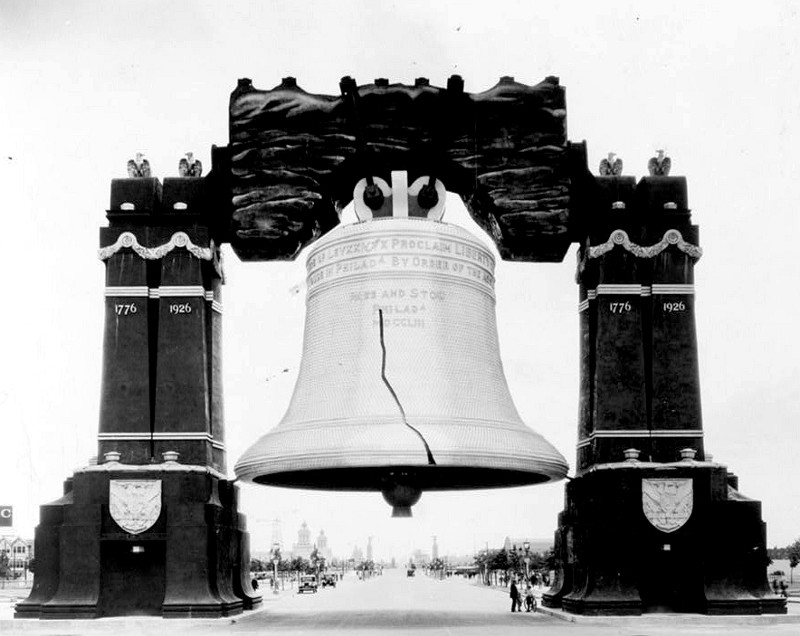 (Image Credit: Library of Congress, Prints and Photographs Division. Public Domain.)
The Exposition had an attendance of ~6.4 million during a very rainy Philadelphia summer - the rain played a notable role in dampening attendance (though a good one, no pun intended); paid attendance is reported by various source to be in the range of ~4.6 to ~5.8 million. The admission price for adults was $0.50, and for children it was $0.25. The lower-than-anticipated attendance resulted in a net loss for the organizers of ~$200,000 and the Exposition Association went into receivership shortly after the Exposition closed.
The Association sponsored a Silver Half Dollar and a Gold Quarter Eagle to commemorate the anniversary and Exposition (see link below for more), plus secured participation of the US Government in the Exposition and a souvenir medal to be struck at the on-site US Mint exhibit.
The obverse of the medal features a right-facing portrait of George Washington within a ring of 13 stars. "PHILADELPHIA / 1926" is directly below the portrait. The inscription "SESQUICENTENNIAL INTERNATIONAL EXPOSITION" encircles at the rim with a small Liberty Bell serving as aseparator beteen "SESQUICENTENNIAL" and "EXPOSITION" at the 6 o'clock position.
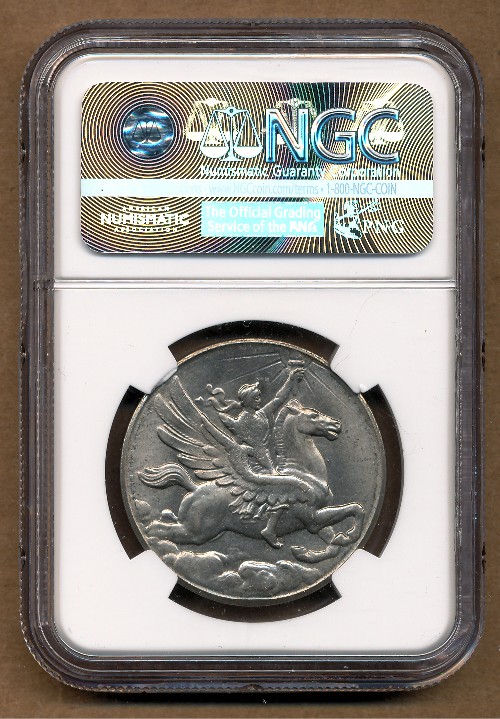
A flying
Pegasus is the primary design element of the reverse, with
Lady Liberty - her torch held high - on its back.
The medal was designed by Albin Polasek. It was available in copper, bronze, brass and nickel. The bronze pieces were struck in higher relief.
1926 Sesquicentennial Exposition Medal - Nickel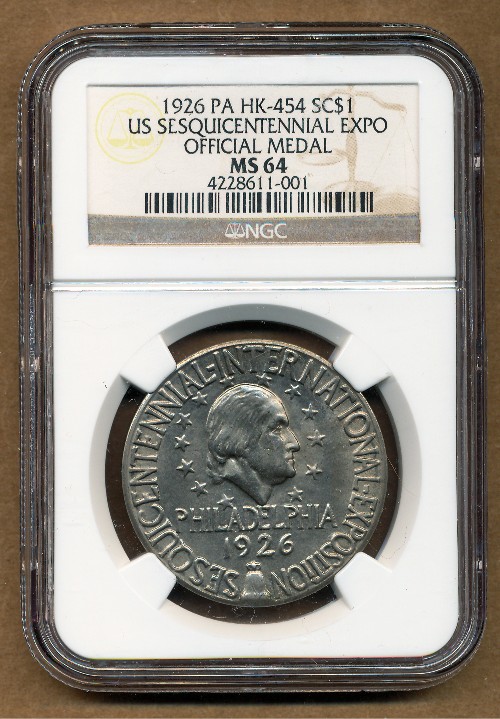
For other of my posts about commemorative coins and medals, including more on the coins of the Sesquicentennial Exposition and other US Mint Exposition medals, see:
Commems Collection.
Additional details about the Exposition can be found in my post here:
-
1926 American Independence Sesquicentennial Ephemera




 Posted 06/28/2023 11:54 am





