It's a given that every reputable reference book on US commemorative coins that includes the 1936 Providence, RI Tercentenary Half Dollar will reference Roger Williams as the European figure depicted coming ashore in 1636 (on the coin's obverse), and being greeted by a local Native American.
But who exactly is this Roger Williams?
First things first, his exact birth and death dates are unknown. Baptismal records suggest he was born in London, England in 1600; he died in Providence in early 1683.
No known contemporary portraits or sculptures of Williams exist; all existing portraits spring from the minds of artists who have worked from contemporary descriptions. Such is the case for the Roger Williams statue that is part of the Roger Williams Monument in Providence.
The Monument is located within Roger Williams Park inthe City of Providence, RI. The land for the park was donated to the City by Betsey Williams, the great-great-great granddaughter of Roger Williams, who made the bequest as part of her will. The donation required a contest be held for the design of a statue/monument to her ancestor to be erected in the new park. Franklin Simmons won the competition, and created a larger-than-life, 7-1/2 foot tall bronze statue of Williams that was mounted on a 20-foot tall granite base whose stones were quarried in Rhode Island. Below Williams is seen
Clio, the Greek goddess/muse who is symbolic of History, She is depicted inscribing "Roger Williams 1636" in the base.
Rogers Williams Statue (Closeup) in Rogers Williams Park, Providence, RI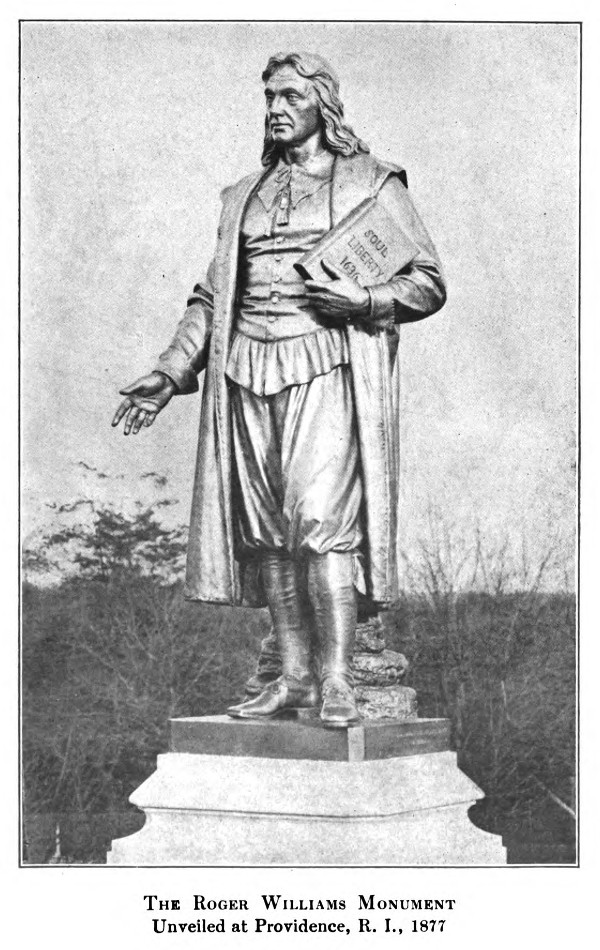 (Image Credit: Carpenter, Edmund J. Roger Williams : a study of the life, times and character of a political pioneer. 1909. Public Domain.)Rogers Williams Statue in Rogers Williams Park, Providence, RI
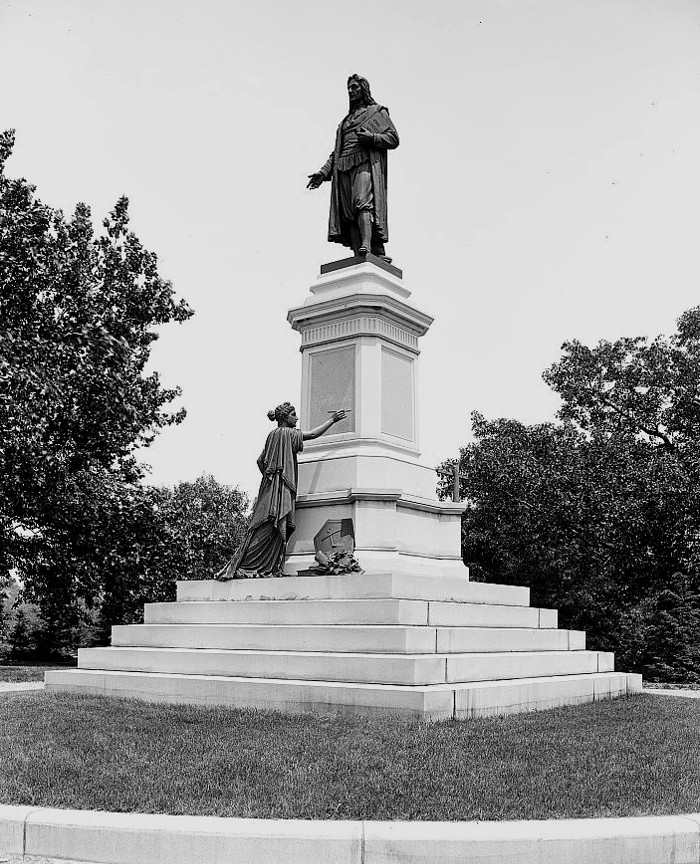 (Image Credit: Library of Congress, Prints and Photographs Division. Public Domain.)
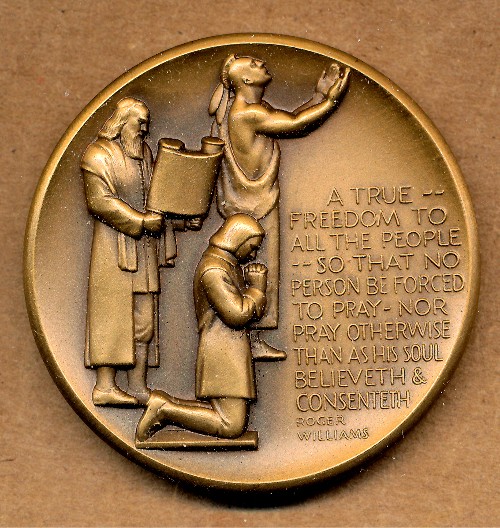
Commenting on his portrait of Roger Williams on his medal for the New York University - Hall of Fame for Great Americans series, Designer/Sculptor Robert A. Weinman stated: "I have attempted to portray a man of courage, of sensitivty, of learning; a man of high ideals steeled by the determination to effect those ideals."
Roger Williams NYU-Hall of Fame Medal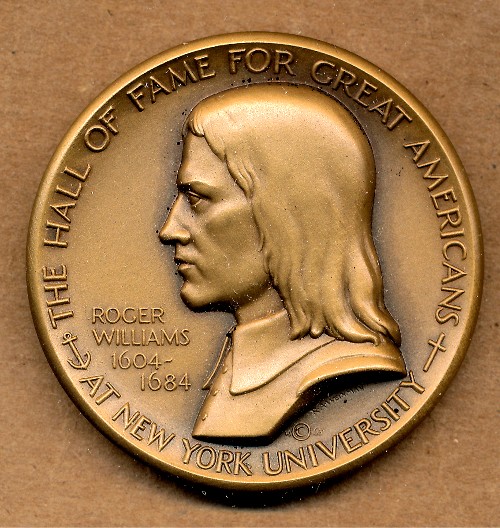
Williams first came to America to settle in the Massachusetts Bay Colony. He arrived in Boston, but soon moved to Salem due to religious disagreements with John Winthrop, the Colony's leader. His time in Salem was also short-lived, however, and he moved on to the separate Plymouth Colony seeking more religious freedom.
His became a trader, exchanging British goods with the (Native American) Wampanoag and Narragansett; this brought him back to Salem. He continued to preach in addition to his trading business, and this once again caused him to run afoul of Massachusetts Bay Colony authorities as he continued to preach for the separation of church and state.
He was eventually charged by Colony authorities and sentenced to be deported. Fearing he would be arrested and deported to England, Williams fled his Salem home and family in advance of his arrest. He faced a very difficult winter in 1636, but was given aid by the Wampanoag he had previously befriended. Williams was given a tract of land in the spring by Massasoit, the leader of the Wampanoag.
Williams was soon joined by some of his followers from Salem who helped him work his land and begin building houses. Unfortunately for Williams, the land was claimed by the Plymouth Colony, and its Governor, Edward Winslow, sent a letter to Williams informing him that if he moved to the other side of the Seekonk River, he would be out of Plymouth Colony and would be free to continue his settlement efforts without further issue from Plymouth.
Williams, with others, explored the other side of the river via canoe and came upon a group of Naragansett on a large rock that later came to be known as "Slate Rock." Legend has it that the Naragansett greeted Williams in a friendly manner and called out "What Cheer Netop!" which was a combination of an informal English greeting meaning "What cherry news do you bring?" and the Naragansett "Netop" which means "friend."
Such a scene is recreated on the commemorative US half dollar:
1936 Providence, RI Tercentenary Half Dollar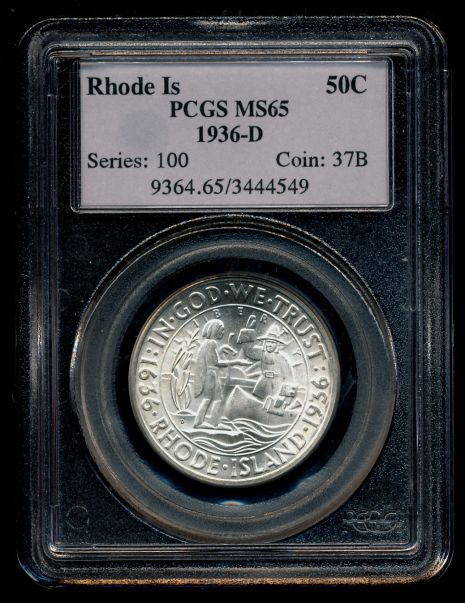
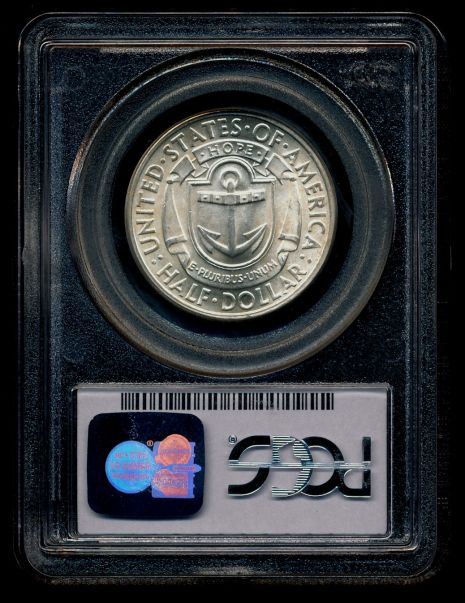
There are quite a number of paintings/drawings depicting Williams' landing at "Slate Rock" - in the future Providence, RI. Here's an engraved image of a painting by Alonzo Chappel.
Rogers Williams Landing - Alternate View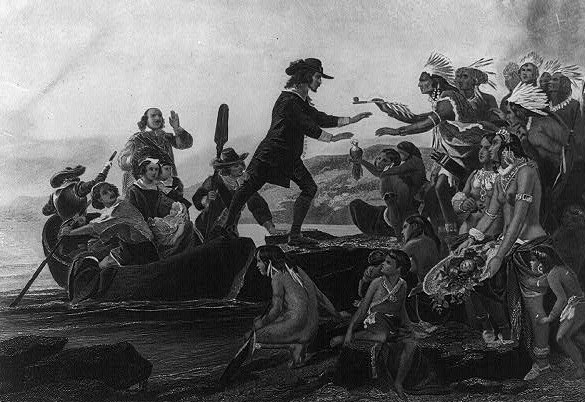 (Image Credit: Library of Congress, Prints and Photographs Division. Public Domain.)
With a new site selected outside of established colony jurisdiction, Williams set about building a settlement that was open to all, regardless of faith / religious beliefs. The settlement flourished and grew into the present-day city of Providience, RI and State of Rhode Island. Over the course of its history, Rhode Island has been the site of the first Baptist Church in America (Providence, 1638), the first Synagogue (Newport, 1763) and the first Quaker Meeting House (Newport, 1699).
And that's a brief look at Roger Williams, the founder of Providence, RI and, by extension, the State of Rhode Island, and his belief in everyone's right to believe and worship as they wished.
For a deeper dive into the life of Roger Williams, I would suggest visiting the National Park Service web site for the Roger Williams National Memorial:
https://www.nps.gov/rowi/index.htm.For other of my posts about commemorative coins and medals, including more on the Rhode Island half dollar, see:
Commems Collection.





 Posted 08/29/2023 12:36 pm





