The US' Modern Non-Circulating Legal Tender (NCLT) Commemorative series was launched with the 1982 George Washington Half Dollar that marked the 250th anniversary of his birth. Washington was born on February 22, 1732 in Westmoreland County, Virginia at his family's farm/plantation on Pope's Creek (near the Maryland-Virginia border in eastern Virginia; the creek empties into the Potomac River).
George Washington - Portrait by Gilbert Stuart (circa 1798-1800)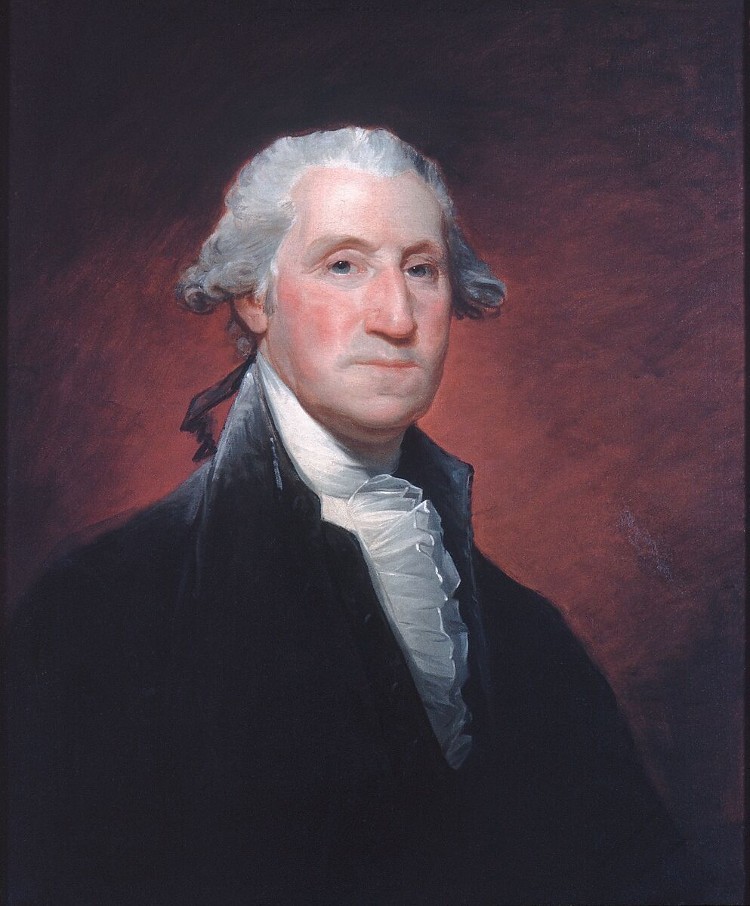 (Image Credit: Metropolitan Museum of Art. Public Domain.)
There are many biographies available on the life of George Washington, in print and on the internet, so I'm not going to try and present a comprehensive one here. I refer those interested in a brief overview to the Mount Vernon web site and:
-
Biography of George WashingtonFor this post, I'll just present a quick overview of Washington's career via the words of US Representative Frank Annunzio (D-IL):
"Washington is such a towering figure in American history that it is impossible to recount all his contributions to founding this great nation and shaping our form of government. His expeditions and missions to the western frontier laid the groundwork for the expansion of America. His leadership obtained our independence. He was president of the Constitutional Convention that established our form of government. As our first President, he organized and strengthened the United States so that we took our place among nations and ascended to our place as the foremost of nations. Many times he returned to his home at Mt. Vernon after serving his country only to be called to service again. Duty, for Washington, was a moral obligation that was not to be evaded, even by honorable means."During the 97th Congress (1991-82), four bills were introduced that called for commemorative coins in honor of Washington - three for half dollars and one for a $10 coin (subject of a future What If?). Of the half dollar proposals, two were in the House of Representatives and one in the Senate. All three featured virtually the same language and specifications, though some notable changes were made between introduction of the first and the final bill signed into law.
The first coin bill was introduced in April 1981 in the House by Doug Barnard, Jr. (D-GA), co-sponsored by Frank Annunzio. Upon its introduction, it was referred to the House Committee on Banking, Finance and Urban Affairs, which then referred it to its Subcommittee on Consumer Affairs and Coinage - Annunzio was the Chairman of the Subcommittee.
The bill called for the production of up to 10 million silver half dollars with an issue price of actual cost plus a surcharge of up to 20%, with the collected surcharge funds to be deposited into the General Fund of the US Treasury. The coins were to bear the date "1982" with production authority set to expire on December 31, 1982.
The Subcommittee held a Hearing on the bill. The Hearing included testimony/statements by Angela Buchanan, Treasurer of the United States, George Hatie, president of the American Numismatic Association (
ANA) and Anthony Swiatek, professional coin dealer and commemorative coin expert and enthusiast.
Buchanan made the Treasury's stance on the proposed coin known from the beginning:
"At the outset, let me inform you that the Treasury Department supports this proposal, subject to comments and recommendations that we will discuss today.
While the Department of the Treasury has a history of objecting to the issuance of commemorative coins for the benefit of private sponsors and organizations , it has not objected to special coinage authorized by Congress for the Government's own account.
The Treasury Department thus did not object to the Eisenhower 40-percent silver dollar program enacted in 1970, or the American Revolution Bicentennial 40-percent silver set program enacted in 1973. The Treasury Department believes the 250th anniversary of the birth of the Father of our Country is an occasion which justifies the issuance of a special noncirculating commemorative coin."A new day was dawning!
The primary recommendations Buchanan referred to were:
"(1) Adding a provision which will provide that the Mint use the silver originally earmarked for the Eisenhower 40 % silver dollar program for the half dollars, and
(2) Amending section 2(d) of this bill to allow for the production of the coins until December 31 , 1983."George Hatie from the
ANA began his testimony with a review of the abuses seen during the classic-era series, then lauded the new bill stating, "The subject matter is of national interest; the proceeds of the sale go to the government, and the coin will be issued for only 1 year."
In his prepared statement, Hatie outlined ways by which the US Mint could ensure it had capacity to produce the commemorative coin, if the US Mint raised objections - I find two of his points particularly interesting:
"The issuance of the proposed commemorative half dollars in 1982 is more important than the issuance of the regular mint issue half dollars. Our citizens seldom receive, do not miss, and do not need, half dollars. There is a more handy substitute in two quarters. A study prepared for the Treasury Department by Research Triangle Institute recommended that the half dollar be eliminated as a regular mint issue. If this is done, a commemorative half dollar could be substituted without any appreciable burden on the Mint. Members of the Automated Merchandising Industry expressed no interest in a half dollar."and
"In considering the priorities of the Mint, commemorative coinage should take precedence over the production of coins for foreign countries and over the production of medals for which there is far less demand."In concluding his statement, Hatie reiterated the
ANA's support for the Washington coin:
"In view of the advantages of commemorative coin issues, it is hoped that the George Washington Commemorative Coin Act will be adopted and that other commemorative coins will be issued at reasonable intervals in the future. To avoid the problems of the past, future commemorative coin legislation should follow the format of the George Washington Commemorative Coin Act."The "format" Hatie was referring to was the Washington coin's
national significance, limited production term and being of
benefit to the US Government vs. private organizations. (Thinking of the programs that would follow...to quote Meatloaf, "two out of three ain't bad.")
Click for
Part II








 Posted 10/11/2023 08:57 am


