|
CCF Master Historian of Commemorative Coins
 United States
12578 Posts |
Continuing the story from Part III... Note: The following direct quotes are from The Congressional Record and reflects their time. As such, word choices often do not match today's social preferences and sensibilities. No offense is intended by me - my only desire is to present history as it happened for educational purposes.Remarks of Representative Franck Roberts Havenner (D-CA): "Mr. Speaker, I rise to support the pending bill.
"Booker T. Washington is one of the great figures in American history. His life work did more to make the Emancipation Proclamation a permanent, effective force in the American way of life than was accomplished by any other American save Lincoln himself. The memory of Booker T. Washington will always be revered by those who believe that there is no place in America for racial discrimination, and that the doctrine of equality among men is a fundamental tenet in a free civilization.
It is eminently fitting that the life of Booker Washington should be commemorated to our Government in the manner proposed by this bill, and I am happy to record myself as enthusiastically in favor of its enactment."Representative Adolph Joachim Sabath (D-IL) offered: "Mr. Speaker, it was my good fortune to know this great American and educator, Booker Taliaferro Washington, for many years, because my late friend Julius Rosenwald cooperated with him several years in a successful endeavor to advance the colored people. I am indeed gratified to hear of the great services that have been rendered not only to the colored people but to the whole country, due to the advisory and financial assistance given by Mr. Julius Rosenwald to this great American teacher and reformer, who was born in Franklin County, Va., in 1859 and died November 14, 1915, as the result of overwork.
"Soon after the Civil War he went to Malden, W. Va., where he worked in a salt furnace and then in a coal mine. He obtained an elementary education at night school, and became a house servant in a family where his ambition for knowledge was encouraged. In 1872 he traveled 500 miles to the Hampton (Va.) Normal and Agricultural Institute, where he remained 3 years, working as janitor for his board, and graduated in 1875. For 2 years he taught at Malden, his former home, and studied for 8 months in 1878-79 at the Wayland Seminary, in Washington, D. C. In 1879 he became instructor at the Hampton Institute, where he developed the night school, which became one of the most important features of the institution. In 1881 he was appointed organizer and principal of a Negro normal school at Tuskegee, Ala., for which the State legislature had made an annual appropriation of $2,000.
"Opened in July 1881, in a little shanty and church, the Tuskegee Normal and Industrial Institute became, under Washington's presidency, the foremost exponent of industrial education for the Negro. In the first 19 years of the school's existence, 40 buildings were erected, all but 4 largely by student labor, and student labor also provided other necessities.
"To promote the interests of the school and to establish better understanding between whites and colored, Washington delivered many addresses on this throughout the United States, notably a speech in 1895 at the opening of the Atlanta Cotton States and International Exposition. In 1900, at Boston, Mass., he organized the National Negro Business League. Harvard conferred upon him the honorary degree of master of arts in 1896 and Dartmouth that of doctor of laws in 1901.
"During his long and useful career he found time to write 13 scholarly books.
"Human hands may continue to erect memorials to honor this great leader, marble and brass may continue to keep alive an appreciation of his good, altruistic work, but the Tuskegee Institute for practical training of Negroes in trades and professions, with, at the time of his death, 100 buildings, extensive real estate holdings, a faculty of 200, a student body of 1,500, an endowment of $2,000,000, and an annual budget of $300,000, all of which have been increased very much, and the great influence he continues to exercise through the useful lives he helped to mold, will continue to be his greatest monument and renew our faith in the opportunities of America, where anybody may, by diligent and intelligent effort, break birth's invidious bar and rise to reward and renown.
"I wish time allowed me to give a more exhaustive recital of this useful man's accomplishments, but it will not, and moreover, scholars and those who are interested know more or less what I would say if time afforded."Much praise for an inspiring leader. It's no wonder that the House of Representatives voted to authorize the coin bill, and that the Senate concurred without objection. 1946 Booker T. Washington Birthplace Memorial Half Dollar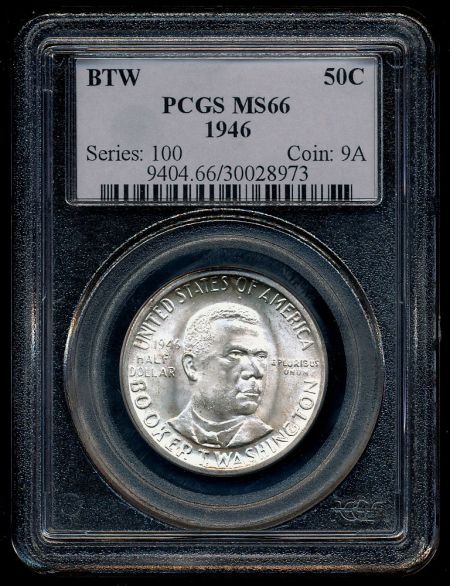 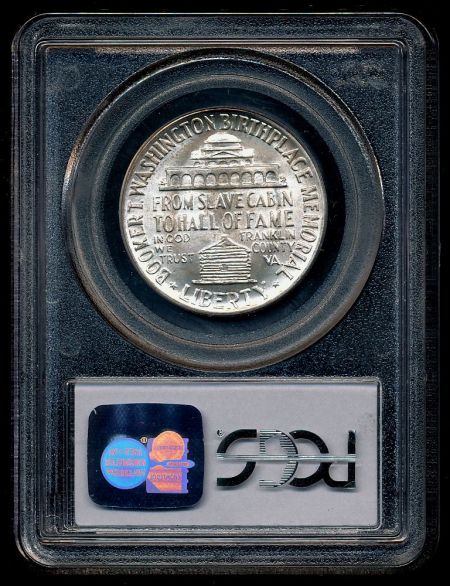 To catch up on the previous parts to this story: - Part I- Part II- Part IIIFor more of my stories about commemorative coins and medals, including more on the BTW commemorative coins, see: Commems Collection. Collecting history one coin or medal at a time! (c) commems. All rights reserved.
|










 Posted 07/28/2024 12:58 pm


 Uncirculated American Silver Eagles


