|
CCF Master Historian of Commemorative Coins
 United States
12578 Posts |
By popular demand (OK, by the request of one or two), I'm back with a deep dive into the discussion that took place when the House of Representatives brought up the bill "to authorize the coinage of 50-cent pieces in commemoration of the one hundredth anniversary of the enunciation of the Monroe doctrine." Allen Towner Treadway (R-MA) got things rolling when the Monroe Doctrine coin bill was brought up for consideration. "Mr. TREADWAY. Mr. Speaker, reserving the right to object, will the gentleman interested in this measure kindly explain some reason why this legislation should be adopted?
"Mr. LINEBERGER. I will be very glad to furnish the information which the gentleman desires. This bill requests an authorization for the coinage of 50-cent pieces in commemoration of the one hundredth anniversary of the enunciation of the Monroe doctrine, and is prompted only by the desire to celebrate in a fitting manner a very important national event and international event. There is also to be held in the city of Los Angeles next year a Monroe doctrine centennial exposition. A very unique thing about this bill and the centennial which we propose to hold in Los Angeles is that we do not propose to ask the Government of the United States for one cent of money; that is to say, pecuniary outlay on the part of the Government."
At that point, Louis Convers Cramton (R-MI) rose to initiate his objection to the bill for its specification of a local (Los Angeles, California) sponsor/beneficiary (the Los Angeles Clearing House).
"Mr. CRAMTON. Will the gentleman yield? The provisions of the bill put this issue entirely in the hands of the local clearing house. That is a unique provision, is it not?
"Mr. LINEBERGER. I think not. I believe it has been customary when an exposition or other commemorative events are held in localities and a coin is specifically coined by the Government to commemorate that same event, the locality in which the commemorative event is held is usually permitted to distribute the coin. That is as it should be; that is the only reason for their asking for this, and I hope the gentleman will not object to the present consideration of the bill.
"Mr. CRAMTON. The coin is not to commemorate the exposition or fair, or whatever it is down there, but it is to commemorate the enunciation of the Monroe doctrine, which I do not understand took place in Los Angeles.
"Mr. LINEBERGER. No, it did not take place in Los Angeles, but I want to say to the gentleman, speaking in a historical sense, I do not think that any portion of the country is more interested in the Monroe doctrine, because it was through the Monroe doctrine that California was annexed.
"Ever since the Lewis and Clark expedition, as far back as 1806, England, France, and Russia, had cast covetous eyes along the littoral of the north Pacific coast. California was the main attraction, but the Monroe doctrine proclaimed, in 1823, disturbed their plans and kept the European powers at a distance. However, when war was declared, between the United States and Mexico, on May 13, 1846, the situation, which had been long developing, finally crystallized. Commodore John B. Sloat was in command of the Pacific Squadron, consisting of seven vessels and a transport. This fleet was lying in the Harbor of Mazatlan when, on May 17, word reached him that hostilities had begun between.Mexico and the United States. But, as the report was not official, Sloat contented himself with dispatching a single vessel, the Cyane, under Captain Mervin, to. join the Portsmouth at Monterey, while he remained in the Mexican harbor with the remainder of the fleet. A few weeks later, receiving additional confirmation of the earlier report, he quietly slipped out of Mazatlan and sailed direct to Monterey.
"In taking this course, Sloat was not only guided by Bancroft's orders of the previous year but also by evidence, apparently genuine, that the British Government planned to check the American occupation of California. Admiral Seymour, commander of the British fleet in the Pacific, whose interest in California was well known, was.then cruising in the vicinity of Sloat's command and had shown an unpleasant curiosity in the doings of the American fleet. It was credibly reported that he intended to forestall Sloat's occupation of any California port; and as later evidence showed, only the absence of official orders prevented him from making this attempt.
"As it was, however, Sioat found no obstruction in his way at Monterey. His flagship, the Savannah anchored in the harbor on July 2, but he delayed action until the morning of the 7th. The intervening time was occupied in conferences with Larkin, in the preparation of plans and proclamations for the conquest of the Province, and in exchange of official courtesies with the California authorities."
[Note: Thomas Oliver Larkin was a wealthy American merchant residing in Monterey at the time; he was an important local citizen.]
"At last, however, stirred by news of Fremont's activities in the north, the fear of Admiral Seymour's arrival, and the urging of his own officers, Sloat decided to act. The occupation of Monterey then became almost a matter of' routine. There had been no powder in the fort to salute the American vessels when they sailed into port; all the soldiers -- a mere handful -- had gone south with Castro, and a Mexican flag, had not been seen in the town for three months.
"Accordingly, when the formal demand for surrender was refused, because there was no one with authority to grant it, Sloat disembarked some 250 men, who marched unmolested to the customhouse, where they raised the American flag, July 7, 1846. He fired a salute and formally proclaimed California annexed to the United States. Two days later the flag was raised over San Francisco and Sonoma, and on the 11th at Sutter's Fort. In all these proceedings, and in the proclamations accompanying them, it is worth recording that the American officers sought, according to their instructions, to conciliate the Californians and to treat them with all possible consideration.
"Thus the Monroe doctrine kept the European powers from taking action for the acquisition of California for a period of nearly 25 years, and no doubt was the final source of inspiration which caused Commodore Sloat to act in 1846, thereby forestalling the occupation, of the territory by the British.
"So California has an historical interest in the Monroe doctrine, and in reality owes her place in the great constellation of States to the fact of its existence. Her interest in its present maintenance and future perpetuation is no less now than it was in the past; and it is appropriate, indeed, gentlemen, that this great exposition to commemorate the one hundredth anniversary of the Monroe doctrine should be held upon the shores of the Pacific in the great State of California, which came under the folds of the American flag because of the foresight and patriotism of the statesman of a century ago who promulgated the doctrine and proclaimed the sentiments of the American people therein enunciated to the world."An unusually long bit of history (at least for a commemorative coin discussion) to be presented during a session of Congress, but Representative Lineberger's compelling account did not sway Representative Crampton. More about that in Part II. Enunciation of the Monroe Doctrine Centennial Half Dollar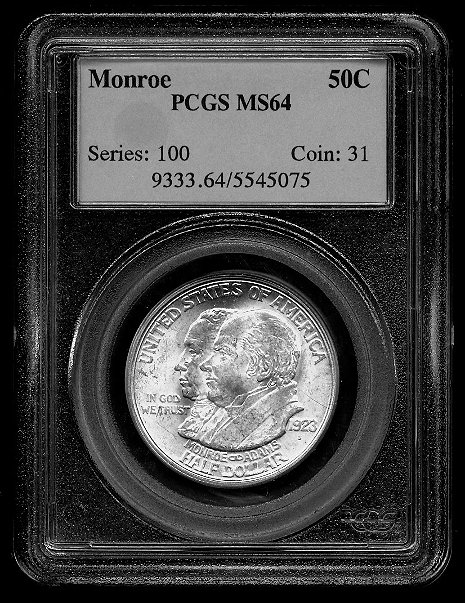 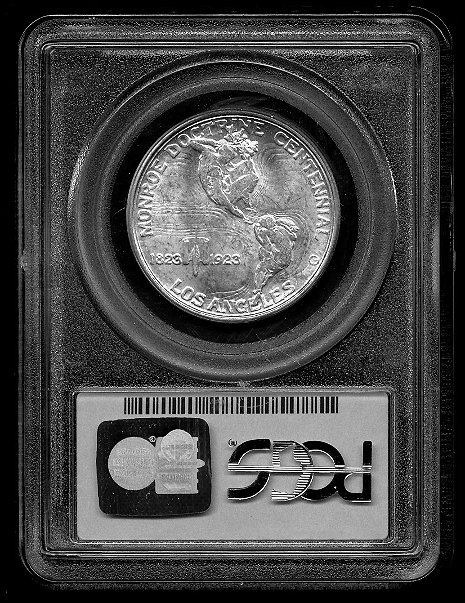 For more of my stories about commemorative coins and medals, including more on the Monroe Doctrine half dollar, see: Commems Collection. Collecting history one coin or medal at a time! (c) commems. All rights reserved.
Edited by commems
08/02/2024 6:10 pm
|





 Posted 08/02/2024 9:50 pm





