|
CCF Master Historian of Commemorative Coins
 United States
12557 Posts |
If you haven't already done so, it would help your understanding of this post if you gave a read to Part IFollowing the extended oration of Walter Franklin Lineberger (R-CA) that outlined California's link to the Monroe Doctrine, Louis Convers Cramton (R-MI) was not persuaded to stray from his initial objection. "Mr. CRAMTON. Is the gentleman willing to cut section 2 from the bill?"
[Note: Section 2 identified the Los Angeles Clearing House as the coin's sponsor/beneficiary.]
"Mr. LINEBERGER. I hope the gentleman will not insist on that omission because this exposition is to be held In Los Angeles and preparations are well on their way and that would be the natural place to distribute these coins.
"Mr. CRAMTON. I will say frankly to the gentleman, with section 2 remaining In the bill I shall be obliged to object.
"Mr. LINEBERGER. What would the gentleman suggest; from whence could, the coin be distributed to better advantage than in Los Angeles?
"Mr. CRAMTON. We have a lot of patriotic towns in Michigan that could distribute them if it Is necessary to have a town distribute them."Sounds a bit convenient/self-serving - a Michigan Congressman suggesting Michigan be the coin's sponsor/beneficiary! At that point, the discussion (temporarily) took another direction thanks to Representative Allen Towne Treadway (R-MA). "Mr. TREADWAY. Mr. Speaker, will the gentleman yield there?-
"Mr. LINEBERGER. Yes.
"Mr. TREADWAY. Is it not a fact that whenever these special things are done, either with respect to stamps or coins, or anything of that kind, eventually there is a very large premium asked for them when they reach the hands of collectors?"
...
"Mr. TREADWAY. Of what benefit would this be to Los Angeles, or what effect would it have on the Monroe doctrine?"
"Mr. LINEBERGER. If the gentleman will permit me to answer him, I will say this, that it is to commemorate a national event that we are holding this exposition, and the coining of this coin, which will cost the Government nothing because the exposition pays all expense, is to commemorate the same event, and I think the coins should be distributed from the point where the exposition is to be held."
From my perspective, Representative Lineberger did not really answer the questions posed by Representative Treadway. I've wondered if he was being purposely obtuse or simply naive as to the bottom line purpose of a US commemorative coin - fundraising. He seemed to be clinging to the notion that the coins were going to be distributed at face value in conjunction with the planned exposition and not sold for a premium. (They were actually priced for sale in excess of face value - $1.00 each.) Maybe Mr. Lineberger needed to better understand for what he was fighting.
Representative Thomas Lindsay Blanton (D-TX) seized upon Mr. Treadway's questions.
"Mr. BLATON. Mr. Speaker, will the gentleman yield for a question?
"Mr. LINEBERGER. Yes.
"Mr. BLANTON. If they are not going to ask the Federal Government for help -- which would be a departure from the usual custom -- and if by section 2, they can sell these coins at a premium of 50 cents or a dollar and thereby secure funds to help them out, why should we object? In my opinion, that is an entirely proper way for them to finance their entertainment."Representative Cramton then jumped back in. "Mr. CRAMTON. Mr. Speaker it does not occur to me that this is a right way to finance the fair.
"Mr. LINEBERGER. It.is not financing the fair. It will cost millions. Will the gentleman.accept the bill if I move to strike out section 2?
"Mr. CRAMTON. Does the gentleman suppose the Senate will restore it?
"Mr. LINEBERGER. I have no way of telling what the Senate will do in the matter.
"Mr. CRAMTON. I will need assurance that section 2 will not be put in.
"Mr. LINEBERGER. I shall not, of course, handle the bill in the Senate. I hope the gentleman will withdraw his objection. He said he would.
"The SPEAKER. Is there objection?
"Mr. CRAMTON. I will object unless the gentleman can assure us that section 2 will not be restored.
"Mr. LINEBERGER. I will say frankly to gentlemen on the Senate side that there was objection here, and I shall do my best to cut it out. I hope the gentleman will not renew his objection, so this will not be necessary.
Mr. CRAMTON. Then I will withdraw my objection."And with that, the bill was able to move forward in the House, be passed in the Senate and be signed into law by US President Warren G. Harding on January 24, 1923. The enacted legislation includes the original Section 2 and names the Los Angeles Clearing House as sponsor/beneficiary. Lineberger 1, Cramton 0. IMO, Cramton's position on the bill was a bit absurd. It wouldn't surprise me to learn that he reviewed recent commemorative coin bills (i.e., 1918 Illinois Statehood Centennial, 1920 Maine Statehood Centennial, 1920 Landing of the Pilgrims Tercentenary, 1921 Alabama Statehood Centennial, 1921 Missouri Statehood Centennial and 1922 US Grant Centenary) and noticed that they did not list a sponsor/beneficiary. While such is true, it was just a function of the evolving commemorative coin bill language of the time, each of the coins had a sponsor behind it and net proceeds from sales of the coin benefited the sponsor. I would have hoped that Cramton would have realized this, but maybe... Enunciation of the Monroe Doctrine Centennial Half Dollar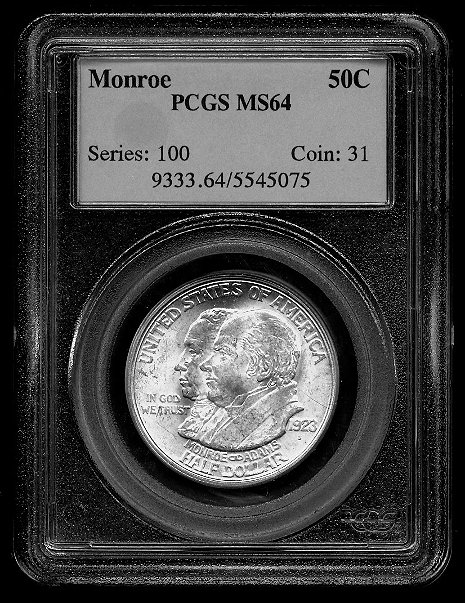 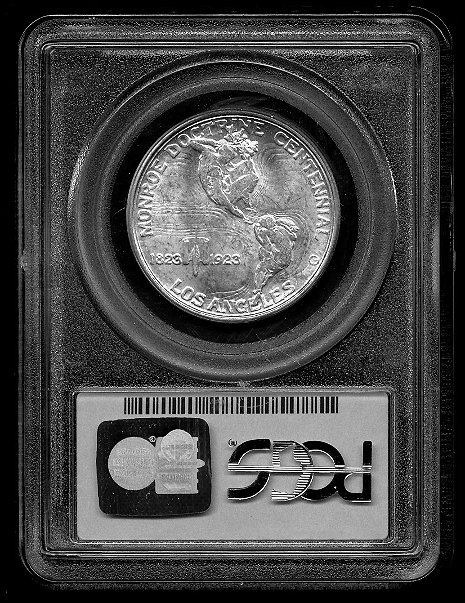 I've discussed the House debates over the Monroe Doctrine Centennial half dollar before, without the extended quotes: - 1923 Monroe Doctrine Centennial - A Lengthy Debate - Part I- 1923 Monroe Doctrine Centennial - A Lengthy Debate - Part IIFor more of my stories about commemorative coins and medals, including more on the Monroe Doctrine half dollar, see: Commems Collection. Collecting history one coin or medal at a time! (c) commems. All rights reserved.
|





 Posted 08/02/2024 10:00 pm





