I recently posted about the 1998 Kennedy Collector's Set (1998 Kennedy Collector's Set), but wanted to return to the Robert F. Kennedy Silver Dollar as a standalone topic. So...The Robert Francis Kennedy ("RFK") Silver Dollar was included in a multi-purpose bill that amended the Bank Holding Company Act of 1956 - Yes, 1956! - the bill's title was the Riegle-Neal Interstate Banking and Branching Efficiency Act of 1994.
The bill, as originally introduced, did not include a provision for a Robert F. Kennedy silver dollar.
After initial disagreements in the chambers over the bill, a Conference was called to resolve the differences. Representatives of the two chambers subsequently met in conference and jointly reported an amended bill that included an RFK coin plus specifications for a Special Olympics silver dollar, a National Community Service silver dollar, a US Military Academy silver dollar, a US Botanic Garden silver dollar and a three-coin Mount Rushmore coin program. From 0 to 8 coins in a flash!
The amended bill, as put forth in the Conference Report, was ultimately passed in the House and Senate and signed into law as Public Law 103-651 by US President William "Bill" Clinton on September 29, 1994.
A few words about RFK:
He was born on November 20, 1920 in Brookline, Massachusetts, the seventh of nine children. He served in the US Navy during World War II ("WWII") - mostly on the USS
Joseph R. Kennedy, Jr., a US destroyer named in honor of his brother - attended Harvard University after WWII, graduated with a degree in Government. He then earned a law degree from the University of Virginia Law School
His political career began in 1952 when he when he served as John F. Kennedy's campaign for the US Senate. He later served as the US Attorney General, appointed by JFK after he successfully managed his campaign for the US presidency. As Attorney General, he successfully fought organized crime and was an ardent support erof civil rights. RFK served as the US Attorney General between January 1961 and September 1964 (first under his brother John Fitzgerald Kennedy (JFK) and then under Lyndon Baines Johnson who succeeded JFK after his assassination.
Following his time as US Attorney General, RFK turned his attentions to elected office and won election as the US Senator from New York; he served from January 1965 until June 6, 1968.
After serving as one of New York's senators for several years, RFK decided to make a run for US President, announcing his intentions on March 16, 1968. His campaign centered on bringing divergent groups of Americans together - rich and poor, black and white, young and old - his message resonated across the country. He won Democratic Party primaries in Indiana, Nebraska, South Dakota, Washington, DC and California.
Soon after addressing his supporters following his victory in California on June 5, 1968, RFK was shot by Sirhan Sirhan. He was rushed to the hospital, but did not recover. RFK died early in the morning on June 6.
The commemorative Silver Dollar was to be struck "to commemorate the life and work of Robert F. Kennedy."
The coin was available in Proof and Uncirculated versions. The issue price of the Proof dollar was $33.00 (Pre-Issue) and $27.00 (Regular Issue). The prices for the Uncirculated coin were $30.00 and $32.00, respectively. A Two-Coin Set was also available (one each, Proof and Uncirculated coins) for $59.00.
The Proof version had an overall mintage of 99,020 (69,694 individual, 29,326 in the Two-Coin Set); the Unicirculated version sold a total of 106,422 coins (12,955 individual, 29,326 in the Two-Coin Set and 64,141 in "Kennedy Collector's Set). The Set options appear to have moved collectors away from purchasing the standalone Uncirculated coins.
The coin's obverse design presents a forward-facing, not-completely-formal, portrait of RFK, wearing just a shirt and tie (i.e., no suit jacket). The coin's reverse reflects RFK's service to the US and his service roles within the Federal Government. Presented are the Seal of the Department of Justice (rear) with the Seal of the US Senate in front of it (at right). The Senate Seal is the source of the coin's 13 stars which are meant to symbolize the original 13 States of the Union.
Both the obverse and reverse designs were the work of US Mint Sculptor-Engraver
Thomas D. Rogers.
No surprise, I opted for the Unirculated version for my collection.
1998 Robert F. Kennedy Silver Dollar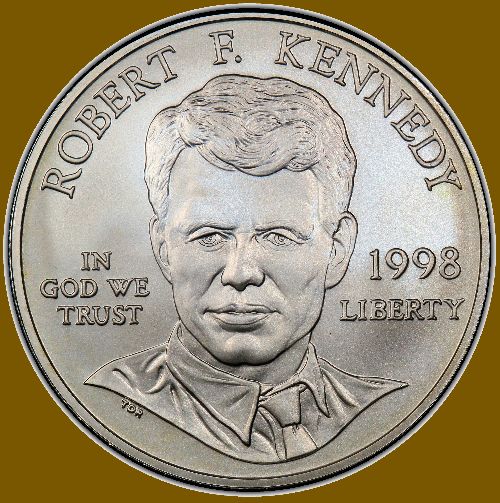
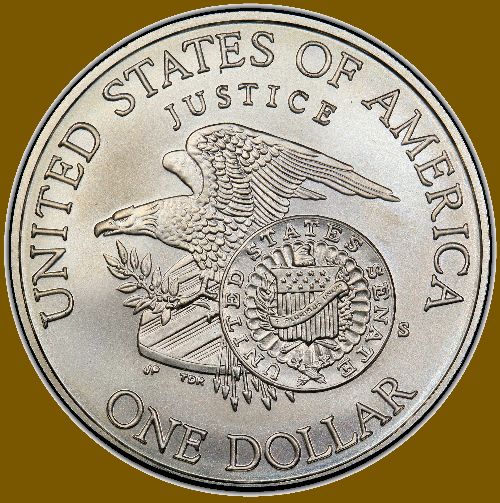
For more on the stars that are part of the RFK Silver Dollar design, see:
-
Post Your Coins With StarsFor more of my topics on commemorative coins and medals, including other Lafayette dollar stories, see:
Commems Collection.










 Posted 11/10/2024 2:11 pm


 what is the 1998 dates Purpose, Is there a Significance for that date, Thanks...


