This is the fifth and final installment of the 2008 NASA 50th Anniversary commemorative coin proposals story, this time out I will be discussing the one coin bill that was introduced during the 111th Congress.Previous discussions:
-
What If? 2008 N A S A 50th Anniversary - 108th Congress-
What If? 2008 N A S A 50th Anniversary - 109th Congress-
What If? 2008 N A S A 50th Anniversary - 110th Congress - Part I-
What If? 2008 N A S A 50th Anniversary - 110th Congress - Part IIThe NASA 50th Anniversary commemorative coin bill proposed in the 111th Congress (in the House of Representatives) was introduced in January 2009 and was sponsored by - say it with me - Sheila Jackson-Lee (D-TX). Upon its introduction, the bill was referred to the House Committee on Financial Services.
The bill was a near duplicate of Jackson-Lee's 110th Congress NASA Anniversary bills:
- Same "Findings" section that summarized NASA's history/accomplishments
- Same call for the gold and silver coins plus bronze medal
>>>> 50,000 Gold $50 coins
>>>> 300,000 of nine different Silver Dollars (one for each planet + Pluto)
>>>> Bronze medal duplicates of Gold $50 coin
- Same design specifications
- Same surcharge amounts
>>>> $50 on Gold $50 coins
>>>> $10 on Silver Dollars
>>>> $1 on Bronze Medals
The distribution of the surcharges was updated, vs Jackson-Lee's earlier bills, to reflect the group of beneficiaries first specified in the the Senate bill introduced by Bill Nelson (D-FL) (110th Congress): two repeat and two replacements:
Repeat Beneficiaries: >>>> NASA Family Assistance Fund
>>>> Dr. Ronald E. McNair Educational (D.R.E.M.E.) Science Literacy Foundation
Replacement Beneficiaries:>>>> Challenger Center for Space Science Education (replacing the Dorothy Jemison Foundation for Excellence), "for the purposes of creating positive learning experiences using space science as a theme that raise student expectations of success, fostering a long-term interest in mathematics, science, and technology, and motivating students to pursue careers in these fields."
>>>> Smithsonian Institution - National Air and Space Museum (including the Steven F. Udvar-Hazy Center) (replacing the National Trust for Historic Preservation) for the "preservation, maintenance, and display of space artifacts" at the Museum.
The other notable change in Jackson-Lee's 111th Congress bill was the switch to an issue date of 2011 (vs. 2008). The coins were still intended to commemorate NASA's 50th Anniversary (1958-2008), but as a 2008 issue date was no longer a possibility in 2009, it was pushed to 2011.
Why all the way to 2011? The maximum release limit (two per year) had already been reached for 2009 and 2010. (2009: Abraham Lincoln Bicentennial, Louis Braille Bicentennial; 2010: Boy Scouts of America Centennial, Disabled American Veterans).
The bill was never reported out of Committee, and, with just two co-sponsors, was never considered by the House under the suspension of the rules. When the 111th Congress adjourned in 2010, Jackson-Lee's dream/mission to secure a US commemorative coin program for NASA faded into the ether.
ICYWW: Representative Jackson-Lee's zeal for this coin program is likely traced to her elected post representing Texas' 18th District. Texas was/is home to the Lyndon B. Johnson Space Center (Houston) which serves as mission control for manned space missions; it is also a primary site for astronaut training. The original name for the Johnson Space Center (established November 1, 1961) was the Manned Spacecraft Center; it was renamed in honor of Texan/US President Lyndon Baines Johnson on February 17, 1973 via a Senate Joint Resolution. (Johnson died on January 22, 1973.) Jackson-Lee was doing her best to get her local community commemorated.
As I mentioned in the second installment of this series, I think a smaller, simpler coin program would have had a better chance at passage. For example, a four-coin program with a Gold Half Eagle ($5), two Silver Dollars (one for manned missions, one for unmanned) and a Half Dollar would have served the intended purpose and been much more manageable - for the Mint and collectors. It might have gained support in the House and Senate. Instead, the push for a grand coin program failed to gain the needed traction and a worthwhile historical milestone was passed over.
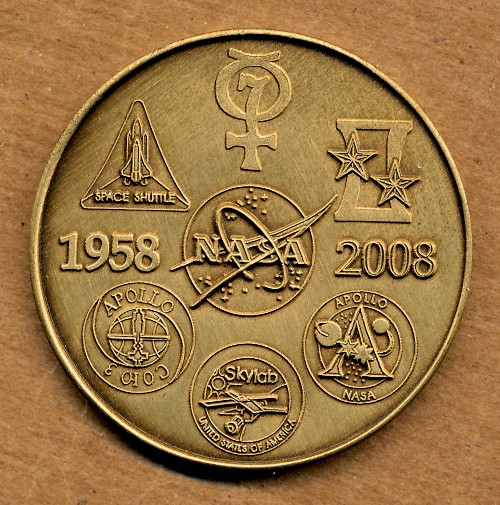
Though no US commemorative coin was ever struck for NASA's 50th Anniversary, I have come across a simple commemorative medal for the occasion. It features the NASA 50th Anniversary logo on the obverse and adaptations/depictions of the mission patches for NASA's manned space missions from its inception to the (then) present day. Starting at the 12 o'clock position: the insignia representing Mercury, Gemini, Apollo, Skylab, Apollo-Soyuz and the Space Shuttle are shown.
2008 NASA 50th Anniversary Medal - Antiqued Bronze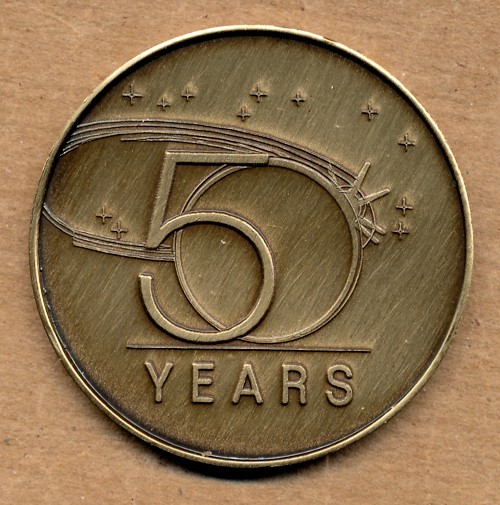
For more of my posts about commemorative coins and medals, including other What If? stories, see:
Commems Collection.







 Posted 12/11/2024 11:57 am





