Between 1995 and 2012, eight bills were introduced in Congress that called for the minting of coins that would honor the legacy of Theodore Roosevelt. The proposals fall into three logical groups, so I will discuss them in three dedicated posts. Up first, the lone member of Group 1 - a bill introduced by Richard W. Pombo (R-CA) in the House of Representatives in September 1995.
Pombo's bill called for the minting of "coins in commemoration of Theodore Roosevelt, to authorize the appropriation of the surcharges imposed with respect to such coins to the Secretary of the Interior for use in connection with the administration of the Endangered Species Act of 1973, and for other purposes."
Theodore Roosevelt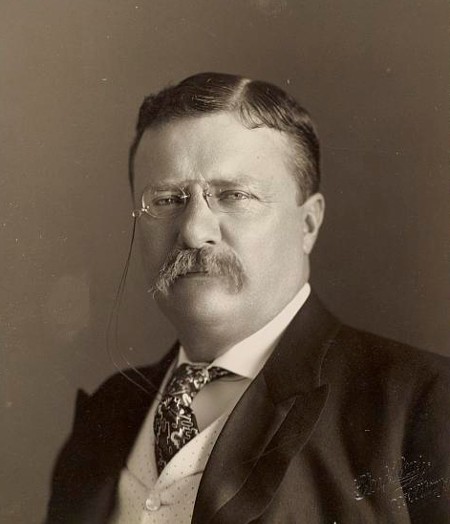 (Image Credit: Library of Congress, Prints and Photographs Division.)
The bill has several novel provisions that differentiate it from most other US commemorative coin bills. I'll discuss them below.
As was often the case, the bill included a brief "Findings" section that provided context for the coin request:
Findings--The Congress makes the following findings:
(1) Theodore Roosevelt, the 26th President of the United States, inspired and led the people of the United States toward the goal of natural resource conservation.
(2) The protection and conservation of the Nation's natural heritage requires the acquisition by the United States of habitat and rights to the use of habitat.
(3) Allowing those persons who benefit from and support conservation efforts to participate in the funding of those efforts is desirable and achievable through the sale of collectors' commemorative coins.Another example of Congress looking to collectors to support a fund raising effort!
Pombo proposed a three-coin program: Gold Half Eagles (up to 1 million), Silver Dollars (2 million) and Copper-Nickel (CuNi) Clad Half Dollars (2.25 million). An unusual provision for the mintage figures was the fact that up to half of the authorized mintage for each gold and silver coin was to be struck in 1997, with the other half being reserved for 1998 striking; the Clad Half Dollar mintage was split 1 million/1.25 million between 1997 and 1998, respectively. Defined annual mintage figures for multi-year coin programs have not been standard procedure for US commemorative coins.
As possible, the coins were to be struck at the US Mint facility in West Point, NY.
Gold for the Half Eagles was to be secured by the Treasury via market channels; the silver for the Dollar coins was to come from the US' Strategic and Critical Materials Stockpile (the same Stockpile that was tapped into for initial Silver Eagle bullion coins).
The bill included design specifications for the coins; the obverses were to bear the likeness of Theodore Roosevelt, the reverses were to be "emblematic of the Nation's natural resources." Based on how they were interpreted, the bill's provisions would have produced either distinct designs within a common theme across the three coins, or a pair of common designs repeated across each of the three coins. It's possible also, that different designs would have been used in 1997 vs. 1998 - nothing in the bill prohibited it.
The final designs were to be selected by the Secretary of the Treasury after consulting with the Commission of Fine Arts and having the Citizens Commemorative Coin Advisory Committee review them.
The issue price of each coin was to include a surcharge: $35 on each Gold Half Eagle, $7 per Silver Dollar and $2 per Clad Half Dollar.
Surcharges were to be paid to the Secretary of the Interior to support its administration of the Endangered Species Act of 1973 ("Act"). The distribution, however, was not a simple, straightforward process. The bill made the assumption that Congress would have made appropriations to the Department of the Interior pertaining to the Act prior to coin sales - collected surcharges up to the amount of such prior appropriations were to be paid to the Interior, but excess funds (if realized) were to be paid into the General Fund of the US Treasury.
Note: The Endangered Species Act's purpose was "To provide for the conservation of endangered and threatened species of fish, wildlife, and plants."Upon its introduction, Pombo's bill was referred to the House Committee on Banking and Financial Services, with a further referral to its Subcommittee on Domestic and International Monetary Policy. The bill, however, was not reported out of Committee nor further considered by the House. As a result, there would be no 1997/1998 commemorative coins for "Teddy."
Next up, will be a look at coin bills that sought to celebrate Theodore Roosevelt and his Nobel Prize.
For other of my posts about commemorative coins and medals, including other What If? stories, see:
Commems Collection.








 Posted 05/13/2025 2:23 pm


