Robert Ernest Andrews (D-NJ) won a Special Election in 1990 to fill the House of Representatives seat vacated by James Florio (D-NJ) when Florio resigned to take office as the Governor of New Jersey. Andrews served out the term and was re-elected to the succeeding 12 Congresses. He resigned in February 2014 while under investigation by the US House Committee on Ethics for alleged misuse of political campaign funds (personal use). Andrews claimed he was leaving Congress to take a job with a law firm in Philadelphia, Pennsylvania vs. the ongoing investigation. The House investigation was closed and the complaint was dismissed in June 2014.
During the 107th, 108th and 109th Congresses, Andrews introduced a bill in each (2002, 2003 and 2005) that called for "coins in commemoration of the 100th anniversary of the beginning of Korean immigration into the United States." Up to 500,000 90% Fine Silver Dollars (SDs) were specified.
As typical for the era, the commemorative coin bills included a "Findings" section to provide background and context for the coin proposal:
The Congress finds as follows:
(1) January 13, 2003, will mark the 100th anniversary of the first wave of Korean immigration to the United States.
(2) At the time of this anniversary, more than 100 Korean American communities throughout this Nation will commemorate this important event.
(3) According to immigration records, in December 1902, 56 men, 21 women, and 25 children left Korea and sailed across the Pacific Ocean aboard the S.S. Gaelic, landing in Honolulu, Hawaii, on January 13, 1903.
(4) These early Korean immigrants worked at sugar cane and pineapple fields in Hawaii.
(5) Since that 1st voyage, approximately 1,000,000 Koreans have immigrated to the United States.
(6) Korean Americans have served with distinction in the U.S. Armed Forces during every war and conflict in which the United States is or was involved from World War I through the war in the Persian Gulf and beyond.
(7) Korean Americans have taken root and thrived in the United States through strong family ties, robust community support, and countless hours of hard work.
(8) Korean immigrants have invigorated business, church, and academic communities throughout the United States and Korean Americans have also established themselves as important members in the medical, legal, financial, and governmental professions.
(9) The strategic partnership between the United States and Korea has helped undergird peace and stability in the Asian Pacific region and has provided economic benefits to not only the peoples of the United States and Korea, but to the entire world.The bills included only generic design specifications: "emblematic of the immigration of Koreans into the United States and the significant contributions of Korean Americans to this Nation." The bills of the 107th and 108th Congresses called for 2003 dated/issued coins; the 109th Congress bill targeted 2011.
An unusual aspect of the bills was their lack of a specified surcharge and a named sponsor/beneficiary. In fact, the bills did not specify what to do with any potential net proceeds from coin sales. It stated "the coins issued under this Act shall be sold by the Secretary [of the Treasury] at a price equal to the face value, plus the cost of designing and issuing such coins (including labor, materials, dies, use of machinery, overhead expenses, and marketing)." A US commemorative coin without a surcharge or sponsor was/is far from the norm!
Upon introduction, each of the bills was referred to the House Committee on Financial Services, with a further referral to its Subcommittee on Domestic and International Monetary Policy, Trade, and Technology. None of the bills was reported out, however, and none were considered further.
Collectors with ties to Korea have the 1991 Korean War Armistice Silver Dollar to add to their cabinet, but struck out on a potential Immigration Centennial coin.
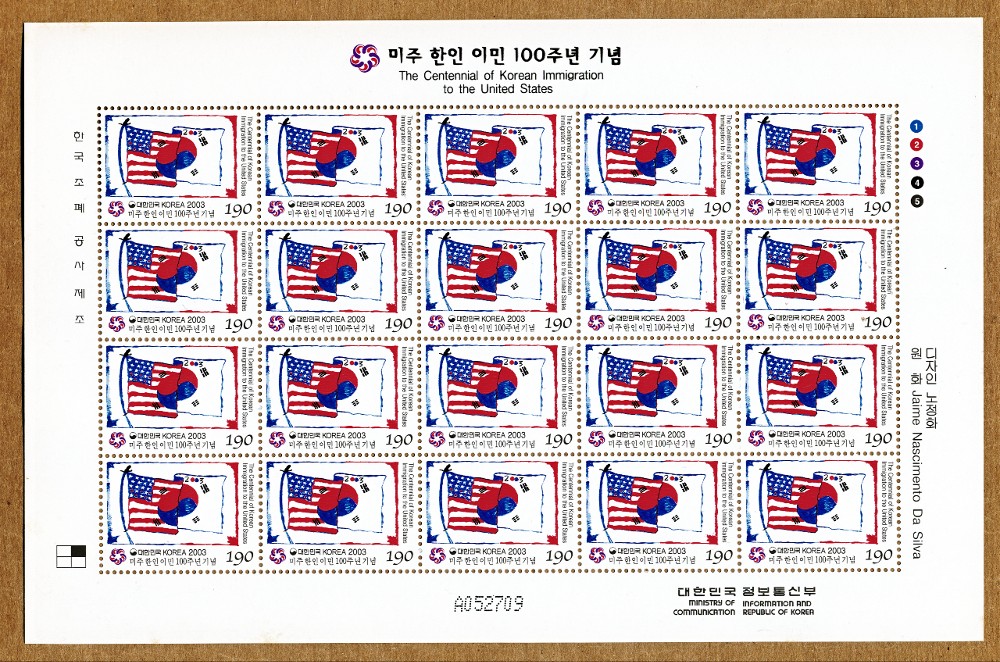
Though no US commemorative coin was issued, commemorative ceremonies for the Centennial of Korean Immigration were held in Hawaii on January 13, 2003, and US President George W. Bush issued a Proclamation for the occasion, it began:
From every corner of the world, immigrants have come to America to discover the promise of our Nation. On January 13, 1903, the first Korean immigrants to the United States arrived in Honolulu, Hawaii, on the SS Gaelic. Today, Korean Americans live throughout the United States, representing one of our largest Asian-American populations. As we commemorate the centennial anniversary of Korean immigration to the United States, we recognize the invaluable contributions of Korean Americans to our Nation's rich cultural diversity, economic strength, and proud heritage.For other of my posts about commemorative coins and medals, including other What If? stories, see:
Commems Collection.












 Posted 05/31/2025 10:59 pm