Here's a facet of the Stone Mountain Memorial Half Dollar that doesn't often get highlighted...But first, a bit of background...
Gutzon Borglum, noted artist/sculptor, was hired by the Stone Mountain Confederate Monument Association (SMCMA) in 1916 - initially as a consultant, but later as the lead designer/carver of the Memorial.
Borglum was a strong-willed artist, and it is well known that his relationship with the SMCMA deteriorated over time. The two sides were often at odds over Borglum's artistic vision for the project (he wanted a grander carving than could be afforded), Borglum's slower-than-expected progress on the carving and the SMCMA's ongoing financial difficulties. The issues came to head in 1924 and spilled over into early 1925.
A Potetnial Resolution via Joint Resolution...
Congress began to hear of the negative issues regarding the SMCMA-Borglum relationship, the Memorial's slow progress and its general operations. It grew concerned over how the funds from the sales of the commemorative half dollar it had authorized in 1924 for the SMCMA (it was signed into law by President Calvin Coolidge) were going to be used.
In the hope of getting a clearer picture of the Association's plans, Roy Orchard Woodruff (R-MI)) introduced a Joint Resolution in the House of Representatives ("House") in late February 1925 that called "for the Secretary of the Treasury to secure from the sculptor and Stone Mountain Memorial Association designs of plans, complete, together with use proposed for moneys to be raised by the sale of the commemorative coins."
The Joint Resolution referenced the plans for the Stone Mountain Memorial that were circulated within Congress and noted that "there has arisen some question bearing upon the fulfillment and the completion of the original plans."
If the SMCMA was forced into compliance with such a Resolution, it would definitely have shed a brighter light on what was happening with the Association, its plans and its Memorial.
By the time of the Resolution, however, the SMCMA had fired Borglum. In addition, he had subsequently destroyed his models for the carving and fled to North Carolina (to avoid an arrest warrant issued on behalf of the SMCMA).
In the midst of these developments, the Joint Resolution did not gain traction within the House and it was not reported out of Committee.
The SMCMA moved on from Borglum and hired Augustus Lukeman to complete the Memorial. Lukeman made reasonable progress on a scaled down Memorial design until funding dried up circa 1928. (He also blasted off the carving work begun by Borglum to support his own vision for the Memorial.) The Memorial sat unfinished until the State of Georgia purchased Stone Mountain in 1958 and re-initiated the project in 1964. The nearly-complete Memorial was unveiled in 1970 and was offically completed in 1972.
The authority to "audit the books" of commemorative coin sponsors is now a part of most modern commemorative coin bills; in 1925, separate legislation was required. That said, it was far from the norm for Congress to consider legislating such authority. I wonder what Congress would have found if it was able to audit the SMCMA's books and review its plan for net proceeds from coin sales?
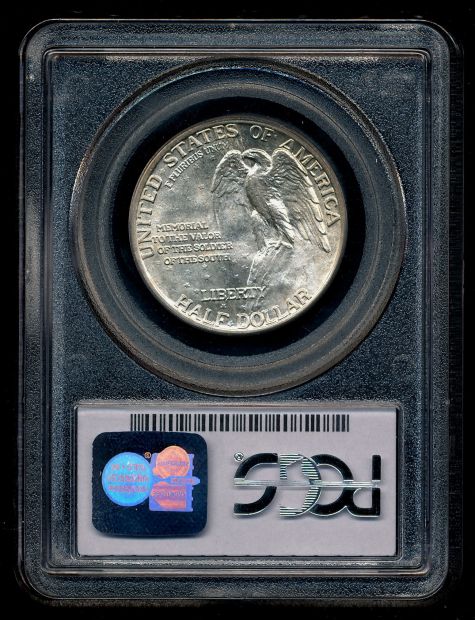
1925 Stone Mountain Memorial Half Dollar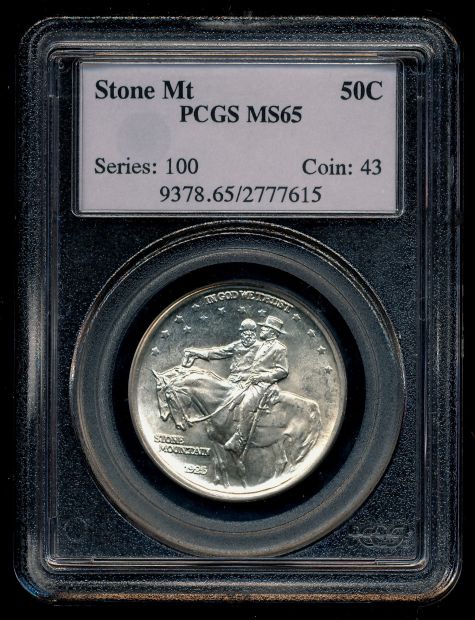
For other of my posts about commemorative coins and medals, including other Stone Mountain half dollar stories, see:
Commems Collection. 








 Posted 07/10/2025 5:51 pm


