In 2005, the United States ("US") issued a Silver Dollar to honor the life and legacy of Chief Justice of the Supreme Court John Marshall. (I previously posted about the coin here:
2005 John Marshall 250th Anniversary Of Birth Silver Dollar.)
He was not the only US Supreme Court Justice for whom a commemorative coin was sought, however. Four attempts were made between 1995 and 2005 to pay tribute to Associate Justice Thurgood Marshall:
1. House of Representatives / Charles B. Rangel (D-NY) / January 1995 - 104th Congress (1995 issue)
2. Senate / Thomas A.Daschle (D-SD) / November 1997 - 105th Congress (Issue date TBD)
3. House of Representatives / Charles B. Rangel (D-NY) / February 2003 - 108th Congress (Issue date TBD)
4. House of Representatives / Charles B. Rangel (D-NY) / March 2005 - 109th Congress (Issue date TBD)
Associate Supreme Court Justice Thurgood Marshall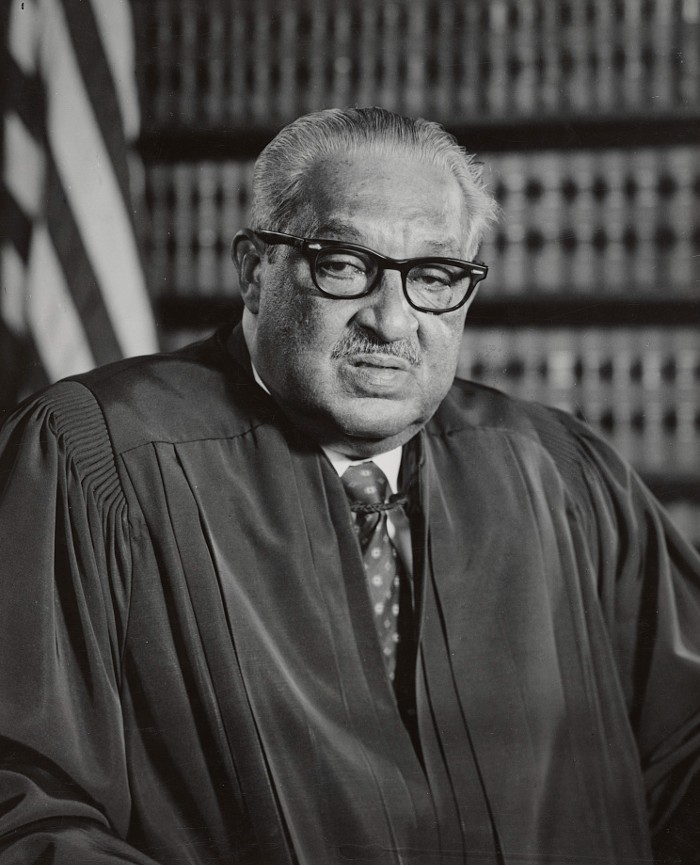 (Image Credit: Library of Congress, Prints and Photographs Division. Public Domain.)
Though the House bills and Senate bill had many common provisions, they were not companion bills (as they were introduced in different Congresses). In addition to small wording variations, one notable difference was the requested number of coins: each of the three House bills called for a maximum of 500,000 Silver Dollars, while the lone Senate bill sought up to 400,000 coins - 100,000 less.
Another difference between the bills concerned the coin's datine and issue dates. The bill introduced in the 104th Congress was the only one of the four to specify a year for the Silver Dollar - 1995. The other bills took a TBD approach that was to be based on the date of enactment of the bill. This could have resulted in coins dated "1998", "1999", "2003", "2004", "2005" or "2006" (in the most likely design/production scenarios).
The design for the Silver Dollar was to be "emblematic of the tenure of Associate Justice Thurgood Marshall on the Supreme Court of the United States." The Secretary of the Treasury was designated to select the final design, after consulting with the Supreme Court Historical Society, the family of the late Thurgood Marshall and the Commission of Fine Arts. The Citizens Commemorative Coin Advisory Committee (CCCAC).was to review proposed designs.
None of the bills included a "Findings" section, but Representative Rangel rose in the House to offer extended comments when he introduced his bill in the 109th Congress. Though his remarks are somewhat lengthy, I've included much of Rangel's statement as I believe it offers an effective recap of Marshall's professional legal career.
A few biographical facts to set the stage:
- Marshall was born in Baltimore, Maryland, on July 2, 1908.
- He earned his BA (Bachelor of Arts) from Lincoln University of Pennsylvania in 1930 and his LLB (Bachelor of Laws) from Howard University School of Law of Washington, DC in 1933 (he was first in his class).
- Marshall passed the Maryland Bar exam in 1933.
- He was Solicitor General of the United States (Aug. 1965 - Aug. 1967)
- He was Judge of the United States Court of Appeals for the Second Circuit (Oct. 1961 - Aug. 1965)
- He served on the US Supreme Court for 20+ years (Oct. 1967 - Oct. 1991)
Excerpts from Representative Rangel's introductory comments:
"I rise today to ask Congress to please join me in cosponsoring,,,the Thurgood Marshall Commemorative Coin Act to commemorate the life and legacy of the Honorable Thurgood Marshall, one of America's distinguished Civil Rights leaders and the first black Associate Justice of the Supreme Court.
"Like Martin Luther King Jr., Malcolm X and many more, Thurgood Marshall led a civil rights revolution in the twentieth century that forever changed the landscape of American society. Working through the courts to eradicate the legacy of slavery and destroying the racist segregation system of Jim Crow, he had an even more profound impact on race relations than many of his peers in the Movement. As the leader of Legal Defense Fund of the National Association for the Advancement of Colored People (NAACP), Mr. Marshall won Supreme Court victories breaking the color line in housing, transportation and voting, all of which overturned the 'Separate but Equal' apartheid, which was the oppressive reality of American life for Blacks from emancipation to the 1960's. It was Marshall who was the mastermind behind the strategies which won the most important legal case of the century, Brown v. Board in 1954, which ended the legal separation of black and white children in public schools and initiated the dismantling of the legal framework which supported segregation. The success of the Brown case sparked the 1960's Civil Rights Movement.
"Marshall's first major case in 1933 desegregated the University of Maryland and initiated his long and distinguished career as the most notable civil rights attorney in American history. Heavily involved with the NAACP, Mr. Marshall navigated through the court system a series of cases to legally challenge the laws that sought to legitimize the denial of constitutionally guaranteed civil rights to African Americans. He was even invited by the United Nations and the United Kingdom to help draft the constitutions of both newly formed Ghana and Tanzania.
"As a result of the success of many of his Supreme Court challenges to state sponsored discrimination, President John F. Kennedy appointed Mr.Marshall to the U.S. Court of Appeals for the Second Circuit. As a Federal Court judge Thurgood Marshall wrote over 150 decisions including support for immigrants' rights, limiting government intrusion in cases involving illegal search and seizure, double jeopardy, and right to privacy issues. As U.S. Solicitor General, Mr. Marshall won 14 of the 19 cases he argued in front of the Supreme Court on behalf of the government. Through this position he represented and won more cases before the Supreme Court than any other American. Therefore it was befitting that in 1967 Lyndon B. Johnson appointed him to the Supreme Court, making Thurgood Marshall the first African American to be a Supreme Court Justice.
"Throughout his tenure as a Supreme Court Justice, Marshall was a strong advocate for equal rights under the law. He strongly believed that integration was the only route to achieving equal protection for all. Once individual rights were accepted, blacks and whites could rise or fall based on their own ability. However, Justice Marshall believed that the Constitution was inherently defective in its acceptance of slavery, and he made it clear that while legal discrimination had ended, there was more to be done to advance educational opportunity for people who had been locked out and to bridge the wide canyon of economic inequity between blacks and whites. Therefore he was a very strong advocate for programs such as Affirmative Action, preferences, set-asides and other race conscious policies. Although Thurgood Marshall worked most of his life on behalf of the rights of African Americans, he built a structure of individual rights that became the cornerstone of protections for all Americans. He succeeded in creating new protections under law for women, children, prisoners, and the homeless. Justice Marshall "refused to acquiesce in outdated notions of `liberty', 'justice' and 'equality,'"' and worked to better them. Therefore, as we now experience the process of appointing a new Supreme Court Justice, let us remember the life and legacy of Supreme Court Justice Thurgood Marshall. For his strength and struggle has contributed greatly to American history and his impact on the Supreme Court fully represents the true essence and purpose of our Constitution."Marshall died in Bethesda, Maryland on January 24, 1993 from heart failure.
The Issue Price of each Silver Dollar was to include a surcharge of $10. Collected surcharge funds were to be paid to the Historical Preservation Committee of the Supreme Court Historical Society "for the purpose of collecting and preserving the physical history of the Supreme Court, including--
(1) research on the history of the entire judicial branch of the Federal Government, and public dissemination of that research;
(2) the acquisition of objects and documents relating to the events associated with the Supreme Court of the United States in the course of the history of the Court; and
(3) the acquisition and preservation of documents, portraits, and period furnishings of historical significance affecting the history of the Supreme Court for the inspiration and benefit of the people of the United States."
Each of the bills was referred to the appropriate House or Senate Committee: the Committee on Financial Services, with a further referral to its Subcommittee on Domestic and International Monetary Policy, Trade, and Technology for the House bills and the Committee on Banking, Housing, and Urban Affairs for the Senate proposal.
None of the bills, however, was reported out of Committee or considered further. Considering Marshall's role in the US' Civil Rights Movement and his leading involvement with landmark cases while on the Supreme Court, the failure of Rangel's efforts is surprising and disappointing. (Note: Charles Rangel served in Congress for 45 years; he died in May 2025, just before his 95th birthday in June.) The 125th Anniversary of Marshall's birth in 2033 seems like an appropriate milestone for a coin. Maybe...
IMO, a Thurgood Marshall Silver Dollar would pair well with the 2014 Civil Rights Act 50th Anniversary Silver Dollar.
For more of my topics on commemorative coins and medals, including more What If? stories, see:
Commems Collection.










 Posted 07/22/2025 09:44 am


