In a previous post about the 1996 National Community Service Silver Dollar
1996 National Community Service, I took a look at the Silver Dollar's designs and their origins, along with some of the coin's specification details. In this post, I'm taking a look at the coin's legislative origins and outlining its historical context.
The coin with which today's collector's are familiar started its journey in Congress via a bill introduced by Joseph P. Kennedy (D-MA) in the House of Representatives ("House") in May 1994. The bill called for the "Secretary of the Treasury to mint coins in commemoration of the Program on Social Ethics and Community Service."
The bill sought the minting of up to 500,000 Silver Dollars, with Proof and Uncirculated versions to be struck. The Issue Price of each coin was to include a $10 surcharge that was to be paid to the National Community Service Trust "for the purpose of funding innovative community service programs at American universities, including the service, research, and teaching activities of faculty and students involved in such programs."
The bill was referred to the House Committee on Banking, Finance and Urban Affairs, with a further referral to its Subcommittee on Consumer Credit and Insurance. Though it had fairly significant support - 222 Co-sponsors - it did not move quickly through Committee.
The Interstate Banking Efficiency bill was introduced in the House in February 1994. In its original form, the bill sought to "amend the Bank Holding Company Act of 1956, the Revised Statutes of the United States, and the Federal Deposit Insurance Act to provide for interstate banking and branching." It did not include any provisions for the issue of commemorative coins. (This would change, however!)
The bill was referred to the House Committee on Banking, Finance and Urban Affairs. The Committee reported the bill with an amendment in March 1994, whereupon it was passed in the House and sent to the Senate. Upon being received, the bill was referred to the Senate Committee on Banking. And that is when the "fun" began!
The Senate Committee on Banking was discharged from considering the House bill, as the Senate introduced an amendment via substitution in April 1994. In anticipation of struggling to get concurrence on its amendment in the House, the Senate called for a Conference on the bill. The House agreed to the Conference request, appointed Conference members (Representative Kennedy was among the appointees) and met with the Senate appointees in July 1994.
It was during the Conference that multiple commemorative coin provisions were proposed to be added: National Community Service, Special Olympics, Robert F. Kennedy Memorial, United States Military Academy Bicentennial, United States Botanic Garden and Mount Rushmore Memorial.
The proposed coin programs were all included in the version of Conference Report approved by the House and Senate. Thus, the Interstate Banking bill became the vehicle for six commemorative coin programs to be put in front of US President William "Bill" Clinton. Clinton signed the bill into law on September 29, 1994 and the National Community Service Silver Dollar became a reality.
The Interstate Banking bill incorporated the provisions of Representative Kennedy's original bill - not much of a surprise considering his involvement with the Conference. Namely, the striking of up to 500,000 Silver Dollars, use of a design selected by the Secretary of the Treasury in consultation with the National Community Service Trust, an issue year of 1996, a $10 surcharge per coin, with surcharge funds to be paid to the National Community Service Trust.
As there was no practical need for it, Representative Kennedy's original bill for the coin was never reported out of Committee or considered further.
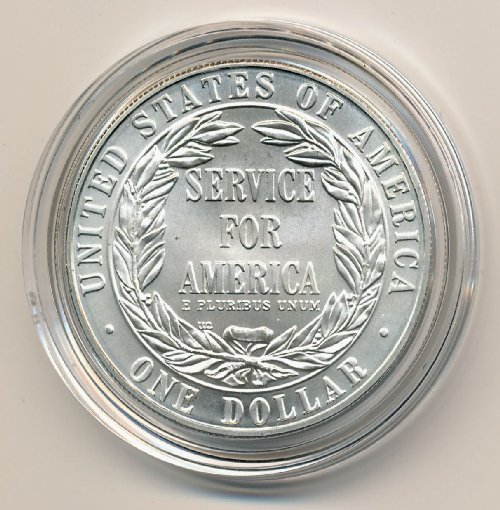
1996 National Community Service Silver Dollar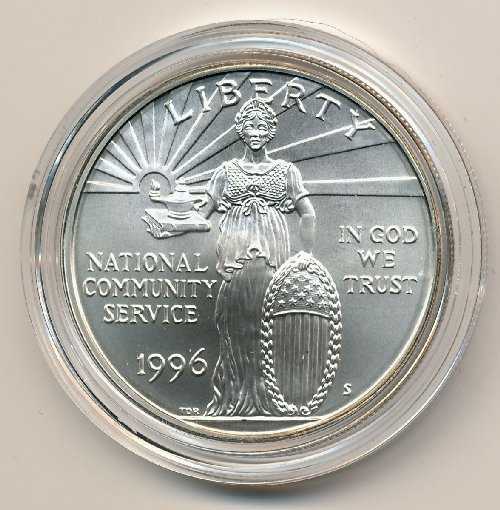
For other of my topics on commemorative coins and medals, including more on the Community Service dollar, see:
Commems Collection.







 Posted 08/11/2025 11:53 am





