Ezra Meeker's pivotal role in securing the legislation that authorized the Oregon Trail Memorial Half Dollar is undeniable, as is his role in promoting the preservation and marking of the original Oregon Trail. Meeker died, however, before his vision could be fully realized - he passed on December 3, 1928 (a Monday).
Ezra Meeker (right) with US President Calvin Coolidge on the White House Lawn- October 1924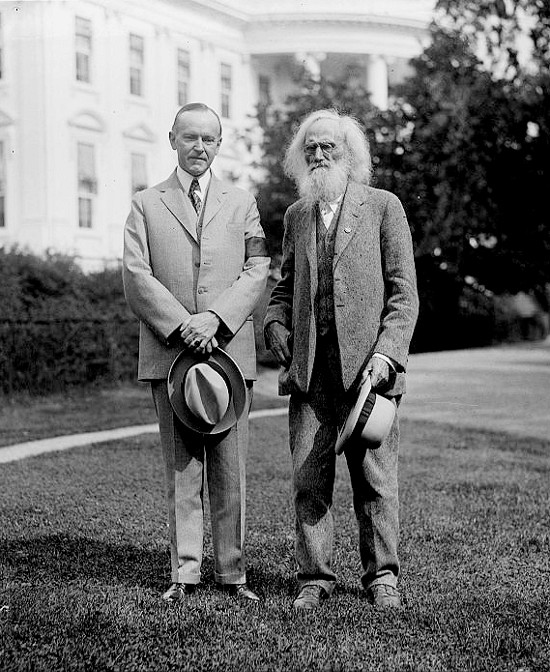 (Image Credit: Library of Congress, Prints and Photographs Division. Public Domain.)
In the wake of Meeker's death, the Oregon Trail Memorial Association had to reorganize a bit and develop its plan for moving forward. It also had to select a new president. (Meeker was the organization's founder in 1922 and served as its president until his death.) Howard R. Driggs was the Board's choice (he had been Meeker's hand-selected vice-president) but Driggs needed certain assurances from the Board before accepting the position.
He laid out a platform, with its first plank focusing on the Association's commemorative half dollar:
1. Every dollar received from the sale of the memorial coins shall go directly to the central purpose of the organization, namely, the erecting of monuments and markers in honor of the western pioneers.Other of Driggs' planks required Association officers to serve without compensation, for the organization to be non-commercial and promote itself only from an educational and patriotic perspective, for the organization to teach a fact-based history of America's westward march and to fund the organization's administrative, research and promotional activities only through voluntary public donations.
The Association's Board of Directors agreed to Driggs' platform and, by a unanimous vote, elected him as the Association's new president.
Once in office, Driggs took on the task of organizational fundraising. One way the Association went about this task was to print and distribute what could be considered a
prospectus. The 16-page booklet, titled "Oregon Trail: A Plan to Honor the Heroes" was distributed to potential contributors circa 1930. The piece provided background information about Meeker and Driggs, as well as outlining the Association's future approach, financial goals and financial plans.
Sections titled "Plan of Action" and "What the Plan of Action Involves" set up the included "Financial Plan" discussion. Under such heading, the booklet provided the text of a report presented to the Association's Board by the assigned Financial Committee:
"The Committee has given its sole thought to the financial aspects of the worthy intents and purposes of our Association as outlined in our Articles of Incorporation:
"To acknowledge the heroism of the fathers and mothers who traversed the Trail with great hardships, daring, and loss of life, which not only resulted in adding new states to the American Union but earned a well-deserved and imperishable fame for the pioneers.
"To honor the twenty thousand dead that lie buried in unknown graves along two thousand miles of that great highway of history.
"To rescue the various important historic points along the old Trail from oblivion; and to commemorate by suitable monuments, memorial or otherwise, the tragic events associated with that emigration erecting them either along the Trail itself or elsewhere in localities appropriate for the purpose, including the City of Washington.
"This embodies as we see it two distinct though coordinated working units
"1. A Central Organization properly sponsored and properly financed so that the spirit and intent of our organization will be accepted with proper creditability by the large number of citizens whose assistance we need.
"2. A Field Organization as an integral part of the Central Organization to distribute six million corns and to handle the requirements where monuments or other memorial work is to be done The fifty cents returned to the Association from the sale of each coin is to be entirely applied to the expense of monuments etc."The "Financial Plan" discussion was followed by "The Vital Need" section which was the Association's financial call to action. It began "The vital need at this time is funds to carry on the work so well begun."
Meeker had started the ball rolling, but getting to the finish line proved to be a formidable task for the Association. The total number of Trail markers erected fell far short of original goals and coin sales never approached the maximum authorized limit of 6 million coins - just ~264,000 (~4.4%) coins were sold.
So, while its Memorial half dollar was a central component of its plans and operations, its sales were never enough to fully fund the Association. The Oregon Trail Memorial Association eventually merged into the American Pioneer Trails Association (1940) with Howard Driggs continuing on as the combined organization's president. The Pioneers Association assumed thousands of half dollars in the merger and continued to offer them for sale into the mid-1940s.
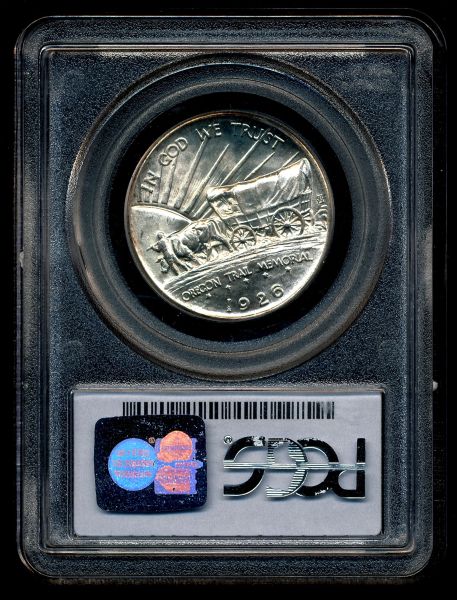
1926 Oregon Trail Memorial Association Half Dollar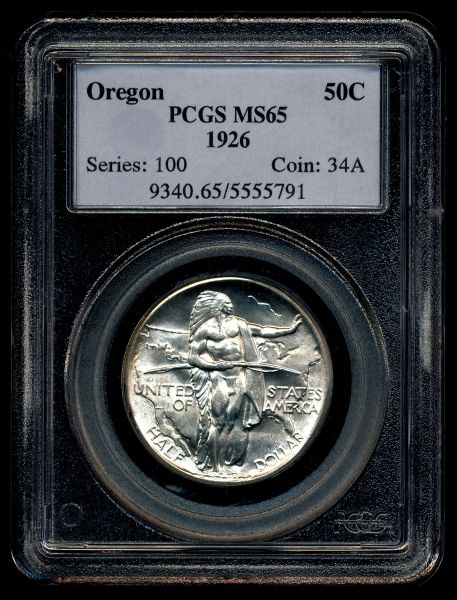
For other of my posts about commemorative coins and medals, including others about the Oregon Trail coins, see:
Commems Collection.










 Posted 08/24/2025 10:50 pm


