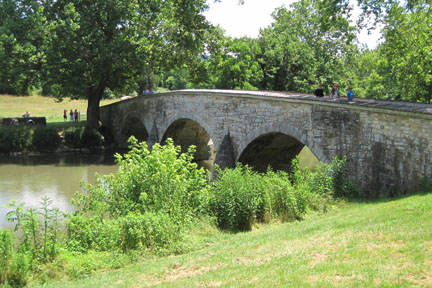
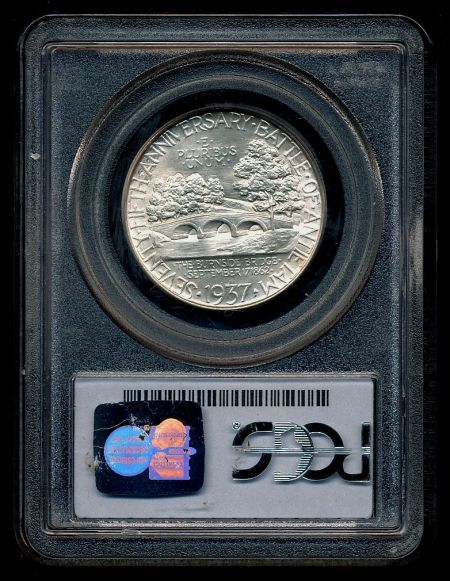
The 1937 Battle of Antietam 75th Anniversary Half Dollar is often praised for its design and execution - William Marks Simpson is the artists responsible. IMO, its photo-realism design is quite impressive.
In a previous post about the Antietam half dollar, I mentioned that the Senate Committee on Banking and Currency - the Committee to which the bill was referred - recommended that the coin's mintage be increased from the proposed 5,000 to 50,000. (You can read the discussion here:
1937 Battle Of Antietam 75th Anniversary - Origin Story - Part I.)
I want to circle back to this discussion and add a bit of additional context. And just everyone is on the same page, the bill that was approved for the Battle of Antietam half dollar called for up to 50,000 coins with minimum coin orders being for at least 25,000 examples.
In late March 1936, Senator Millard Evelyn Tydings (D-MD) introduced his Battle of Antietam coin bill in the United States ("US") Senate. Upon its introduction, the bill was referred ro the Senate Committee on Banking and Currency. The bill called for the striking of up to 5,000 coins.
In the first week of April, David John Lewis (D-MD) introduced a companion bill to Tydings' in the US House of Representatives ("House"); it also called for 5,000 coins to be struck. The bill was referred to the House Committee on Coinage, Weights, and Measures.
In mid-April, the House Committee reported the House bill with an amendment to raise the mintage to at least 20,000 coins, with a minimum coin order set at 25,000 coins. Taken together, those two amendments set the minimum mintage for the coin at 25,000. When the bill was considered in the House, the Committee amendments were "standardized" to create an the issue of 25,000 coins. The amended bill passed without objection.
Before the Senate Committee acted/reported, Senator Tydings introduced an amendment to his bill (mid-April 1936); the amendment increased the coin's mintage proposal When the Senate Committee on Banking and Currency reported on the bill, it recommended the mintage increase to 50,000. The Committee noted that it did so based on Tydings' suggestion/amendment. The Committee issued its Report in May 1936.
This is where things get especially confused in Congress...
When Senator Tydings called his bill up for consideration in June 1936, he stated that the House bill was identical to the Senate bill and, as it had already been passed in the House, it should be substituted for his original Senate bill for the Senate's consideration. No objection was raised to the proposed substitution, so the Senate Clerk read the bill into the record. The problem was, the Clerk read a version of the bill that stated a maximum mintage of 50,000 coins - this differed from the House bill's "not less" than 25,000 specification.
The differing provisions of the two bills were not resolved before the Second Session of the 74th Congress adjourned, and so Tydings had to re-introduce his bill in the 75th Congress. He did so in January 1937. The bill included a provision for up to 50,000 coins delivered in minimum batches of 25,000. In essence, the coin's sponsor - the Washington County Historical Society - was authorized to place up to two orders for its coin.
The bill was approved by the House and Senate and became Law on June 24, 1937 when it was signed by US President Franklin Delano Roosevelt. (Note: The House did make an administrative amendment to the bill regarding required approvals by the Director of the Mint for the coin's distribution - the amendment was approved in both chambers before the bill was presented to Roosevelt.)
And so, that's the story of how the Battle of Antietam half dollar went from a proposed limited mintage of 5,000 coins to one with potential for 50,000. The full authorization of 50,000 was struck by the US Mint, but the coin's sales volume never reached such a level. In the end, 32,000 coins were returned to the Mint to be melted, leaving a net mintage of just 18,000. (To read a bit more about the Antietam's melting, see:
To The Melting Pot #14 - 1937 Battle Of Antietam 75th Anniversary.)
1937 Battle of Antietam 75th Anniversary Half Dollar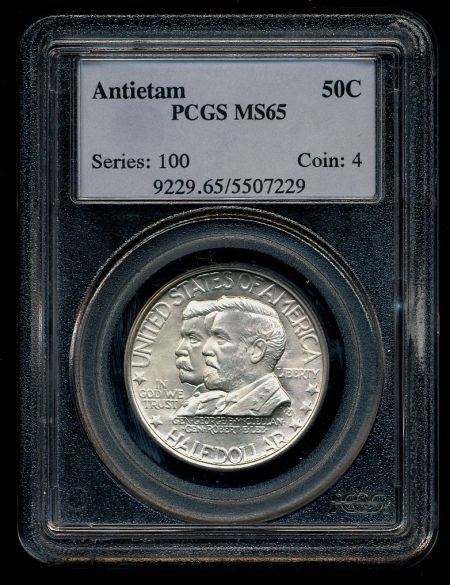
For other of my posts about commemorative coins and medals, including more Antietam half dollar stories, see:
Commems Collection.










 Posted 09/23/2025 06:38 am