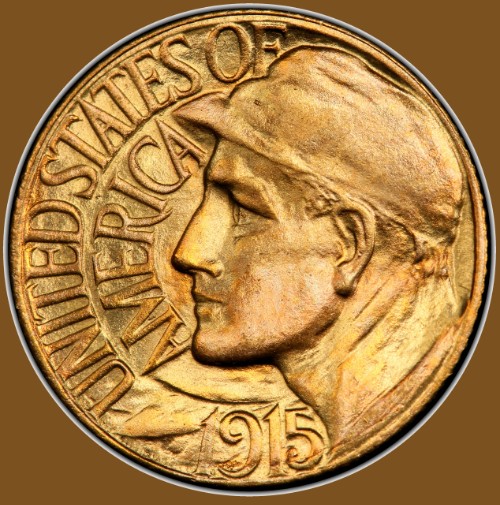
I've previously discussed the "Labor" design of the 1915 Panama-Pacific International Exposition ("Pan-Pac") Gold Dollar, (see:
1915 Panama-Pacific International Exposition Gold Dollar - Labor), but wanted to return to the topic after I read an uncredited editorial published in the
The Evening Herald of Fall River, Massachusetts on June 12, 1915 - I thought some might find it interesting.
Here it is in its entirety:
INADEQUATE MEMORIAL
It is proposed to issue a coin bearing the image of the face of a laborer in commemoration of the Panama Pacific exposition. The coin is to be a special gold dollar. The issue will be limited to 25,000. The idea is to recognize the part played by labor in building the Panama canal, the connecting link between the two oceans.The sentiment is worthy of public recognition, whether by the issue of a new coin or by other token. But the recognition should be adequate and should be as practical as as has been the part of the nation's development or the development of any undertaking that labor represents.
In the first place, a $1 gold coin is not a serviceable coin. The value of the metal in it, if it is kept in any high degree of purity, would make it necessary to mint a money piece too small for convenient use. The gold dollars were were little short of being a nuisance. They were not easily handled, they were easily lost and at present they would fill no real need in the currency plan. For these reasons they are not practical as a memorial to labor, which itself is intensely practical.
In the second place an issue of 25,000 would be inadequate for such memorial. It would not go into general circulation, to be a constant reminder of the object for which it was issued. The issue would speedily be gobbled up by collectors of coins, who would be able eventually to reap a snug profit out of it. The gold dollars would soon command a premium and would never get far in general circulation for that reason.
The cause of labor would would have little reason to feel honored by such dilettante issue of gold coin of the realm. as stated, if a money issue is to be devised for the purpose of recognizing the work which labor has done in in this country, where nearly everybody's hard work, including the heavily burdened capitalists, it should be a sturdy issue in form and dimensions for common use in the everyday traffic in which the workingmen, as well as other people, engage. It should not be represented by a coin so small that it would need to be tied in the corner of a handkerchief to escape being lost from one's pocket."[
Note: The separation of the original piece into paragraphs was my doing; I did it to support easier reading. The original piece was printed as one long paragraph.IMO, the author of the piece did not understand the collector-focused purpose of the Pan-Pac commemorative piece - it was never intended to be a circulation coin. So, complaining about the coin's limited mintage seems needless and off base. ICYWW: The Pan-Pac gold dollar had a net mintage of 15,000 (out of an authorized limit of 25,000) with ~10,000 being returned to the Mint to be melted. Apparently, those pesky collectors didn't "gobble up" quite as many of the coins as the author of the editorial assumed they would. To be fair, the coin's 2X face value selling price might have dampened demand for the coin.
As background, the specifications for classic-era US gold dollars - including the Pan-Pac Gold Dollar - were:
- Composition: 90% gold, 10% copper
- Total Weight: 1.672 grams
- Net Gold Weight: 1.5048 grams (0.04838 ounces)
With an official US spot price of gold set at $20.67 per ounce during the classic era of the coins, the standard specifications result in a Gold Dollar with an intrinsic value of $1.0000 - i.e., a match of intrinsic and face value. (0.04838 * $20.67 = $1.0000)
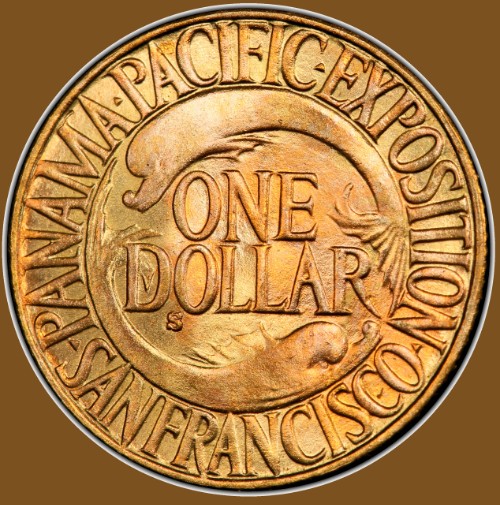
The 1915 Pan-Pac Gold Dollar is my favorite classic-era commemorative gold dollar. Do I think the design would have also worked on a larger diameter coin? Absolutely. I believe Charles Keck's design would have worked easily as well on the program's Gold Quarter Eagle. That said, I don't believe that "American Labor" was slighted by the use of the Gold Dollar to commemorate its efforts. IMO, the dollar's strong design sets it apart regardless of its potential practical issues.
For other of my posts about commemorative coins and medals, including more about the Pan-Pac coin program, see:
Commems Collection









 Posted 12/01/2025 12:37 pm


 Uncirculated American Silver Eagles


