This is a 25-year old story, but one that remains an interesting facet of the modern United States ("US") commemorative coin program that continues to have relevance today.In June 2001, the US Mint released the 2001 American Buffalo Silver Dollar. The design (closely based on the 1913
James Earle Fraser design for the Indian Head/"Buffalo" five-cent piece) was not copy protected. (Today, the Mint has several rules for the use of its designs in place - they are not all automatically in the public domain as with coin/medal designs issued prior to March 1989.) As a result of the lack of copyright, many private mints/marketing companies reproduced the designs on a variety of numismatic medals, bullion pieces and tokens. (The popular design continues to be used today!)
Within weeks, the National Collector's Mint ("NCM") was advertising its version of the "Silver Buffalo" piece. The NCM is a coin and collectibles marketing company that has grown over the years and expanded its product offerings beyond its original limited offerings - it still operates today.
The problem with NCM in 2001, was that its "Silver Buffalo" was deceptively advertised to give the impression that it was a genuine US Government issue, which, of course, it was not. For example, the headline of the advertisement shown below touts "NEW 2001 U.S. GOV'T SILVER BUFFALO DOLLAR" It is quite clear that the headline, coupled with the Washington, DC dateline, was intended to falsely establish a link between the NCM product and the US Government.
2001 National Collector's Mint "Silver Buffalo" Advertisement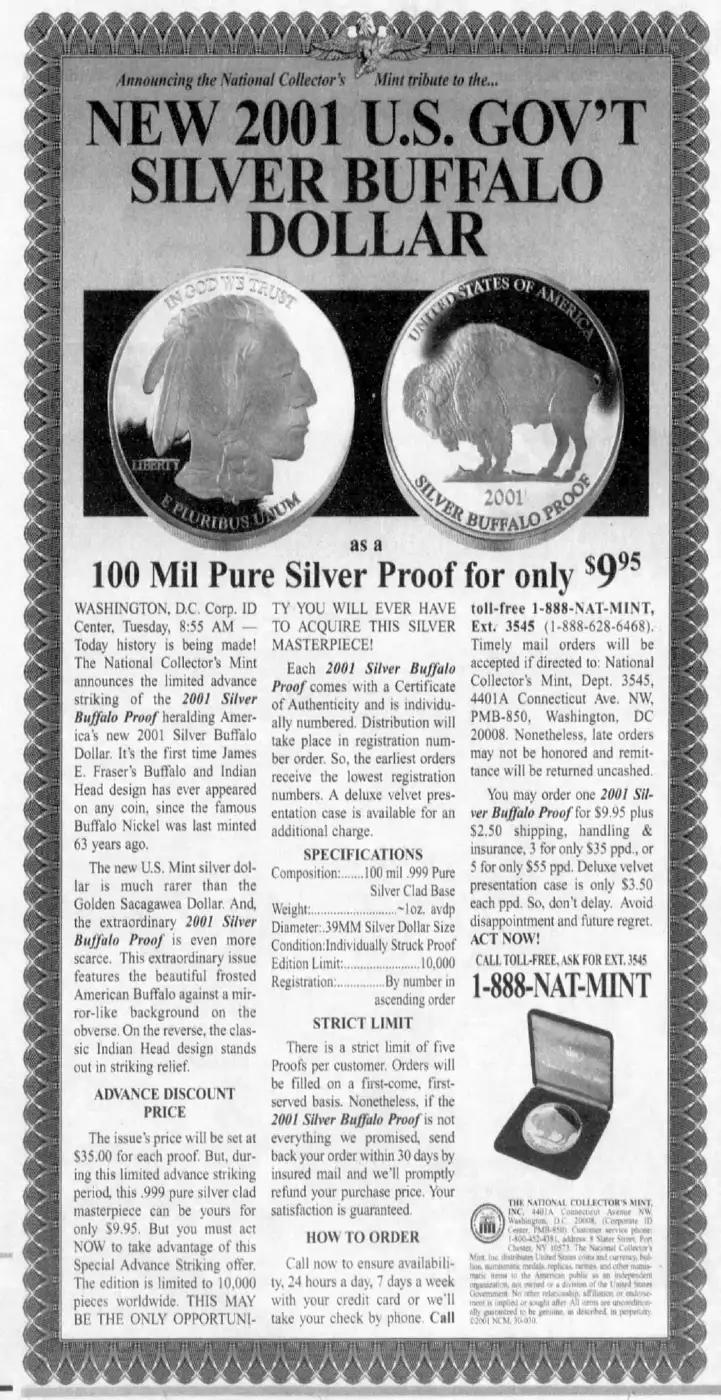 (Image Credit: National Collectors Mint, various oublications. 2001.)
Enough people purchased the NCM "Silver Buffalo" thinking that it was actually an official, lower-priced US Mint product, that the Mint was compelled to issue public warnings about the pieces and how they were
not US Mint products - individual customer responses were deemed inadequate.
Note: Due to the design's public domain status, the NCM was not the only private firm to create collectibles with the "Buffalo" design in 2001, but it was the most visible and pervasive of the marketers.The Mint did not sue the NCM in 2001, preferring instead to pursue its "educate the public" initiative vs. legal action.
The educational effort highlighted the fact that the NCM medals did not carry a denomination as did genuine
US coins, that most NCM pieces were silver-plated vs. 90% solid silver (though some were one-ounce of solid 0.999 fine silver) and that the NCM replica lacked the artist's initial "F" (indicating
James Earle Fraser as the design's creator). On the "plus" side, the NCM pieces were inscribed "COPY" as per the Hobby Protection Act of 1973 - an inscription not found on genuine coins.
Note: The coin illustrating the advertisement above did not include the "COPY" inscription - another bit of intentional potential deception?.
IMO, the US Mint's immediate sales success with its American Buffalo Silver Dollar afforded it more leeway to pursue options other than legal action against NCM. Its education-focused approach was aided by the fact that the Mint's Silver Dollar proved very popular with collectors and sold out its authorization of 500,000 coins in just 15 days (June 7, 2001 - June 21, 2001). The Mint did not have to compete against the NCM for an extended period (late Summer, Fall and early Winter).
2001 National Collector's Mint "America United Silver Eagle" Advertisement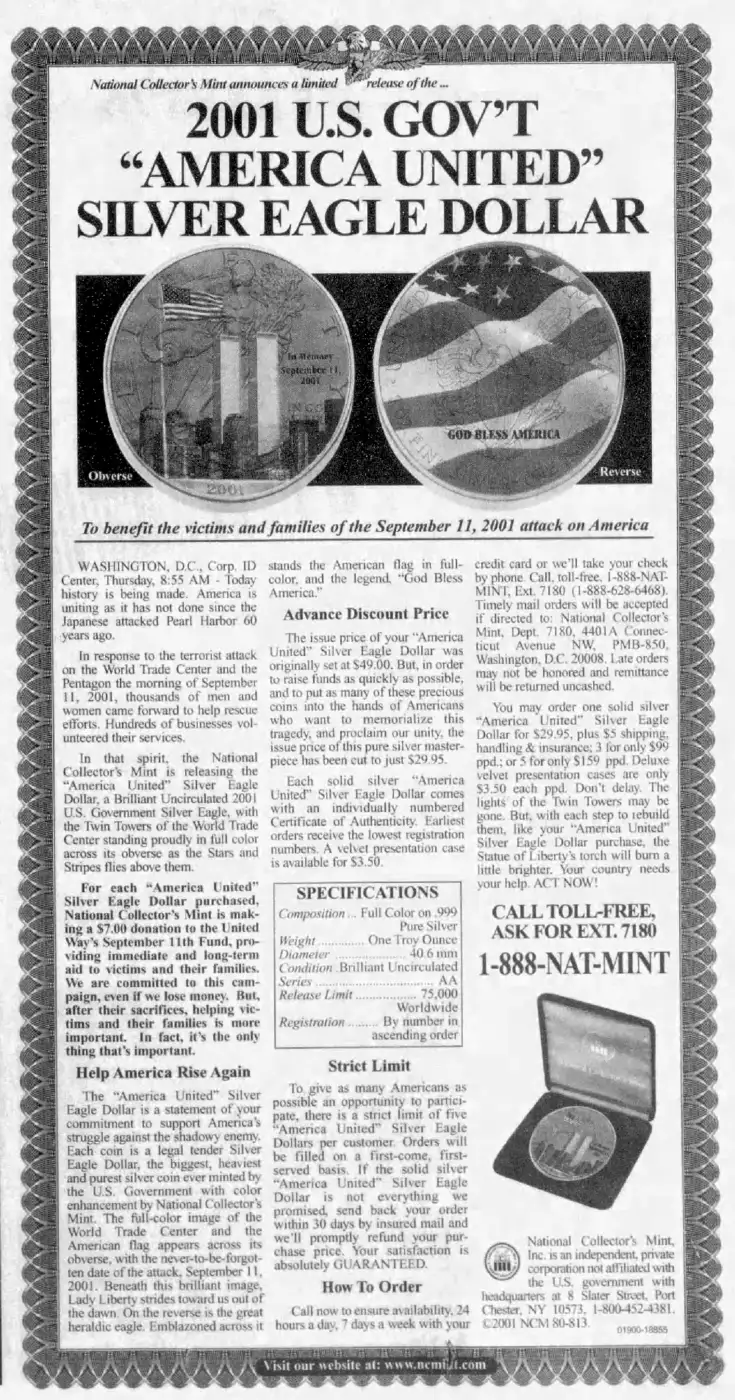 (Image Credit: National Collectors Mint, various publications. 2001.)
At The same time, however, the NCM was marketing several World Trade Center ("WTC") pieces as "official" products (which they weren't) which caused the Federal Trade Commission ("FTC") to engage and sue NCM for deceptive marketing and for misleading customers. Originally sued for $22 million, NCM eventually settled for $750,000 and an agreement by which it would change its marketing to make it clear that its WTC products were private-sponsored collectibles vs. official government products.
That's a quick summary of the NCM vs. US Mint story of circa 2001. There's more to the story, of course, but I believe I've hit the high points. I encourage those who want to learn more details to use their favorite search tools to explore the topic further.
For other of my posts about commemorative coins and medals, including more modern US commemorative coin stories, see:
Commems Collection 








 Posted 02/21/2026 4:49 pm


 Uncirculated American Silver Eagles


