The Act that authorized the 1992 Christopher Columbus commemorative coin program, provided for the coins to be issued from January 1, 1992 through June 30, 1993 - 18 months vs. one calendar year.
The program included a Gold Half Eagle, a Silver Dollar and a Copper-Nickel ("CuNi") Clad Half Dollar.
Gold Half EagleThe obverse of the Gold Half Eagle presents a left-facing profile of Christopher Columbus (at right) looking upon the "New World" (at left). The elements are in the center, encircled by the anniversary dates "1492" and "1992" and the mandated inscriptions of LIBERTY (at top) and "IN GOD WE TRUST" (at bottom).
It was created and sculpted by US Mint Medallic Artist Thomas J. Ferrell.
The coin's reverse design presents "the crest of the Admiral of the Oceans, an honor that was bestowed upon Columbus, and a map overlapping the western Old World with the date 1492." (US Mint web site)
The design and sculpt was the work of US Mint Medallic Artist
Thomas D. Rogers.
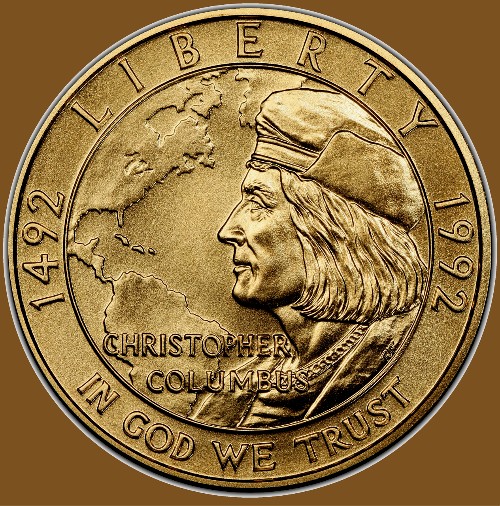
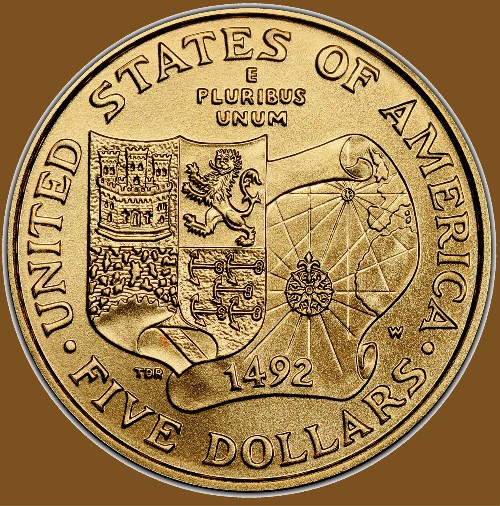
The final overall mintage for the Gold Half Eagle was 104,059 units (79,730 Proof; 24,329 Uncirculated) - ~21% of the authorized 500,000 coin limit.
Silver DollarThe Silver Dollar depicts a standing Christopher Columbus, holding a pole with a waving banner attached at its top in his right hand and a scroll (symbolic of a contemporary navigational chart) in his left. Just behind Columbus is a globe on a pedestal. In the background, are seen three sailing ships that are symbolic of the
Nina, Pinta and
Santa Maria - the three ships of Columbus' 1492 voyage.
The design was the work of US Mint Medallic Artist
John Mercanti (a then-future US Mint Chief Engraver); he also sculpted the design.
Depicted on the coin's reverse is a 'split-view' design with a sailing
Santa Maria shown on the left and the US Space Shuttle on the right. The Earth and a star are seen in the sky in the background at right.
The design was created and sculpted by US Mint Medallic Artist
Thomas D. Rogers.
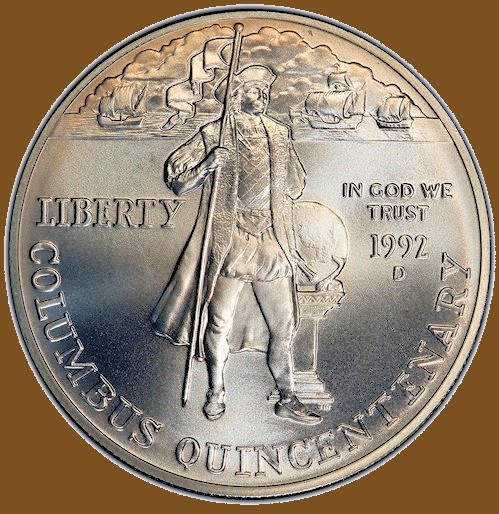
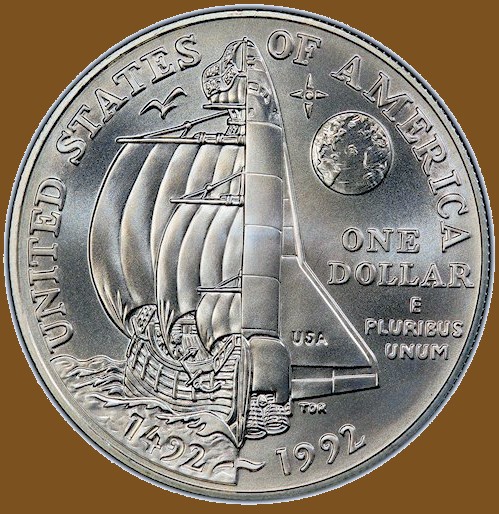
The final overall mintage for the Silver Dollar was 492,190 units (385,241 Proof; 106,949 Uncirculated) - ~12% of the authorized 4 million coin limit.
Clad Half DollarThe obverse design of the Half Dollar depicts Christopher Columbus coming ashore in the New World. His arms are close to his sides with upturned palms - this symbolizes Columbus' openness to what the New World offered. In the background, to Columbus' right, is depicted a small boat from which some of his crew are exiting. Over Columbus' left shoulder (viewer's right) is seen one of his ships at anchor.
The reverse design of the Half Dollar features Columbus' three ships at sea under full sail.
The obverse and reverse designs were created and sculpted by US Mint Medallic Artist Thomas J. Ferrell.
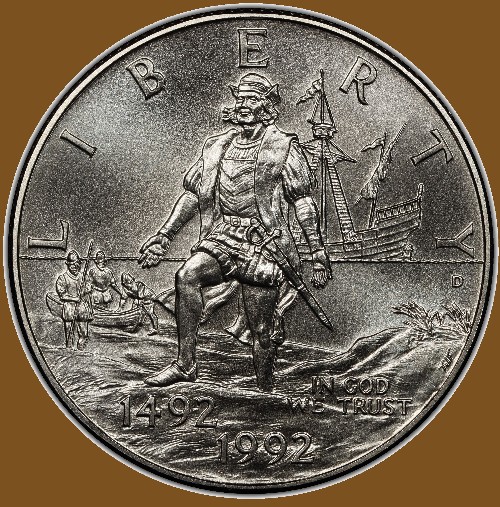
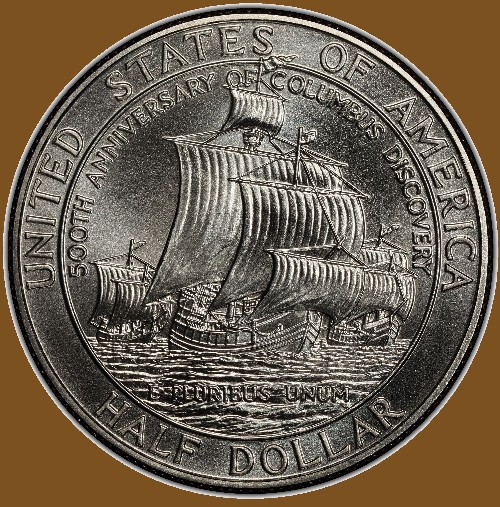
The final overall mintage for the Clad Half Dollar was 525,856 units (390,154 Proof; 135,702 Uncirculated) - ~8.8% of the authorized 6 million coin limit.
The Columbus coins were available individually, in two-piece sets (Silver Dollar and Clad Half Dollar), three-piece sets (one of each denomination) and six-piece sets (complete Proof and Uncirculated collections).
One packaging option that was not offered was a 1992 Christopher Columbus Young Collectors' Set ("YC Set"). It had the potential to be a better initial YC Set vs. either the 1993 World War II or 1993 James Madison/Bill of Rights Sets. Maybe the Mint hadn't thought about such sets in time for the 1992 Columbus coin program?
The coin program's disappointing sales totals generated ~$7.61 million in surcharges for the Fellowship Fund - just ~14.8% of its $51.5 million potential.
For my collection, I purchased the three-piece Uncirculated Set.
To learn about a pair of coin bills that overlapped the time frame of the legislation that authorized the Christopher Columbus coin program, see:
-
1992 Christopher Columbus Quincentenary - EndcapFor other of my posts about commemorative coins and medals, including other Columbus Quincentenary stories, see:
Commems Collection









 Posted Today 1H 47M ago


