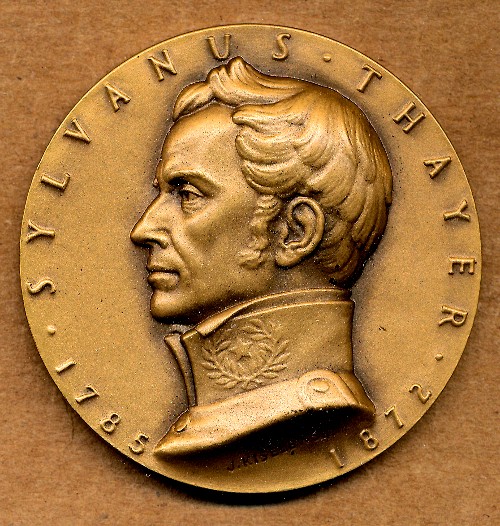
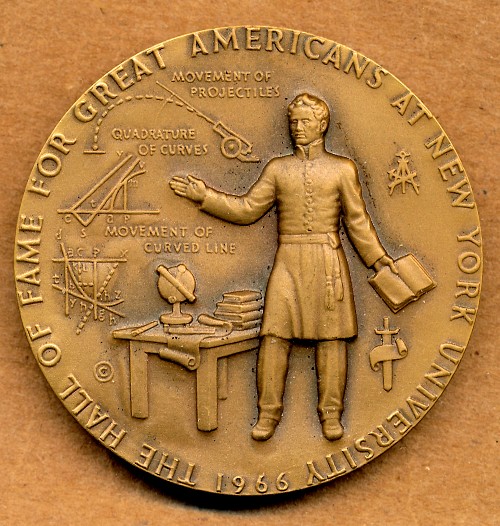
In June 1958, during the Second Session of the 85th Congress, Katharine Price Collier St. George (R-NY) introduced a bill in the United States ("US") House of Representatives ("House") that called for "the coinage of 50-cent pieces in commemoration of the one hundred and fiftieth anniversary of the graduation from the United States Military Academy of Sylvanus Thayer."
Sylvanus Thayer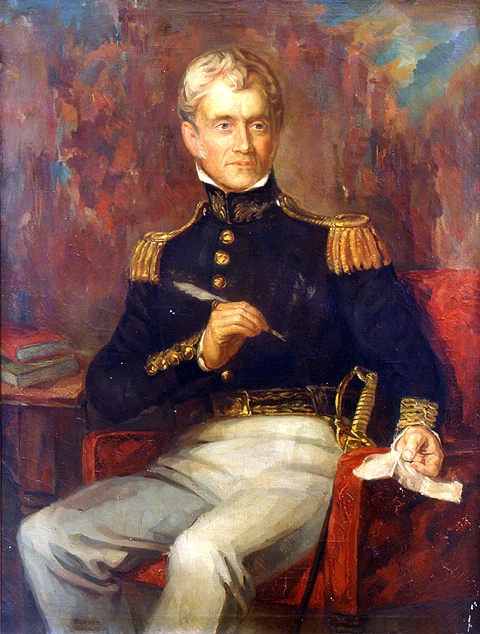 (Image Credit: Robert Walter Weir, Public Domain, via Wikimedia Commons.)
Sylvanus Thayer was born on June 9, 1785 in Braintree, Massachusetts.
Sylvanus Thayer Birthplace, Braintree, MA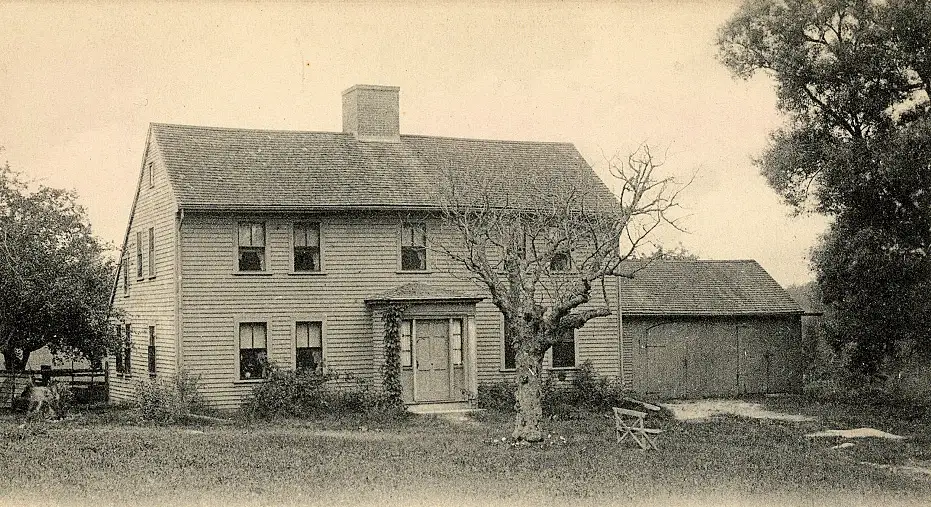 (Image Credit: Library of Congress, Prints and Photographs Division. Public Domain/)
Thayer attended Dartmouth College between 1803 and 1807; he graduated as his class valedictorian. He followed his time at Dartmouth with attendance at the US Military Academy (at West Point), attending from March 1807 until his graduation on February 23, 1808 - upon his graduation he was commissioned as a 1st Lieutenant.
Thayer was an Assistant Professor of Mathematics from 1809 to 1811 at West Point. He left the Academy to serve as an engineering officer during the War of 1812. During the War, Thayer served as a Chief Engineer in the northern campaigns (at Niagara and Lake Champlain) and then was transferred to Norfolk, Virginia to improve the city's fortifications. Driven by his engineering successes, Thayer attained the rank of Captain, and later the honorary rank of Brevet Major.
After the War of 1812, Thayer went to Europe to study military education approaches. He returned to the Academy in 1817 and served as its Superintendent until 1833; he was a Lieutenant Colonel when appointed Superintendent by US President James Monroe.
Note: Later in his career, Thayer was awarded the rank of Brevet (Honorary) Colonel (1833) and Colonel (Regular) in the Corps of Engineers in 1863; he also was awarded the rank of Brevet Brigadier General (1863, the day before he retired) for his lifelong service and accomplishments. Thayer retired from the Army on June 1, 1863.Thayer is known/remembered for his leadership regarding the reshaping of the Academy's academic curriculum such that it became a leading academic institution with strong engineering studies. He also emphasized/established strict standards of discipline, honor and duty among all at the Academy.
Note: Thayer also founded the Thayer School of Engineering at Dartmouth College in 1867 via a donation of $70,000.His leadership and initiatives as West Point's Superintendent earned him the monikers: "Father of West Point", "Father of the Military Academy" and "Father of Technology."
He died in Braintree, MA on September 7, 1872 at the age of 87.
Representative St. George's bill sought 100,000 silver 50-cent pieces of standard
US coinage specifications with designs to be determined by the Director of the US Mint in conjunction with the US Secretary of the Treasury. The bill did state one specific design element, however, it mandated that the coin was to present Thayer - "in an appropriate manner" - as the "Father of Technology."
The coin was to bear the date "1958" regardless of when struck; the legislation sought to ensure the coin marked the 150th Anniversary of Thayer's West Point graduation (he graduated in 1808).
The bill was referred to the House Committee on Banking and Currency; it did not proceed out of Committee.
Representative St. George tried again in January 1959, during the First Session of the 86th Congress, but her re-introduced Thayer coin bill met with the same fate as her previous bill: it stalled in the House Committee on Banking and Currency.
There would be no Sylvanus Thayer commemorative half dollar.
Note: The 1959 bill retained the previous provision that required the coins to bear the date "1958" regardless of when struck. If the bill had been approved, a bit of 'back dating' would have taken place at the Mint to comply with the direction of Congress.If you'd like to learn much more about Sylvanus Thayer, check out a biography about him at:
-
Sylvanus Thayer BiographyFor other of my posts about commemorative coins and medals, including other What If? stories, see:
Commems Collection







 Posted Today 8H 1M ago