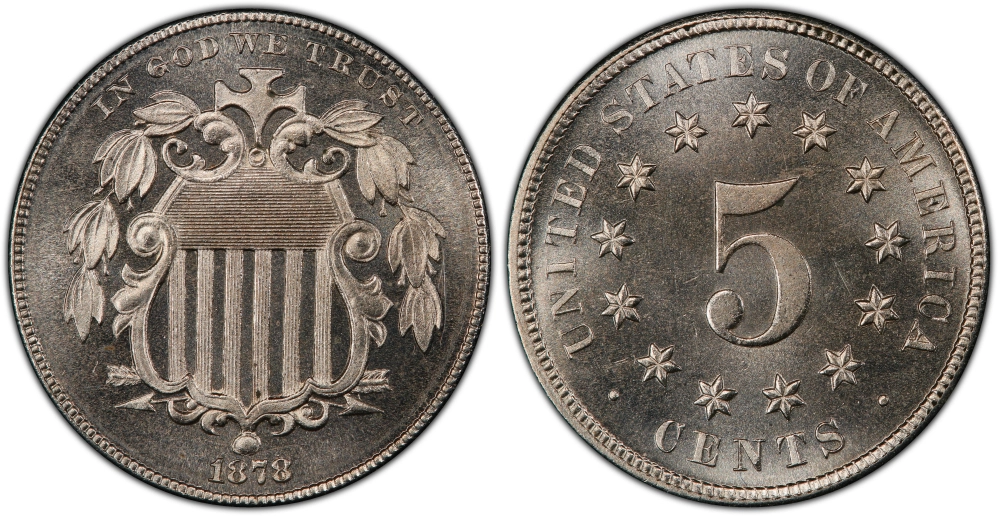
This reflected a battle between rich industrialists in the late 1800's. East Coast industrialist Joseph Wharton lobbied Congress for decades to be able to sell his nickel production out of his mines in New Jersey to the U.S. Mint. He finally succeeded in 1857 with the introduction of the 88% copper/12% nickel small cents into maistream coin production. This came about as silver was scarce and hoarded before and during the Civil War. White copper-nickel coinage was introduced in 1866.
Things began to change in 1859 when Henry Comstock was credited for a broad set of silver and gold discoveries near Virginia City, NV, leading to a series of silver and gold rushes. This eventually led to statehood for Nevada. The Comstock Lode was largest silver discovery in North America. By the 1870s, silver went from scarce to so abundant that it crashed the global price of the metal. Comstock yielded 192 million pure ounces of silver and 8.3 million ounces of gold. This was the source for the hundreds of millions of Trade and
Morgan silver dollars produced in the latter part of the 19th century.
The proposal for a 5 cent silver coin pitted Wharton, an Eastern nickel industrialist who also was a founder of Bethlehem Steel and the Wharton Business School at the University of Pennsylvania against the Western silver mining interests that were both lobbying the Mint for purchases of their metals.
In the end, silver was so abundant here from the 1870s to the end of the century that silver interests were more keen to have large $ cartwheel and half $ production for their silver than the minor coinage that would require vastly smaller amounts. Wharton eventually lost the economic fight, retaining small 5c coinage production, while the western silver interest won the bulk of the economic fight at the Mint, dominating the lion's share of coinage production.
As an endnote, the Comstock gold strikes, at 8.3 million ounces, were almost as large as the 12 million ounces produced during the earlier California gold rush and much larger than the 1.25 million ounces produces during the Yukon gold rush in Alaska at the end of the 19th century.
IN NECESSARIIS UNITAS - IN DUBIIS LIBERTAS - IN OMNIBUS CARITAS
THE MAN IN THE ARENA, Theodore Roosevelt at the Sorbonne Paris on April 23, 1910: "
It is not the critic who counts; not the man who points out how the strong man stumbles or where the doer of deeds could have done better. The credit belongs to the man who is actually in the arena, whose face is marred by dust and sweat and blood, who strives valiantly, who errs and comes up short again and again, because there is no effort without error or shortcoming, but who knows the great enthusiasms, the great devotions, who spends himself in a worthy cause; who, at the best, knows, in the end, the triumph of high achievement, and who, at the worst, if he fails, at least he fails while daring greatly, so that his place shall never be with those cold and timid souls who knew neither victory nor defeat."
My coin website:
https://fairfaxcoins.com






 Replies: 5 / Views: 100




 Posted Yesterday 3:43 pm


