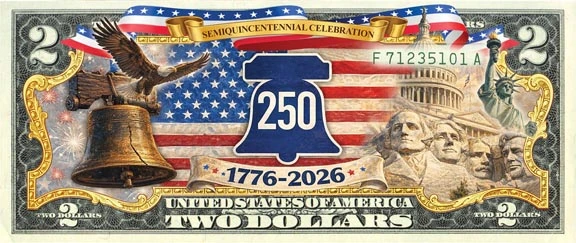
Worldwide, banknote commemoratives aren't as commonly encountered as commemorative coins. But there have been commemorative US notes in the past - the most recent and obvious being the 1976 $2 note, with its bicentennial theme. It was somewhat of a "quiet" commemorative, in that it wasn't loud and proud about it's commemorative status and functions perfectly well as a "normal $2 note design".
And I think that's the point. The BEP is, first and foremost, a money-making organization, in that most literal sense. Making things that people actually use as money is their main job. Keeping that money secure and trustworthy as "the world's reserve currency" is also part of that job. So there is that sense that everything they make has to be part of that currency system.
The BEP is of course no stranger to issuing a plethora of commemorative items - up until 2005 it was also their job to print US postage stamps, of which commemorative issues form a major component of the total issue. They are also aware that plenty of countries have in recent decades issued commemorative banknotes, both for circulation and for NCLT.
It is that "NCLT" part that seems to be their main deterrent in following the same path as some other countries, and the same path as the US Mint, in producing lots of items specifically made for collectors to be sold at a premium to those collectors and never intended to be actually used as money. NCLT collector items require special printing presses, special rooms, special staff dedicated to their production and sale. This seems to be... all too much trouble to operate for them.
They are prepared to produce "special collector items", such as uncut notes they've been doing for several decades now - but these are in essence just regular banknotes that have had slightly abnormal treatment prior to retail packaging and sale, so it's not too much extra effort for them, a distraction from their prime directive.
Ultimately, I think the issue is that banknote design and production in the US is essentially in the hands of the bankers - and the bankers just want to print money, without all the hassle of dealing with those weird "collectors" who think that this one $10 banknote is somehow more interesting and valuable than this other $10 banknote.
For another example of "the bankers don't like commemorative money", just look at Europe. With the euro, the national governments of the member-states control the coinage design, but the banknote design is controlled by the European Central Bank. And with the euro, we find many and varied commemoratives in each country's coinage series, but the banknotes are somewhat bland and uniform, with even the distinguishing mark of the country of origin hidden in the serial number prefix. The bankers in the ECB refuse to allow the member-state governments to issue any commemorative banknotes.
Don't say "infinitely" when you mean "very"; otherwise, you'll have no word left when you want to talk about something really infinite. - C. S. Lewis






 Replies: 5 / Views: 127


 Posted Today 3H 28M ago





 to the CCF, ljs_piper!