Quote:
If memory serves correctly, anything that you can move around with a toothpick tip is considered crud, not patina.
I do think it's worth asking—is there anything that can be wiped off with a wooden toothpick that isn't considered crud?No - as a general rule, corrosion can't be removed with a toothpick, or with mild solvents. And what we call "patina" or "toning" is really just mild corrosion. If you scrub vigorously enough with the toothpick you'll start to wear away at patina, but I'm going to assume that "vigorous scrubbing" with anything isn't on your options list to start with, at least for a coin you're aiming to keep for your own collection.
Quote:
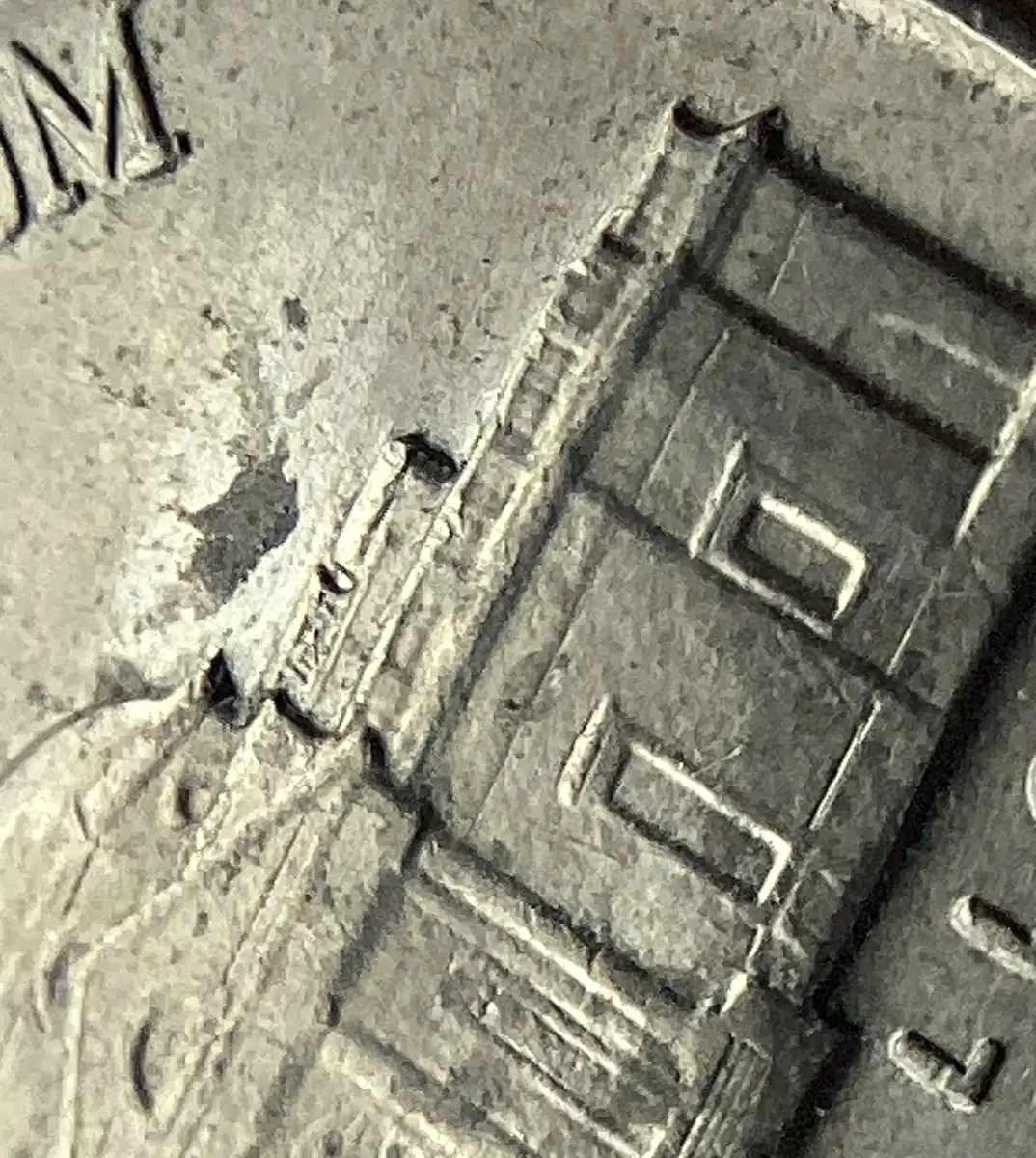
What is this stuff, and how do I properly clean it off the coin?
Unfortunately, we cannot definitively answer the second part of the question properly without knowing the answer to the first part, and the answer to the first part is going to remain a mystery since we do not have a full record of the coin's history and also assuming you aren't going to be sending the coin off to a chemical analysis lab for months for the thousands of dollars worth of lab tests you'd need to run to identify the gloop. Such tests are irrelevant because we don't really need to know exactly what it is - we just want to remove it. "Trial and error" is all we have to go by, which is why the polarity ladder of solvents is helpful - it gives a good order of solvents to attempt.
All sorts of "stuff" can get stuck to coins. Sticky glue-like things, such as actual glue, stickytape residue and PVC goo, are among the most commonly encountered, which is why "Acetone as your first option" often works. But there's all kinds of things out there that can stick to and/or stain coins - spilled foodstuffs, greases of all kinds, tree resin, half-decomposed rubber bands, melted candle wax... anything out there that's moderately gluggy can in theory stick to a coin.
Note that in terms of "crud vs patina", it's not necessarily an either/or situation. It could be both: the gloop could be high in sulfur, or otherwise contain substances that react chemically with the coin's surface, causing corrosion. Or the reverse can take place: a blob of goo lands on a coin and stays there while the coin continues to circulate and oxidize, with the goo protecting the patch of coin underneath the goo from corrosion, so removing the goo creates a "hole" in the patina later.
Don't say "infinitely" when you mean "very"; otherwise, you'll have no word left when you want to talk about something really infinite. - C. S. Lewis




 Replies: 9 / Views: 220




 Posted Yesterday 6:04 pm





