| Author |
 Replies: 34 / Views: 28,915 Replies: 34 / Views: 28,915 |
|
Valued Member
United Kingdom
129 Posts |
I've noticed a re-occuring problem of fake Chinese banknotes being sold by dealers and others, and especially in on-line auctions. Some at least, of these people I think genuinely dont know that these notes are fake. There is an auction about to end on ebay which so far has 11 bids and has reached nearly $30, for a fake note that I've seen around for years (photo below)  I should add some points as to why it is easily identified as a fake once you know what to look for: The note is supposed to be of the early 1940s however the Chiang Kai-Shek portrait didn't appear on any currency until 1948 (some issues dated 1945 didnt enter circulation until 1948). The appearance of the large arabic/western '10' on the front; there are few examples (Hong Kong & Japanese military) of such appearing on the front of a Chinese note - and even then not as boldly. The back of the note has the vignette of a ship which has been copied from an early issue of the Peoples Bank of China, and, I dont remember ever having seen the words 'dollars' and 'yuan' used together on any note. The text which ends with the words 'defece tick' is actually trying to say 'defence ticket' or 'military currency'. The note also bares the typical style of serial numbers common to such fantasies and forgeries. Edited by xavierz27
06/18/2012 08:56 am
|
|
|
|
Valued Member
 United Kingdom
129 Posts |
Some more examples of fake (fantasy) notes which seem to sell: This supposed Central Bank note is an adaptation of the $50 1945 note - there was no $500 for this series. The fake printed on planchettes (dots) appear in grey, and the notes has the typical 'fake' serial numbers.  For this note; a genuine example would for a start be spelt as Hainan not 'Hei Nan'. The positioning and sizing of the Chinese characters for the amount is incompetant, as is the positioning of the vignette of the bridge on the back which is copied from Central Bank of China issues of 1948-49. The signatures are of Central Bank officials and there is no such printer as the 'Printing Mill of Hong Kong'.  This one pupports to be an issue of the communist Bank of Chinan. No such note exists - it employs a reversed image of the Summer Palace at Beijing, taken from Hopei Provincial Bank notes, and the usual 'fake' serials.  Edited by xavierz27
06/18/2012 09:11 am
|
|
Valued Member
United Kingdom
129 Posts |
An example of a forgery of a genuine note: Bank of China 10 Yuan of 1934. Appears convincing at a glance but closer inspection reveals the 'flat' dot matrix printing, the dull, flat serial numbers which on genuine notes should nearly always be overprinted, and in this case, the lack of watermark. This is not however usually detectable in an online photo ( ebay) etc. Two things to look out for are a dull sheen to the printing of the note which can come across in photos, and quirks - such as the silk threads which abruptly stop far short of the edge of the note (in this case the upper edge). Photos: The note plus enlargements showing the dot matrix printing, and the cut off 'silk threads'.   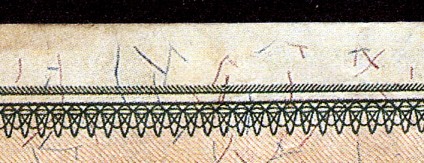 |
|
Valued Member
United Kingdom
129 Posts |
There is also a problem of altered notes, usually with added overprints: For example: some Central Bank of China 1923 $1 notes come with a GENUINE circular Swatow branch stamp with accompanying characters for the place name on the front, and 'Swatow' in English on the back. However these overprints, (usually without the Chinese place name on the front) have started appearing on such as the orange 1936 1 Yuan of the Central Bank (shown below), the De La Rue red 500 Yuan of 1944, and the 10 and 20 cents notes of 1940. These last two are especially ridiculous as Swatow had fallen to the Japanese in 1939. The whole purpose of course is to add value and interest to otherwise commonplace notes.  Edited by xavierz27
06/18/2012 08:35 am
|
|
Valued Member
United Kingdom
129 Posts |
Last for now: some examples of things to look out for (all from common fantasies and fakes, usually from online auctions). Some notes (American Banknote Company printed in particular) contain small planchettes or circles of coloured paper within the body of the note as a security feature. If they appear printed, or at least very strongly within the design, and in dark colours - the note is a fake (see image below). 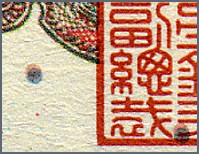 If there is any unusual colour distortions or bleeding the note is either a fake, or in some cases the distortion is the result of a harsh, incompetant cleaning process. Photo of a bled and distorted fake:  A third tell sign is the serial number - even if the number has been overprinted as it (usually) should be, this is no guarantee as most fantasies and forgeries make the effort to at least go this far. One way of telling is the font. At present most fakes carry serial numbers in this style: 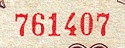 Lastly - a fantasy note which demonstrates why research of elements within notes, helps. The overall look of the note is wrong, it is clearly too modern though it pretends to be a vintage provincial issue. It serves as a good example because of the vignette - the picture of the pagoda on the front. This is the famous Yellow Crane tower in Wuhan. This was commonly featured on the notes of the Hupeh Provincial Bank - however - the pagoda depicted on these original notes had actually burnt down in the 19th century, and its meagre replacement was destroyed in the Cultural Revolution. In the 1980-90s, the Chinese rebuilt the pagoda based upon the burnt 'original' however, they built it taller and in a different location. This fake note shows the new, current pagoda, not the original!  Edited by xavierz27
06/18/2012 08:39 am
|
|
Valued Member
United Kingdom
129 Posts |
Another crop of fantasy-fakes: Supposedly a 25,000 customs gold units - these scarce horizontal notes only came as a 100 and 500. Amazingly I've seen these sell - despite the flawed reverse which says 'twenty five thousand' but is numbered as 250,000!  The Fu-Tien Bank - one of several related and very common fantasy-fakes. Seen in the 'flesh' these notes are not up to the printing standards of such as the American Banknote Company (true of most of the these forgeries). That aside, the reverse vignette is copied from a Central Bank of China issue of 1948, 100 Yuan (P 406), showing the pagoda and lake of Wei ming Hu Yan yuan jianzhu, near Beijing. Usual serials and false printed grey-black planchettes.  Some type of purported military note with a reversed portrait of Chiang taken from Central Bank issues and the Summer Palace vignette taken from the Hopei Bank notes. Plus - I have only once ever seen blue seals on a Chinese note.  Edited by xavierz27
06/18/2012 10:11 am
|
|
Pillar of the Community
United States
747 Posts |
Excellent post. Do you have one of the 5,000,000 cgu notes also?
|
|
Valued Member
United Kingdom
129 Posts |
Thank you!
I havent got a 5,000000 cgu or even a decent image of it to post here. Do you have one?
There's more images of other 'dodgy' notes to come. New ones seem to appear all the time, and the really worrying notes are more difficult to deal with - there seems to be alot of, sometimes excellent forgeries of early Peoples Bank of China notes. And there are some funny ones (probably not so funny for anyone who's been taken in by them!).
I tend to be naturally suspicious so didn't fall for too many fake notes when I started collecting. I was taken in (sort of) early on by what seemed to be a late 1930s communist issue, which had been artificially aged and circulated, though I had doubts. Looking at it now, it's funny. The vignette used on the front was copied from the back of the ABNC Central Bank 1 Yuan of 1945... There's also been a few slips ups when I havent been paying attention well enough!
|
|
Valued Member
United States
484 Posts |
Thanks for posting this important information for us Xavierz27! It's a shame that we have to be so vigilant, but your information helps to better understand the notes as well.
|
|
Valued Member
United Kingdom
129 Posts |
Thanks Dave.
I'll try and expand on this topic periodically. I should be posting some more examples shortly.
|
|
Valued Member
United Kingdom
129 Posts |
Some examples of fake Peoples Bank of China notes, a commercial note and a 'fantasy' provincial note: Sold as a Peoples Bank of China 1949 5 Yuan. Has fake staining. The most obvious clue as to its false nature (other than the seller listings including many obvious fantasies as genuine notes), is the faked wear to the surface. Look carefully and you'll see traces of horizontal and vertical scratches which are a misguided attempt to make the note appear circulated.  Pei Yang Tientsin Bank - flawed faked ageing and an overall appearance of not being quite right - the colours are too weak for what should be a quality printed note, and this comes across even via a photograph. This note is a popular subject for fakers and frauds!  Another example of a supposedly early Peoples Bank of China note. Looks more convincing as has not been overstained and appears to be off-centre. However it has the tell-tale faked scratch marks. (And is from the same dealer as first example)  Sold as a "1927 China Hubei Provincial Farmers Bank 2 Yuan". A nonsense note which borrows the main part of the back vignette from a 5 Yuan of the Central Bank of China of 1941 (P 235), showing hilltop pagoda and temple nr Chungking (Chongqing).  |
|
Pillar of the Community
United States
747 Posts |
I don't have the fake 5,000,000 cgu note. It is based on the 1930 100cgu note in that it is the large format and red. They used to appear quite often on ebay but I have not seen them of late. |
|
Valued Member
United Kingdom
129 Posts |
I bet one or more of that fake CGU will appear again eventually.
The note that I started this thread with I first noticed five years ago. There seemed to be a lot and then nothing for ages - I thought someone had seen sense and abandoned producing it, but it seems to have recently made a comeback. There seems to be a growing interest in Chinese notes - noticeably amongst the Chinese themselves, and new collectors are easy prey!
|
|
Pillar of the Community
Thailand
1509 Posts |
Thank you xavier for sharing your expertise in this field.
I'm quite surprised that I don't get offered more old Chinese notes here in Thailand but I now have a greater appreciation on what to look for.
|
|
Valued Member
United Kingdom
129 Posts |
Thanks thai-vic - glad to be of some help.
The problem of fake notes has been bothering me for sometime so I decided I had to try and do something. About to add some more images and observations.
|
|
Valued Member
United Kingdom
129 Posts |
Hunting around for useful images of the fakes and fantasies I stumbled across this photo on Flickr. There was no explanation of exactly what this is but the photo was taken at the Mausoleum of President and 'would be' Emperor Yuan Shikai. From the context of the other photos it seems to have been taken in the site museum and shows a heap of Chinese banknotes. The brown Central Bank note with the tatty edge and possibly the green CGU may be genuine and if so are the ONLY genuine notes in that photo. The rest are either blatant fantasies or fakes. Are they being passed off as 'old' notes for display to tourists who they think wont know any better, has the museum itself been conned, or are these being offered for sale as souvenirs?  |
| |
Replies: 34 / Views: 28,915 |










 Posted 06/17/2012 5:35 pm


