| Author |
 Replies: 38 / Views: 3,381 Replies: 38 / Views: 3,381 |
|
|
|
Valued Member
United States
240 Posts |
I think you should take the money and buy a Sear catalog and or the appropriate Sayles book. Go on Wildwinds.com and look around. Then decide what you want to get into.
Invest in the books, and you will be able to invest with confidence.
If you decide to stop, you can sell the books for nearly what you paid for them and any coins you bought will have been purchased with knowledge. They will be easier to recoup your money with than coins that you overpaid for.
|
|
Pillar of the Community
3352 Posts |
Thomcollects => I agree with you ... I followed that strategy when I first started hunting ancients ...
=> I bought:
David Sear's Roman Coins and Their Values (Volumes I-IV) => kinda like "The Red-Book, for Ancients"
ERIC II (amazingly beautiful, but expensive book ... but maybe my favourite reference book)
The Twelve Caesars (an absolutely awesome read ... a reference for the emperors, not the coins)
=> I regularly use all of them (NOTE => along with the countless "free" internet aids)
... I also meant to buy the Greek version of David Sear's book, but haven't done that, yet ...
=> I look at the ref-books as much as I look at my coins ...
EDIT => I just ordered David Sear's "Greek Coins and Their Values" (Volume I & II)
Edited by stevex6
08/07/2012 10:05 pm
|
|
Pillar of the Community
United States
1549 Posts |
I suspect you might like this one:  When Vesuvius erupted, Titus issued a series to appease the gods including this one for Neptune who controlled things like earthquakes and volcanos. My example was in the name of his little brother Domitian who continued the series after Titus died but you can get the same coin in Titus as well. Finding one this nice for 100 pounds might be a stretch but it never hurts to shop around. The ultimate Pompeii coin would be one of the gold aurei found at Boscoreale near Vesuvius. Gold does not tarnish but the extreme gasses made these aurei a distinctive reddish color. Most are in the museums (check the BM) but there are some in private hands that get auctioned every ten years or so. Under $20,000 would be cheap. Edited by dougsmit
08/08/2012 10:53 pm
|
|
Pillar of the Community
United States
2044 Posts |
I can't see the image you just posted.
|
|
Pillar of the Community
3352 Posts |
Hi dougsmit => hey, I too cannot see the coin-photo that you are describing? (but I'm assuming that it has Neptune and a volcano on it ... can you please try and post the photo again, for it sounds awesome!!)
thanks
|
|
Pillar of the Community
 United Kingdom
2624 Posts |
I can't see it either. As for buying books maybe you are right, I have a Spinks book which lists Roman British coins but I will need some reference for Greek coins for sure at some stage. As for recouping money on coins I paid too much for though...my first point would be I don't sell any item that I buy and my second point is I am not looking to pay too much for any item (I don't just buy the first thing I see I have a good look first and compare prices and conditions and try and buy the most attractive I can for the least possible) One question though... I saw a nice silver Drachm from Alexander the great for not much money... it looked very clean, a little worn but details are fine, its £8 with a day left to run in auction. It has a large indent on both sides which the seller describes as bankers test marks (for purity of silver) do those detract much value? (I dont think they are unattractive and its a nice story...not sure how the ancient people used to test their metals) Photo stolen from ebay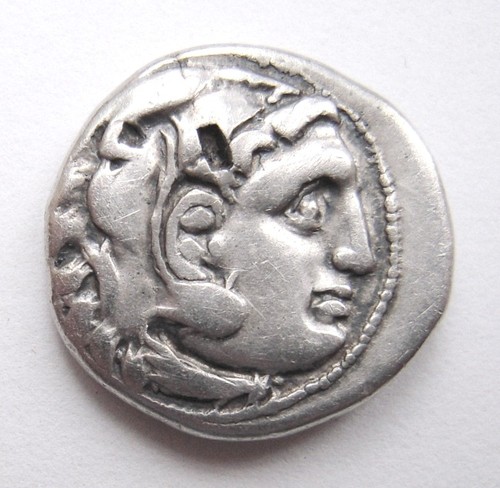 What would a coin like that be expected to fetch with and without such marks? Edited by DavidUK
08/08/2012 7:57 pm
|
|
Pillar of the Community
United States
4253 Posts |
If the price stays the same, it's a great deal. Almost too good. But I doubt it will remain so low. Some collectors actually look for coins with banker's marks. Many marks are identifiable making them collectible. In the case of your coin, I don't think it detracts from the overall appearance. I recently purchased a drachm of Alexander III (the Great), but I purchased from a reputable dealer. I'm very pleased with the coin. It is only 17mm, but weighs in at 4.2g. The reverse will tell you where it was minted. Here is the image of mine and I don't mind telling you I paid substantially higher than 8GBP: 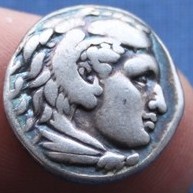 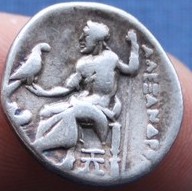 |
|
Pillar of the Community
United Kingdom
2624 Posts |
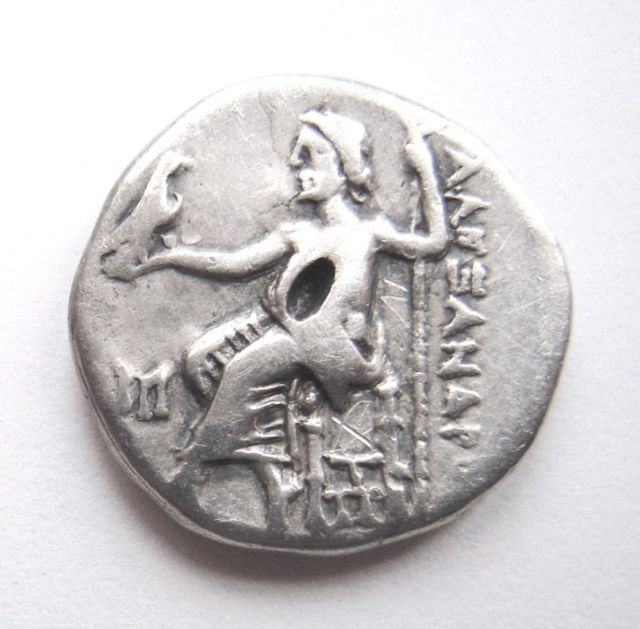 Thats the reverse...very similar and it is listed as Alexander the Great. Glad to hear those bankers marks don't detract... maybe I will have a bid on this one. I think it will shoot up but maybe I will wait till the last minute and stick in a bid, what do you suggest should be my max bid? |
|
Pillar of the Community
United States
5155 Posts |
|
|
Pillar of the Community
United States
4253 Posts |
That all depends on you and your budget, but even 50 GBP would be a good price for this coin. If you want to get a good idea on the value of such coins, look on Vcoins and serach for Alexandria III drachm, or go to acsearch.info and search the same there. I am no Greek coin expert and have only recently dabbled in them. I prefer Roman coins because I understand the legends and the Roman minting, whereas Greek coinage was issued by city in a haphazard way to me. I know the Greek collectors here would argue with me on this last point. Greek coins are beautiful though and they have rich histories. Good luck on this coin and keep us informed on what happens.
|
|
Pillar of the Community
United States
5155 Posts |
JW - No. No. your right, but "hap-hazard" would be an understatement.
In the "Greek" world very little is uniform. The use of different devices, legends, written dates (calenders and use of letters as numbers)and interpretations of Gods and/ or divine animals seems limitless and ever changing. You will often see a level of artistic talent rarely seen in later coinage.
|
|
Pillar of the Community
United States
4253 Posts |
I think I have found the attribution to the Alexandria III coin. If I am right (big ?), it would be Price 1531: Alexander III AR Drachm. Abydus Mint 310-301 B.C. Head of Herakles right in lion skin / ALEXANDROU, Zeus enthroned left with eagle & sceptre; monograms left & beneath throne. Take a look at this link: http://www.wildwinds.com/coins/gree...ice_1531.jpg Anoob: I know you are right, but I just can't get my head wrapped around the Greek system. Just finding the above attribution took me way too much time. |
|
Pillar of the Community
United States
5155 Posts |
For those looking to dip there toes. I dont think it matters if your a your a modern collector looking at ancients as a new sphere, or a Roman collector looking at Greeks or if your a Greek collector trying to figure out what your looking at. II recommend this far more inexpensive book approx 16 USD.
The Official Whitman Guidebook
Handbook of Ancient Greek and Roman Coins.
By Zander H. Klawans
It gives a good brief overview of ancient coins, as well as how to read the Roman Legends, really nice book. Its not like a catalog or Corpus of coins but a good overview of whats out there and the different types and styles. A must have.
|
|
Pillar of the Community
3352 Posts |
|
|
Pillar of the Community
3352 Posts |
dougsmit => thanks for reposting => that's a very cool Neptune dolphin-coin ...  |
| |
Replies: 38 / Views: 3,381 |








 First Page


 Posted 08/07/2012 9:55 pm


