| Author |
 Replies: 5,134 / Views: 386,252 Replies: 5,134 / Views: 386,252 |
|
|
|
Pillar of the Community
United States
1328 Posts |
Quote:
1949 Brass Threepence I like these coins. Many of the ones I see have spots, but this one's really nice |
|
Pillar of the Community
4628 Posts |
Meanwhile I could become a grading expert with this addition, not a coin per se (The silver crown is a book weight to stop the cover bouncing up) 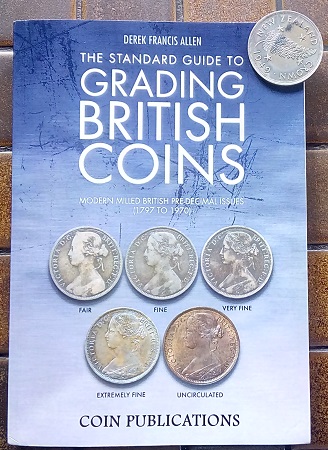 It's a British photograde I only knew of a few months ago. You can't buy them here or on local bookseller sites so I had to buy it DIRECT from the UK and glad I did, it's superb showing photos of the coins in grades from EF down to Fair and occasional extra ones of UNC/AU and Poor for some coins. Yes its a bit cheap looking and only covers coins from the Cartwheel onwards, but I think its very helpful and at the price, belongs in every collection! Does anyone else have this book? It sums up my grading guesses on my 1829 Halfcrown, well above the Fine example, but truly below the VF and in the gFine to aVF area. The 1949 Threepence, is definitely a full EF to gEF one (They don't have AU, basically EF, gEF and then UNC/BU). If it was UNC it would be no light wear on flower hole things. Edited by Princetane
09/18/2021 12:54 am
|
|
Pillar of the Community
United Kingdom
700 Posts |
@ Prince. Yes you are correct in the grade as the Book on British Grading interprets. I have the book also. But it seems redundant with CGS or LCGS as they are now taking over grading of British coins. Everything has shifted almost 2 grades. I myself disagree with their grading standard and for all their supporters who say they are consistent. All I can say is they are when they want to be and they are overly critical on the grading. Perhaps it is to fit the respective grades of GF GVF AEF NEF etc in to their unfathomable 100 point system that swaps between 2 points to 3 points for any given grade and when 97-98-99-100 all = MS70 equivalent you know somethings not right lol.
|
|
Pillar of the Community
4628 Posts |
I have never heard of this 100 point grading scale, please elaborate (On another part of the site, if this discussion is a wee bit irrelevant to the thread).
Sounds silly though and I for one won't use it. Yes that book is definitely not for the people with extremely high grade MS examples of British coins, but more for us who realistically collect circulated coins.
|
|
Pillar of the Community
United States
1077 Posts |
Quote:
Princetane wrote:
Daltonista - don't you think you are grading a bit harsh on Otto's halfcrown, it is at least gVF.
To respond briefly, I could have added, "...but if I were buying it in New York, I would expect it to be graded at EF." Perhaps I'm a prisoner of my specialties, but -- aside from ebay, where I can ignore the seller's ideas about grade -- virtually all my acquisitions for the last 35 years or so have been early 19th-century British copper and silver tokens*, and virtually all my sources are either UK dealers and auction houses, or if not located in the UK, they apply British grading standards. Those are typified in this summary I scanned from one of my old Seaby catalogs years ago and have saved on all my external hard drives ever since. 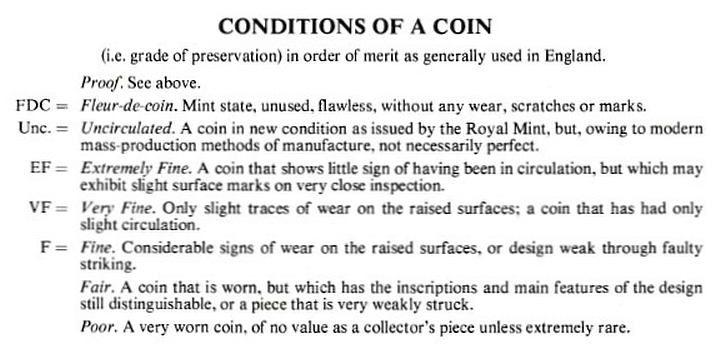 * Collectors of which, for the most part, have no use for TPG's nor for MS numbering systems. I could share a few stories about helping Heritage fix some of their auction listings that simply parroted flagrantly incorrect NGC and PCGS attributions and grades."If everything seems to be under control, you're just not going fast enough."
--- Mario Andretti
|
|
Pillar of the Community
United Kingdom
700 Posts |
@ Prince here it is in a nutshell 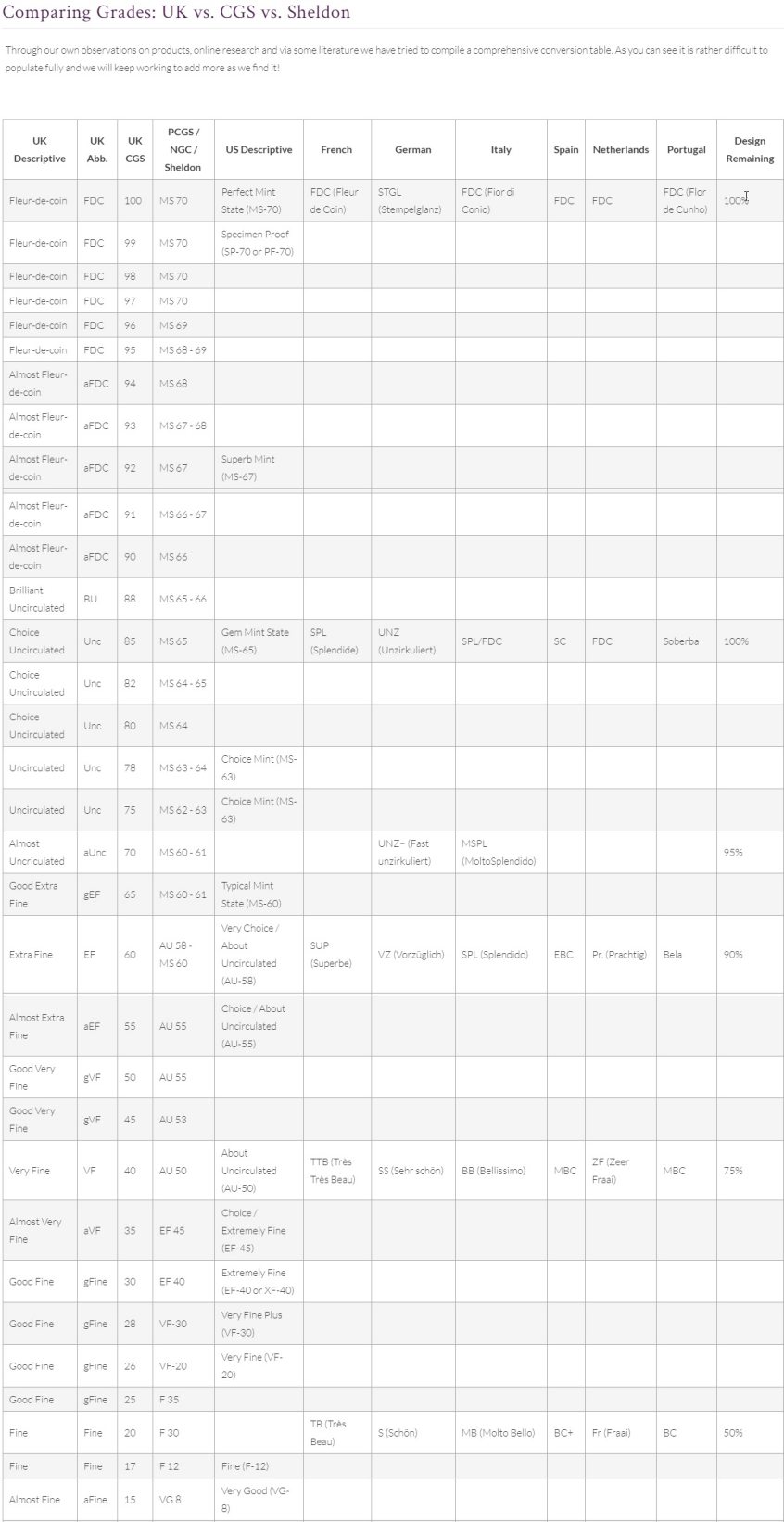 |
|
Pillar of the Community
4628 Posts |
Oh okay, interesting and silly. But thanks for posting. I don't think it will catch on outside the slabbing community.
They should be making it easier not harder and more difficult - entirely another American concept forced on to us. I think I will stick to my UNC,AU,EF,VF,Fine,VG,Good (Or Fair if you are British British).
Thanks for showing though. I have some more shillings arriving this week, a couple are pretty nice.
|
|
Pillar of the Community
United Kingdom
700 Posts |
If we are fortunate or have trodden in something a day may come when something a little bit special may land unexpectedly in our laps. Today for me is that day. I acquired a rather unassuming 1861 Bronze Penny. On further study I became aware that it was no ordinary 1861 penny. The coin in the picture is as described a Gouby BP1861E 4+F dies F+f with top leaf on obverse. This particular variety is extremely if not excessively rare and much rarer than the R17 rating given. Gouby states as of 2017 June only 2 recorded examples were known to exist. The Gouby BP1861EA variety with the top leaf missing alos extremely rare has 8 known examples known. A real heavy weight in the Victorian Bronze penny die pairings. 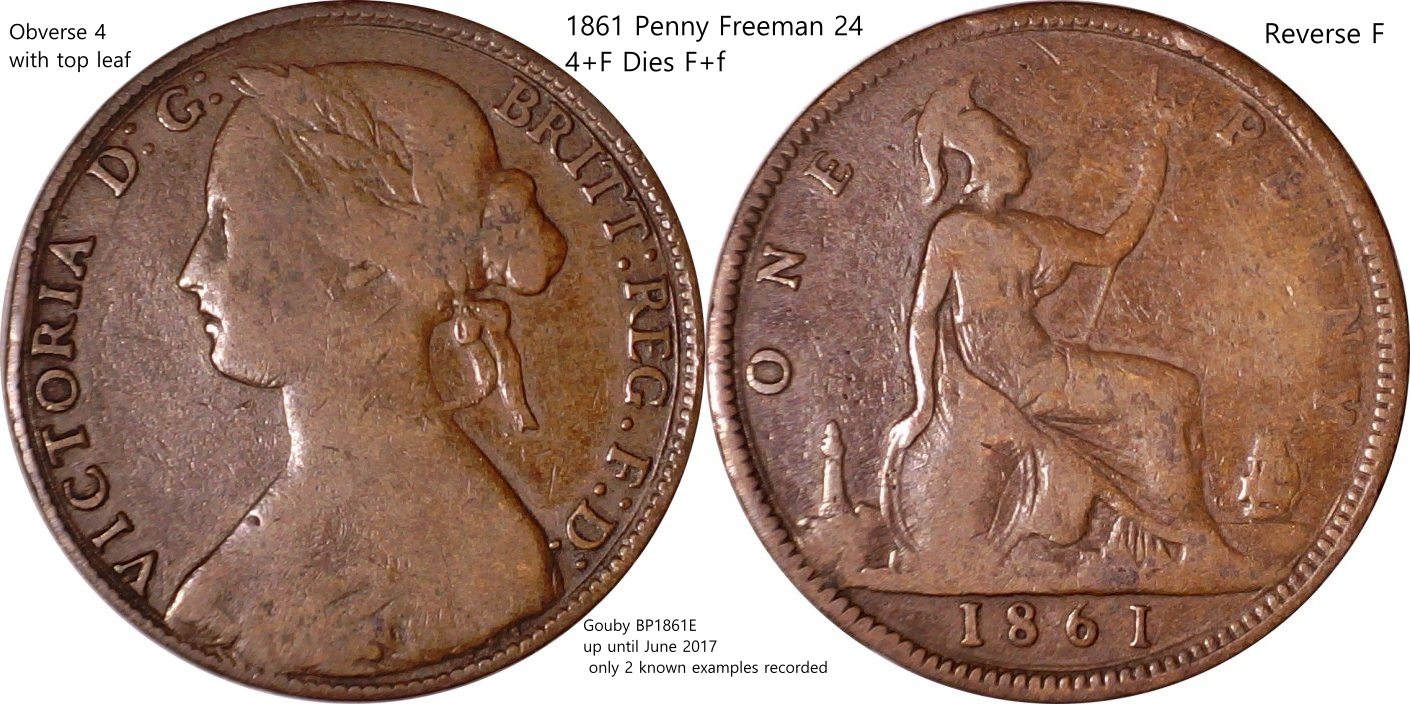 |
|
Moderator
 United States
195559 Posts |
Outstanding!  |
|
Pillar of the Community
United States
1077 Posts |
Not to belabor the topic several of us have discusssed over the last week, but rather to further illustrate the generally perceived disparities between US and UK grading, here are a three snaps from the latest tokens list (received yesterday) issued by one of my best and favorite UK sources.  That's certainly one way to handle it! "If everything seems to be under control, you're just not going fast enough."
--- Mario Andretti
|
|
Pillar of the Community
4628 Posts |
Looks like that catalogue was a bit ambitious with the grades. My new book has a scale which goes
UK Grade = US grade
Fair = Good4
Almost Fine = VG8
Fine = Fine12
goodFine = VF20
Very Fine = VF30
good Very Fine = XF 40 - 45
Extremely Fine = AU 50
Good EF = MS60
About Uncirculated = MS 61/62
BU/UNC = MS 63/64
Choice UNC = MS65/66
Superb UNC = MS 67 - 69
FDC (Fleur De coin) = MS70
BU = Brilliant UNC - used on copper and bronze coins
UNC = Uncirculated - used on Silver, gold, cupronickel and brass and/or steel coins (Any muck metal that is not brown).
|
|
Pillar of the Community
4628 Posts |
I bought some more shillings, mostly George VI to fill the gaps and cheaply (Most are gFine to gVF and a few more worn early 20th century ones). 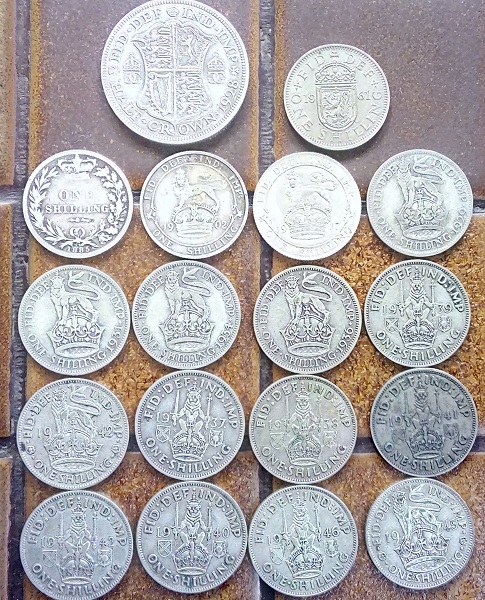 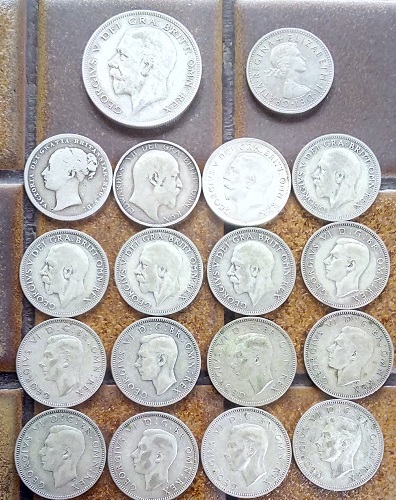 Dates - 1885 (VG), 1902 (Fine+), 1917 (EF), 1929, 1931 almost Fine, 1934 and 1936 Fine, 1937 - 1942 Scotland, 1946 Scotland and 1942 and 1945 England, 1961 Scotland (Semi key, almost EF), plus 1928 Halfcrown upgrade. 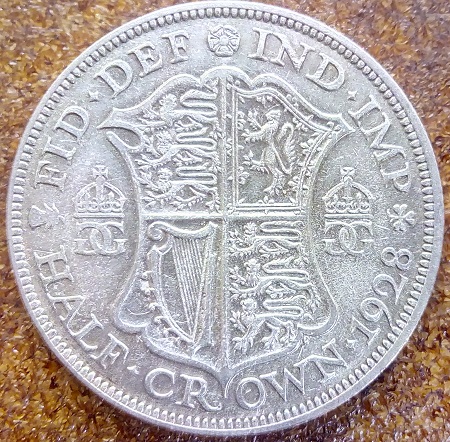 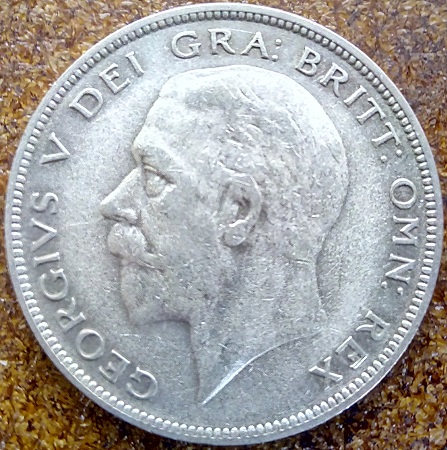 1928 Halfcrown - bare VF, but cheap to me and an upgrade on a nasty VG one. |
|
Pillar of the Community
4628 Posts |
Close up of that nice 1917 Shilling for you. Sadly its so fresh it nearly burnt the flash out of my camera, but I can assure you it has almost no wear at all. 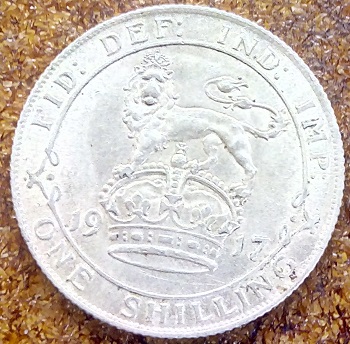 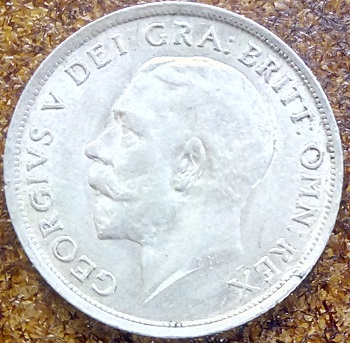 And the 1885 and 1902 Shillings, the 1902 is a decent little coin in itself. 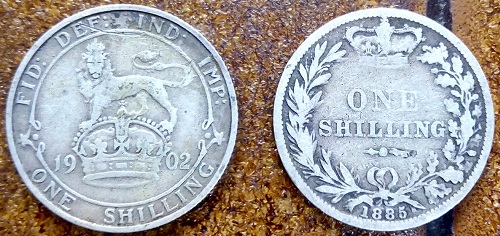 For a giggle I had mother and son face each other (Although it may have been better with old bat Victoria!) 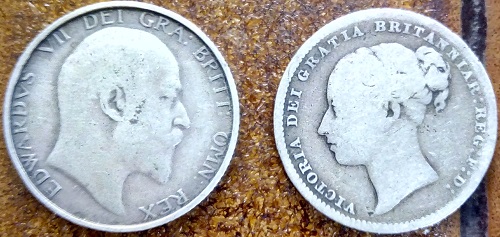 The general condition was average, but all these coins after 1917 were cheap, like $4 or $5 each and that is including the $3.20 - $3.30 of silver in each coin. I know that generally you can get 1937 onwards for peanuts except 1959 Scotland, but finding EF/UNC shillings of that era is not easy here as by that stage we had our own shillings, and what came here was mostly in the pockets of the £10 Poms! Edited by Princetane
09/24/2021 08:01 am
|
|
Pillar of the Community
Australia
9808 Posts |
Quote:
£10 Poms! You talking about me. :) Actually my parents paid 10 pounds, kids were free. Nice coins Princetane. |
|
Pillar of the Community
4628 Posts |
And for a few bob extra, you could have come to New Zealand!
By that stage, inflation crept in. You only needed to commit some petty crime to get a free one way trip to Australia between 1787 and 1868 (7 to 21 years of forced labour had to be paid on arrival and no right of return).
Then later if you had some useful skill, you were eligible for an assisted passage in steerage, you got a free or heavily subsidised (£1 a head etc) if you would provide some useful trade or service in Aus or NZ.
Of course if you were rich, a few handfuls of gold sovereigns would get you a nice cabin, however you better have a Plan B in the colony, it was no place for rich wastrels until well in the 1860s.
But seriously, your parents may have had some change on them and many of those coins they would find, were not really usable in Australia, hence they likely disappeared into a coin collectors pocket.
Edited by Princetane
09/24/2021 08:09 am
|
| |
Replies: 5,134 / Views: 386,252 |








 First Page
 Previous Page


 Posted 09/18/2021 12:51 am


