Coin Community Family of Web Sites Join Thousands of Coin, Bullion, & Money Collectors
Royal Estate Auctions - $1 Coin AuctionsVancouvers #1 Coin and Paper Money Dealer Join Thousands of Coin, Bullion, & Money Collectors Royal Canadian Mint products, Canadian, Polish, American, and world coins and banknotes. Coin, Banknote and Medal Collectors's Online Mall 300,000 items to help build your collection! Specializing in Modern Numismatics


Username:
Password:
Save Password
Forgot your Password?


This page may contain links that result in small commissions to keep this free site up and running.

Welcome Guest! Registering and/or logging in will remove the anchor (bottom) ads. It's Free!

1844 Uruguay Peso Fuerte

To participate in the forum you must log in or register.
Author Previous TopicReplies: 26 / Views: 5,135Next Topic
Page: of 2
New Member
United States
38 Posts
 Posted 03/23/2015  11:02 pm  Show Profile   Bookmark this reply Add Carlos J to your friends list Get a Link to this Reply
Read my link. The actual mintage was 1,226 pieces. Current known specimens is ca. 250. That is much higher survival ratio than usual. Mint records are known and have been for quite some time. The numismatist is a rather poor source for information related to the Latin American series.
Pillar of the Community
swamperbob's Avatar
United States
5362 Posts
 Posted 03/23/2015  11:29 pm  Show Profile   Bookmark this reply Add swamperbob to your friends list Get a Link to this Reply
I read the text that accompanied the sale of that particular coin as well as several others. It is nice sale copy but appears to be written in a very self serving manner to get the highest possible amount for the coin.

I also know how many times counterfeits have been encapsulated as genuine and have then been sold at prestigious auctions. I never believe all that I read unless it makes scientific and LOGICAL sense and has an historical documentary context.

Did you read my summation of the historical facts about coin collecting and the re-coining operations of the mid-1800s mints? Do you dispute the facts of the era? Do you have any supportive data other than add copy? There are too many open issues with the appearance of the dies used for me to adopt your position without significant historical support from the period between 1844 and 1900.

Where are the dies or examples of the coin that appeared in the Numismatist or do you dismiss that as a fantasy?
New Member
United States
38 Posts
 Posted 03/24/2015  08:05 am  Show Profile   Bookmark this reply Add Carlos J to your friends list Get a Link to this Reply
I don't want to get into a pointless argument. Just two things.
- what I am saying is that a new theory based on an article from the 1911 Numismatist, regarding a well know issue for which historical data including mintage records has been already published is fantasy. what can be true for another given issue in the 1844-1900 era does not apply in this case. Extrapolating one given scenario to a probable occurrence in another case is just a logical mistake.
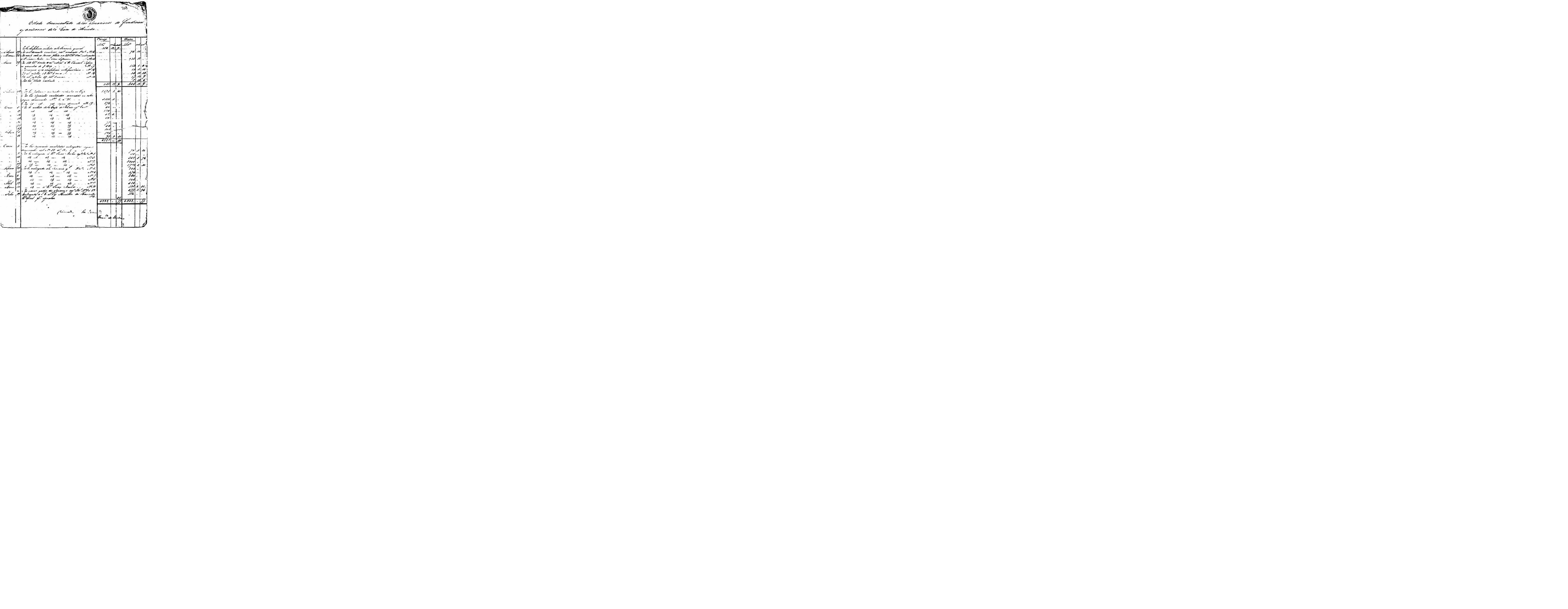
- As I said, historical mintage figures exist. I know and corresponded with Hugo Mancebo, who found the mintage records. Here is a copy of the mint report for the Peso coinage.


1844-Uruguay-Peso-Fuerte
- the mintage is of 1226 pieces totalling 1471 (spanish) pesos 1 Real and 60 Centesimos. Perhaps the latter figure is the origin of the mistaken figure of 1500 pesos you are using.
- Andres Lamas was the man in charge of the minting of these coins. The mintage record document is conserved in his papers, now housed in a public archive in Buenos Aires. His specimen, currently housed in a Uruguayan collection comes from the same pair of dies as the Heritage coin.
- If I had to choose between a serious research based on actual mintage records of the time, and well pedigreed coins or a small article from the 1911 Numismatist that gives no serious references and contains serious mistakes, I think I would choose the former. If you choose the latter, that is your, also respectable, choice.

P.S: I agree that the third party grading companies sometimes make mistakes, and I never take their opinion for granted either.
Pillar of the Community
swamperbob's Avatar
United States
5362 Posts
 Posted 03/25/2015  7:03 pm  Show Profile   Bookmark this reply Add swamperbob to your friends list Get a Link to this Reply
Carlos J You say:

Quote:

I don't want to get into a pointless argument. Just two things.
- what I am saying is that a new theory based on an article from the 1911 Numismatist, regarding a well know issue for which historical data including mintage records has been already published is fantasy. what can be true for another given issue in the 1844-1900 era does not apply in this case. Extrapolating one given scenario to a probable occurrence in another case is just a logical mistake.


I agree a pointless argument is of no value but the points you then raise are simply incorrect.

First - I began questioning the issue because Krause and Heritage did not match the Numismatist and Fonrobert (1875). There is a discrepancy between the two sources. I am merely pointing out that discrepancy and trying to get a factual answer to resolve it. I know the question has been out there for some time and my research has NOT disclosed a definitive published response. In fact the issue is still being questioned on such "common" sources as Wikipedia among others.

So I do not see my inquiry as a "fantasy" at all just good scientific method being employed.

As to the "well known published source of the history" I have not been able to locate one. Please provide the book(s), page(s) etc. This may indeed be the answer if it is a well known credible source. I would definitely want to get a copy for my reference library.

When someone like myself runs into a discrepancy like this - in particular were there are multiple die varieties involved - I tend to research the question for myself. I have now discovered that the auction sources record coins from TWO die states. The dies survived in use long enough to require recutting of several letters. These letters have split serifs they are not caused by Strike Doubling or double striking. The other coins DO NOT have this feature. This indicates, at least to me, that it was likely struck over a longer period than just a couple days.

I still have not located another picture of the Fonrobert entry of 1875. That leaves that discrepancy OPEN. It will only be resolved when a higher quality picture is discovered. That one photo makes it appear that two dies as well as multiple die states may actually exist. The photo can not be dismissed as a fantasy.

The page displayed from the Andres Lamas collection was not clear enough to allow enlargement or to allow me to read it. I would like to get a better source for this letter too as well as any other pertinent documents.

My research also disclosed a couple interesting things. Lamas was police chief and the mint operated under his administration and was initially located in the police station. Lamas is quoted in some sources as handing two examples of the coin to officials including Suarez the President, at a meeting. The copy given to the President is believed to reside in the National collection at least according to some sources. There is no mention of who made the dies for the peso in that record.

The actual earliest dies were made by a Frenchman named Austin Jouve who also minted the early coppers under a government contract. The contract dated to December 13, 1843 and it called for several denomination coins including the Peso. Jouve started work coining on May 8, 1844 according to one source but other sources indicate the pesos were made in February, 1844. Supply of materials (copper) prevented Jouve from completing the order for coins - he made too few - only $500 out of a contract for $20,000). He delivered those coins in October of 1844. Those coins were made at Jouve's own workshop or armory. That appears to be the location where the dies were made as well. The contract was apparently taken over by the officials of the government in October AFTER the breach of contract. That appears to mean the dies for the Peso were still in Jouve's possession until October, 1844 NOT February. That calls the dates into question.

In the second coining operation at the Police Station they continued to use Jouve's dies at least for a time. One record indicates that Jouve's dies were poor quality and there are references to NEW dies being cut or Jouve's dies being re-worked.

Who exactly struck the Strong Pesos, when and where is not uniformly portrayed in various sources and the dies used for the issue is NOT clear. The strongest references indicate Jouve's dies were used at both locations but the same source indicates the issue was continued .... "It is believed that more was coined as a commemorative item for circulation."

This reference is exactly what I was speculating (theorizing about) so I am not alone.

There is a statement that Professor Julio Antonio Lenoble evaluated the silver used for the Peso as being 875 fine. This is an odd standard and could be determined by using Specific Gravity of a high level of accuracy or XRF.

Restrikes made well after the original issue date might not be made with the same alloy. Also since the earliest issues were made from silverware belonging to rich individuals the alloy should DIFFER from native silver. So XRF is probably essential for clarification of the varieties should they be confirmed.

Another factor attested in the early records are that both coin and medal alignments were issued. WHY? Was it a simple error made during a re-mounting of the dies? Or was it intentional? I suspect that there was a reason for the axis revision - because a second "commemorative" issue was produced.

The change of die rotation was a more or less standard way of marking an issue as being either Medalic or Monetary in many mints. This in turn could point to the actual reason for the existence of two axes (without any intermediate rotations being mentioned).

Lamas initially the police chief rose to the rank of Minister of Finance and as such directed the second coining operation. Lamas resigned from that office on 20 September, 1844 as a result of stories of improprieties at the mint. The odd part about that is the resignation dates to a point BEFORE the Jouve contract was terminated for breach.

I was reading further tonight regarding the use of National History to form a collective identity in Uruguay. The work is a doctoral thesis from W.G.Acree on the development of the collective national story and the fact that settled dates for national celebrations were a bit more important than actual historical fact. This tendency to "standardize" the symbols of nationalism as an epic was not solidified until 1870. I think the national control of the press in Uruguay could be the cause of the failures to get the historical details correct.

I am reading more each day because I do tend to obsess with getting the correct answers to questions like this one.

Finally at the end of the quote above are two statements -


Quote:
what can be true for another given issue in the 1844-1900 era does not apply in this case. Extrapolating one given scenario to a probable occurrence in another case is just a logical mistake.


It is far from a logical mistake to question if an historical practice used in one area apply to another similar area. That is actually a scientific methodology used by forensic historians in all disciplines. Basically you examine how things happened in light of other similar circumstances UNLESS a positive disconnect exists.

The most serious mistake of logic (logical fallacy) occurs when you use the existence of one error to discredit an entire work. ( It is called a Genetic fallacy of logic).

Please let me know what publication tells the entire story of the Strong Peso of 1844.

Edited by swamperbob
03/25/2015 10:41 pm
New Member
United States
42 Posts
 Posted 03/25/2015  9:24 pm  Show Profile   Bookmark this reply Add kolhoznik to your friends list Get a Link to this Reply
Here is a rather helpful Uruguayan site that counts 3 variations.
http://www.monedasuruguay.com/var/007.htm

The description reads "SA cataloga 3 variantes: 7.1.1 con giro de moneda, 7.1.1R con giro de moneda, reacuñada sobre otra moneda y 7.1.2 con giro de medalla. Diversas investigaciones señalan la existencia de piezas reacuñadas sobre 8 Soles de Bolivia (RA 032-033) y 1 Dólar de Estados Unidos, como tambien sobre monedas de Mexico y España."

Translation: SA (unknown source or author to me) catalogues 3 variants: 7.1.1 with coin alignment, 7.1.1R, with coin alignment, restruck over another coin and 7.1.2 with medal alignment. Diverse investigations signal the existence of pieces that were restruck over Bolivian 8 Soles and American 1 dollar coins, as well as over coins of Mexico and Spain.

My question is are there any modem pics from the auction houses of these 2 variants? If the only photographic evidence is 1875 and 1911 I would suggest the possibility that differences could be chalked up to imperfect resolution.
New Member
United States
42 Posts
 Posted 03/25/2015  10:42 pm  Show Profile   Bookmark this reply Add kolhoznik to your friends list Get a Link to this Reply
Here is another page on that site
http://www.monedasuruguay.com/mon/1843/007.htm
The paragraph next to the picture of Suarez says that about 250 kg of silver had been collected. The peso would be struck at 9 am on Feb. 2, 1844. This would signal the official opening of the mint. Suarez was President of the Senate and acting as president went on to give a speech that signals how this mint is a sign of independent defiance against the Seige. The piece goes on to say that Andres Lamas gives the first peso to President.Suarez and the second goes to a minister named Jose de Bejar who says some thing interesting: Estos Pesos deben ser distribuidos con celo religioso; valen cien veces más que los pesos comunes formados de material de distinto origen y sin este lema: SITIO DE MONTEVIDEO (These pesos should be distributed with religious zeal; they are worth 100 times more than common pesos formed of material of other origins and don't have the words Site of Montevideo.) This speech clearly lays out the attitude behind these pesos as being more than just currency, but a keepsake of liberty and sacrifice. The high value placed on these coins would provide a reasonable cause for a low mintage of 1226 to survive in higher grades and higher. Also if images of Suarez or de Bejar's coin (coins 1 & 2) and if they match the heritage images that would lend credence the one strike idea.
Pillar of the Community
swamperbob's Avatar
United States
5362 Posts
 Posted 03/25/2015  11:45 pm  Show Profile   Bookmark this reply Add swamperbob to your friends list Get a Link to this Reply
kolhoznik I have been reading that site for a few hours. There is a photo on one page (the overstrike) that seems to show the version of 1875 - dots in contact with the upright of the balance in particular the one at the bottom. It also shows the alternate version of the horse legs. It may be the specific coin that started this discussion.

I noticed that one example was struck over a US dollar. I wonder what type of dollar Bust or Seated?


New Member
United States
42 Posts
 Posted 03/27/2015  2:50 pm  Show Profile   Bookmark this reply Add kolhoznik to your friends list Get a Link to this Reply
My question now is do you all think $700-$800 is a good price on that peso?
New Member
United States
42 Posts
 Posted 03/27/2015  2:50 pm  Show Profile   Bookmark this reply Add kolhoznik to your friends list Get a Link to this Reply
It has medal alignment.
Pillar of the Community
swamperbob's Avatar
United States
5362 Posts
 Posted 03/28/2015  12:07 am  Show Profile   Bookmark this reply Add swamperbob to your friends list Get a Link to this Reply
Provided the coin is not a modern forgery the price seems about right.

I see nothing to indicate a forgery but in photos it is very hard to tell.
New Member
United States
42 Posts
 Posted 03/23/2016  2:33 pm  Show Profile   Bookmark this reply Add kolhoznik to your friends list Get a Link to this Reply
Well after a year of saving I bought the coin. I has been hard to find an affordable one but this one has been in only two collections for the past 80 years so to know the history is kind of neat as well. My question is does anyone else have an example of these. I have been studying those from Heritage, and have discovered that there is a variety of centering on strikes and would love to see some more examples.
  Previous TopicReplies: 26 / Views: 5,135Next Topic
Page: of 2

To participate in the forum you must log in or register.


Disclaimer: While a tremendous amount of effort goes into ensuring the accuracy of the information contained in this site, Coin Community assumes no liability for errors. Copyright 2005 - 2026 Coin Community Family- all rights reserved worldwide. Use of any images or content on this website without prior written permission of Coin Community or the original lender is strictly prohibited.
Contact Us  |  Advertise Here  |  Privacy Policy / Terms of Use

Coin Community Forum © 2005 - 2026 Coin Community Forums
It took 0.35 seconds to rattle this change. Forums