| Author |
 Replies: 480 / Views: 54,528 Replies: 480 / Views: 54,528 |
|
|
|
Valued Member
United States
333 Posts |
I couldn't find anything substantial on it. I really wish I could, I'd like to know why the penciled value of 200 doesn't match the total face value. I did take another look around and find that it's pressboard underneath the wax. That's the best I can see.
|
|
Pillar of the Community
 United States
574 Posts |
Edited by casualcoincollector
12/15/2017 5:35 pm
|
|
Valued Member
United States
333 Posts |
Well, that's a trip. Rubber? Wouldn't have guessed that.
I took another look at one of mine and I see the edge does not have the layered appearance that fiber tokens have. The cracks that I see around the edges quite commonly could be dried rubber cracking. It actually makes more sense than it seems. Rubber-magnesite. Neat.
Just as good was they mentioned the British air force tokens. I've been wondering what they were made of. Are you able to find any information on CP3 though? I'm not really seeing anything about the material itself and would prefer to before making a final decision on what to file those away under.
|
|
Pillar of the Community
United States
574 Posts |
@nautilator I haven't been able to find much information on CP3 other than that it seems to be a heavily laminated cardboard similar or the same as formica going under a different trade name. I think that they are different enough and they definitely did circulate, so I actually ended up picking up a (1946) British Armed Forces 1d token for my set. Here is an odd ball composition medal that I came across. They're are medals of Queen Victoria made of crown impression composition. They're not coins, so they don't really fit into what I am trying to put together here but still rather interesting. https://www.ebay.com/itm/Dentistry-...em23314971fa Edited by casualcoincollector
02/10/2018 07:23 am
|
|
Pillar of the Community
 United States
6514 Posts |
Fascinating subject. Just sat and read the thread. Everyone that's been posting has an incredible knowledge base. Thank you.
|
|
Valued Member
United States
333 Posts |
You know, the thread bump had good timing. I posted this in my foreign trade tokens thread, but it belongs here too. This is a nacre trade token from Chile. There is at least one more denomination of it, a 10. 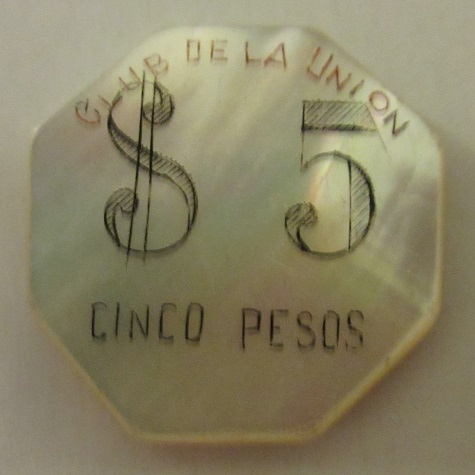 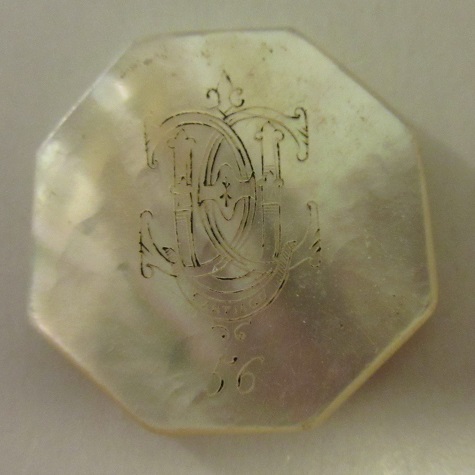 |
|
Pillar of the Community
United States
574 Posts |
@nautilator
That's awesome! But here is my question for you. Do you happen to know if it was a circulating token or a casino/gambling chip? Since I may be wrong here but I was under the impression that there weren't any circulating tokens made of mother of pearl, just casino/gambling chips were made.
|
|
Valued Member
United States
333 Posts |
I'm relatively sure it was a circulating [mine does have light wear on it] token because Club De La Union is a gentleman's club. I'm not 100% sure it doesn't have a casino but as best as I can search I don't see it having a casino. Also, it has a dining room and other amenities where you could be spending money, and this would fit its reputation as being a fancy club.
I've also tried seeing if this is actually nacre and not plastic-like nacre. I'm relatively sure it's nacre for a few reasons but I will be trying to get a hold of comparable buttons for comparison purposes in the near future.
|
|
Pillar of the Community
United States
574 Posts |
I would have to assume that it is actually made out of natural mother of pearl/nacre and not plastic-like nacre simply due to the fact that the design seems to be engraved into the surface of the token. That would only need to be done if it were natural nacre, if it were plastic like nacre it would have most likely been molded or stamped not engraved.
Edited by casualcoincollector
02/10/2018 9:12 pm
|
|
Pillar of the Community
United States
1494 Posts |
Acrylic. From the Democratic Republic of the Congo. Very hard to get a good photo on this guy. The ship is Le Shtandart. The frigate is the exact replica of the man-of-war built by Peter the Great in 1703 in order to defend Saint Petersburg. 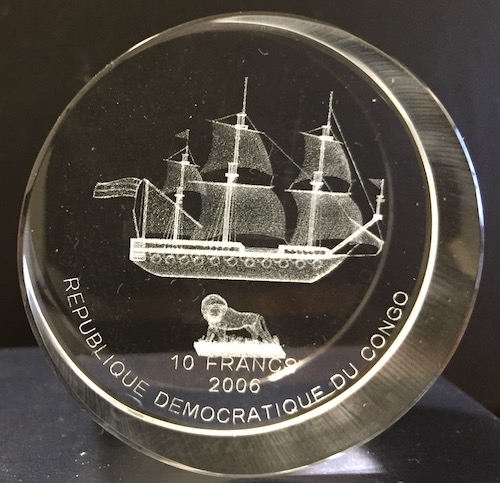 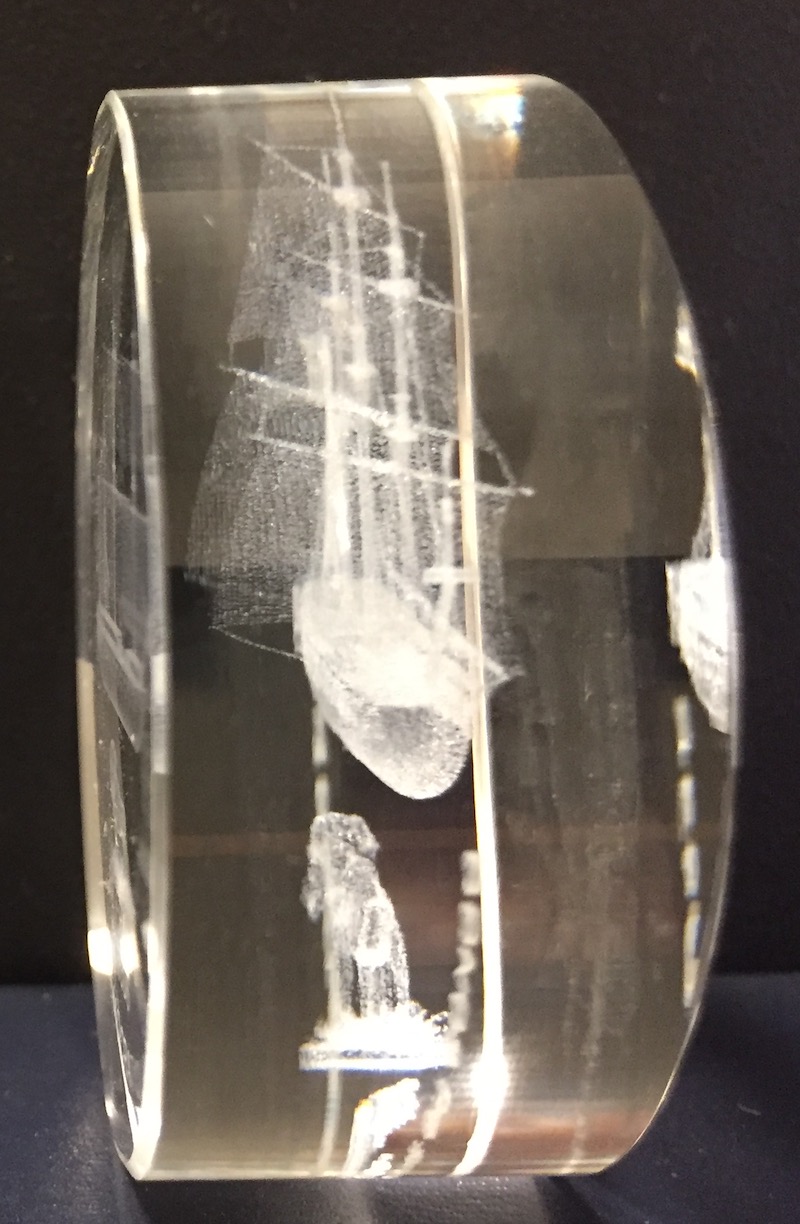 |
|
Moderator
 United States
197800 Posts |
Quote:
Acrylic. From the Democratic Republic of the Congo. Very hard to get a good photo on this guy. Now that is different! I really like it.  |
|
Pillar of the Community
United States
6514 Posts |
Alright owatchman. That acrylic coin is incredibly cool.
Check out my counterstamped Lincoln Cent collection: http://goccf.com/t/303507 |
|
Pillar of the Community
United States
574 Posts |
@nautilator So, I did some looking around because I was curious and I'm not completely convinced that your mother of pearl token is a circulating trade token and not a gambling jetton. Let me explain why. Based on the crest on the back the token it was most likely have been made prior to 1925 due to the fact that the club de la union crest from 1925 to today is missing one of the C's that is represented in the crest that is on the token. If you're assuming that it was made prior to 1925, then you have to look at the concept that 5 and 10 pesos is a huge face value for a trade token and that would have meant that the token would have been worth many times its weight in silver. Now that wouldn't raise any issues if it were a plantation or a company token since those tokens are paid to employees as wages so that they can later spend their earnings at the company store and nowhere else. But since the club de la union was a gentlemen's club it just doesn't add up for me since why would the club have their patrons buy tokens just to later use at the club. It would just add an extra unnecessary step in facilitating purchases, and most of the high end business men and politicians that the club catered to would most likely not be willing to do that. And not to mention the fact that if you only have a face value of 5 and 10 pesos you would have to give change in Chilean money. Making the token even more unnecessary. There is also the fact that the token that you posted is rather similar to some other European mother of pearl gambling jettons from around the same time period that I was able to find on the internet. One example below. https://www.ebay.com/itm/JETON-de-C....m1438.l2649Now, I'm not saying that it is definitely not a trade token but I would need to see more proof to convince me. Edited by casualcoincollector
02/15/2018 09:02 am
|
|
Pillar of the Community
United States
6514 Posts |
I am merely an observer in this thread but I do have an idea in regards to this. The tokens may have been a legal loophole for activities that may have taken place at said gentlemen's club. Perhaps if 'cash' wasn't being exchanged those 'activities' couldn't be prosecuted. Just an idea.
Check out my counterstamped Lincoln Cent collection: http://goccf.com/t/303507 |
|
Valued Member
United States
333 Posts |
Where did you find the Club De La Union crest from before 1925? I'm looking and not immediately seeing it anywhere.
Another thing I'd note is that this token has a (?)serial number on the reverse. Mine says 56, another one that I bought and don't have yet says 118. Of the very small number of casino chips I've seen, none have serial numbers -- do you know of any that do?
I did some more searching and saw that some Club De La Union tokens were being advertised as casino chips, though. Then again, those were all vulcanite (like the mining tokens) and none of those have serial numbers.
Edited by nautilator
02/15/2018 4:51 pm
|
| |
Replies: 480 / Views: 54,528 |





 First Page
 Previous Page


 Posted 12/15/2017 5:29 pm


