| Author |
 Replies: 147 / Views: 24,694 Replies: 147 / Views: 24,694 |
|
|
|
Moderator
 United States
196572 Posts |
Well done.  |
|
Pillar of the Community
 United States
6130 Posts |
Very nice, Ron! The Indian Head cent was always fascinating to me, because the first was struck prior to the start of the Civil War, and the last was struck during the Roosevelt administration, not long before WWI. It's funny how as a Southerner (raised in Georgia), I was taught that the war was about slavery until high school, then taught that it was about state's rights (including slavery, among others) in high school - we were taught that the war was the North's fault because Fort Sumter should have been abandoned peacefully when South Carolina seceded. Not trying to start anything political - it's just interesting how the same facts can be presented! There were actually a few precedents to the Civil War, namely the Whiskey Rebellion during Washington's presidency (corn farmers threatened to secede if the whiskey tax was not lifted, citing that "Taxation without representation!" It was put down (almost) without bloodshed by Washington and the national guard.) As well as the Secession Crisis during Jackson's presidency - also put down without bloodshed. |
|
Pillar of the Community
United States
8137 Posts |
Glad to see this thread revived!   When this coin was minted, Nat Turner led a slave rebellion across Southampton County, Virginia. Turner and his fellow rebels killed between 55 and 65 people, the majority being white slaveowners. While the rebellion was eventually put down by the local militia, Turner escaped but was later captured and executed. The rebellion caused widespread fear in the South, and many slaveowners killed slaves they suspected were involved, although most were not. In addition, state legislators rushed to pass laws that forbade slaveowners from teaching slaves to read and write. |
|
Moderator
United States
196572 Posts |
An interesting and thought provoking contribution, CoinCollector2012. |
|
Pillar of the Community
United States
2645 Posts |
Thaler commemorating victory over France in the Franco-Prussian War. Perhaps the last thalers produced in Prussia (there are others dated 1871). 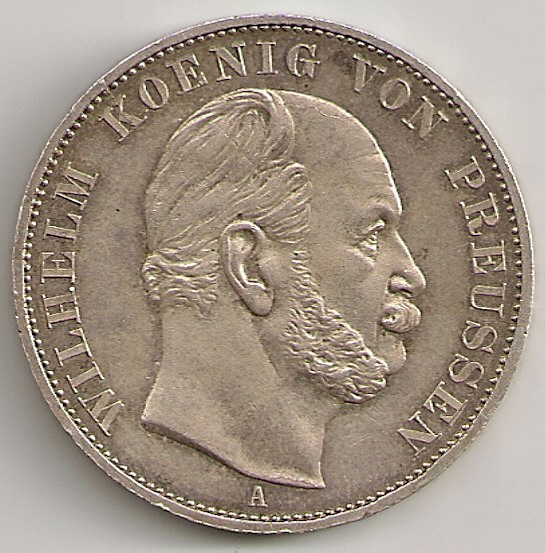 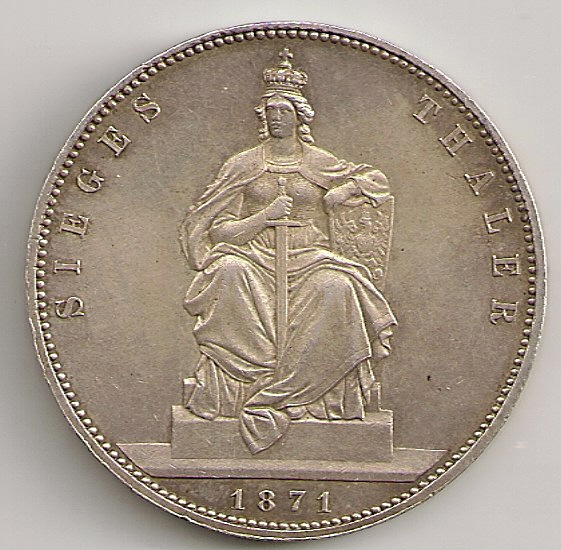 The Franco-Prussian War was fought between the Second French Empire and the German states of the North German Confederation led by the Kingdom of Prussia. Prussian chancellor Otto von Bismarck sought to provoke a French attack in order to draw the southern German states — Baden, Württemberg, Bavaria and Hesse-Darmstadt — into an alliance with the North German Confederation dominated by Prussia. Bismarck adroitly created a diplomatic crisis over the succession to the Spanish throne. A leading candidate was related to the Prussian King. France demanded that this Hohenzollern candidate withdraw. Bismarck rewrote a dispatch about a meeting between King William of Prussia and the French foreign minister, to make it appear that the French had been insulted. The French press and parliament demanded war, which the generals of Emperor Napoleon III assured him that France would win. Napoleon and his Prime Minister, emile Ollivier, equally sought war to reduce political disunity in France. On 16 July 1870, the French parliament declared war on Prussia and hostilities began three days later. The German coalition mobilized and transported its troops much more quickly than the French and rapidly invaded northeastern France. The German forces were superior in numbers, had better training and leadership and made more effective use of modern technology, particularly railroads and artillery. A series of swift German victories in eastern France, culminating in the Siege of Metz and the Battle of Sedan, saw the army of the Second Empire decisively defeated (Napoleon III was captured at the head of an army at Sedan on 2 September). A Government of National Defence declared the Third Republic in Paris on 4 September and continued the war. For another five months, the German forces fought and defeated new French armies in northern France. Following the Siege of Paris, the capital fell on 28 January 1871 and then a revolutionary uprising called the Paris Commune seized power in the capital and held it for two months, until it was bloodily suppressed by the regular French army at the end of May 1871. The German states proclaimed their union as the German Empire under the Prussian king, Wilhelm I, uniting Germany as a nation-state. The Treaty of Frankfurt of 10 May 1871 gave Germany most of Alsace and some parts of Lorraine, which became the Imperial territory of Alsace-Lorraine (Reichsland Elsaß-Lothringen). |
|
Moderator
United States
196572 Posts |
Very interesting period of history. |
|
Pillar of the Community
United States
2645 Posts |
Today in ANZAC day, commemorating (hardly celebrating) the landings at Gallipoli in 1915. I obtained this florin as part of a bulk purchase of world coins. Krause says the Australian florins in 1915 (as well as prior years) were all minted in London (or by Heaton). It was noted here http://goccf.com/t/309046 that 1915 London florins are particularly hard to find in excellent condition; paxbrit suggested that they may have gone to the Australian troops in Flanders and Gallipoli. 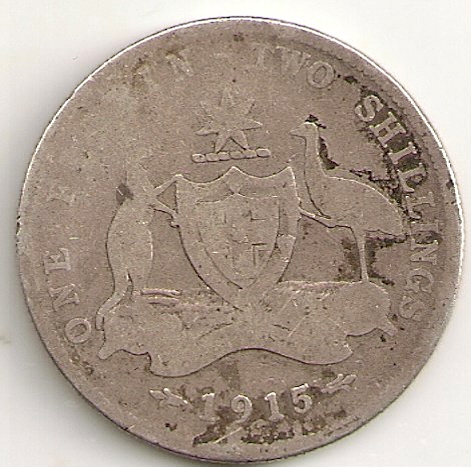 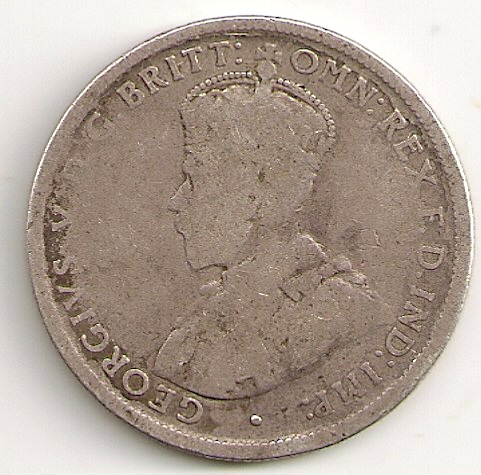 I see no H, and so assume this well-worn veteran is from the London mint. |
|
Moderator
United States
196572 Posts |
Nice contribution! |
|
Bedrock of the Community
 United States
12927 Posts |
"And the band played 'Waltzing Matilda'..."
Interesting coin, Arkie.
|
|
Pillar of the Community
United States
8062 Posts |
This "plaque" (double gros) from Lorraine was minted 1346-1348 in the name of Marie of BLois, regent for the young Duke Jean I. 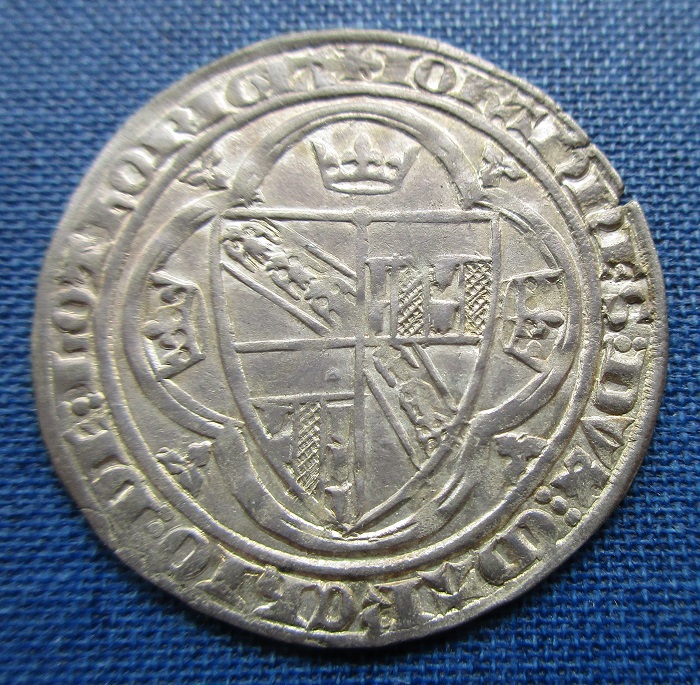 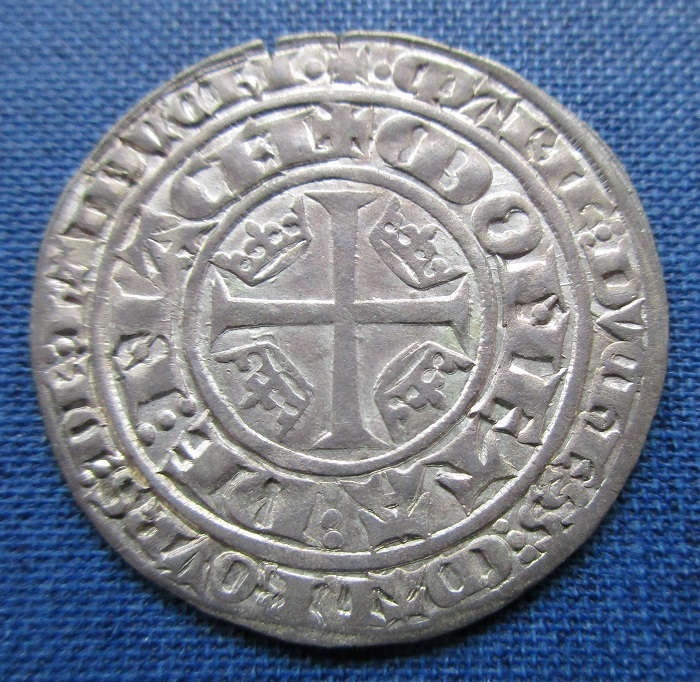 In late 1347, the Black Death first appeared in Europe in Sicily. By January 1348 it had spread to Mediterranean ports like Venice, Genoa, Pisa (yes, it was a port then), and Marseilles. And by the end of 1348 it had reached nearly every region south of the Alps, as well as London and Paris, believed to have been spread by fleas on rats that inhabited merchant ships. In less than 5 years it killed about 25 million in Europe between a third and half of the total population, and perhaps 4 times as many worldwide. The social, economic and political upheaval which ensued was the worst of the entire medieval period. |
|
Bedrock of the Community
United States
12477 Posts |
Excellent post, tdziemia. Coins are history and carry with them the stories of their time. An interesting note (yes, from Wikipedia): Quote:
The Black Death is estimated to have killed 30-60% of Europe's total population. In total, the plague may have reduced the world population from an estimated 450 million down to 350-375 million in the 14th century. It took 200 years for the world population to recover to its previous level. *Bold type added for emphasis.  In Memory of Crazyb0 12-26-1951 to 7-27-2020
In Memory of Tootallious 3-31-1964 to 4-15-2020
In Memory of T-BOP 10-12-1949 to 1-19-2024
Edited by spru
04/26/2018 01:39 am
|
|
Moderator
United States
196572 Posts |
Very interesting. Frightening, but interesting.
|
| |
Replies: 147 / Views: 24,694 |








 First Page
 Previous Page


 Posted 04/16/2018 11:36 am


