| Author |
 Replies: 860 / Views: 49,723 Replies: 860 / Views: 49,723 |
|
|
|
CCF Master Historian of USA Commemoratives
 United States
12497 Posts |
I'll wrap up my survey of the classic era of United States ("US") commemorative coins with a look at a close cousin of the series - the 1925 Norse-American Centennial Medal: The Norse-American medal features allegorical elements on each of its sides. On the obverse, a Viking warrior is presented center stage, on the reverse is found a Viking Longboat. The combined depiction is meant to be an allegory for Norwegian-American ethnic pride and bring attention to the fact that Norwegians visited what would become known as "North America," before other Europeans arrived. Though the medal was issued to mark the 100th Annriversary of the first organized emigration of Norwegians to the US, its designs were representative of much more Norwegian heritage than the anniversary. 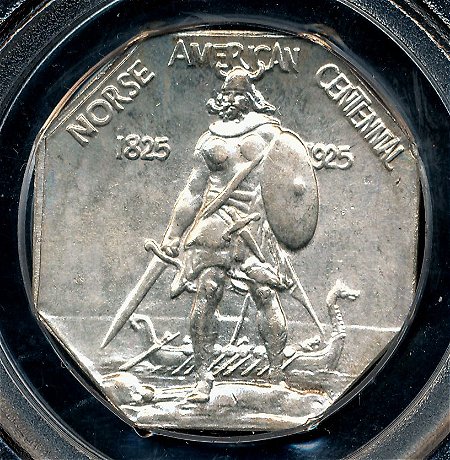 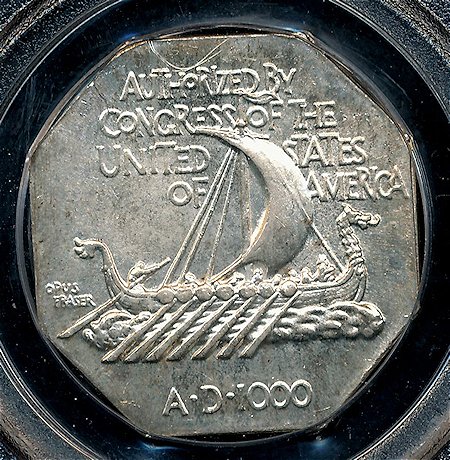 Collecting history one coin or medal at a time! (c) commems. All rights reserved.
|
|
Bedrock of the Community
United States
78273 Posts |
Nice example, commems, and good read as always.  Errers and Varietys.
|
|
Moderator
United States
105310 Posts |
Now that is an interesting coin - at first glance, I didn't think it was even an American coin.
|
|
Moderator
United States
194606 Posts |
A nice finale for the classic era. |
|
CCF Master Historian of USA Commemoratives
United States
12497 Posts |
Quote:
Now that is an interesting coin - at first glance, I didn't think it was even an American coin. Understandable. A Viking warrior is not exactly a common design element on United States coins/medals. Collecting history one coin or medal at a time! (c) commems. All rights reserved.
|
|
CCF Master Historian of USA Commemoratives
United States
12497 Posts |
I decided to swing back to this Gallery to have a quick look at a few of the United States ("US") classic-era gold commemorative coins... First up, the 1915 Panama-Pacific International Exposition Gold Dollar. The gold coin incorporates allegorical elements on each of its sides. On the obverse, the design's dominant element is a canal worker/laborer who is depicted wearing a small, short-brimmed cap/hat. The depiction is meant to symbolize the concept of "Labor" and all the canal workers who worked tirelessly to make the Panama Canal a reality. On the reverse are depicted a pair of dolphins, meant to represent the Atlantic and Pacific Oceans - the two bodies of water connected by the Panama Canal. 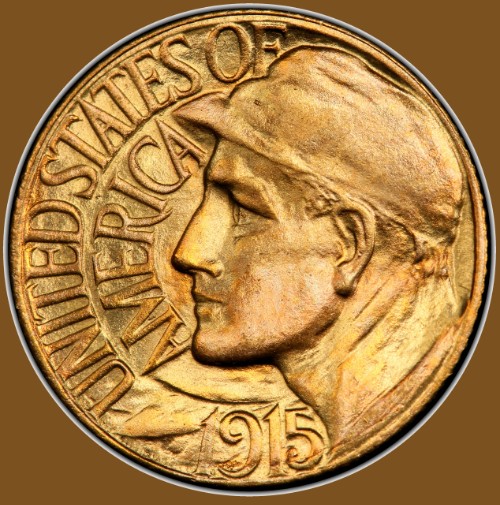 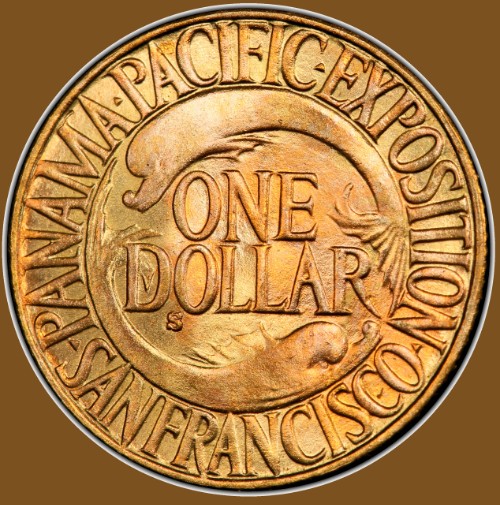 Collecting history one coin or medal at a time! (c) commems. All rights reserved.
|
|
Bedrock of the Community
United States
78273 Posts |
Nice one, commems. Errers and Varietys.
|
|
Moderator
United States
105310 Posts |
That is an excellent looking coin!
|
|
Moderator
United States
194606 Posts |
Quote:
I decided to swing back to this Gallery to have a quick look at a few of the United States ("US") classic-era gold commemorative coins...  Quote:
First up, the 1915 Panama-Pacific International Exposition Gold Dollar Nice example! |
|
CCF Master Historian of USA Commemoratives
United States
12497 Posts |
Next in line is the 1915 Panama-Pacific International Exposition Gold Quarter Eagle ($2.50)... The second gold coin of the 1915 Exposition is also one that incorporate allegory on each of its sides. The obverse features Columbia - an allegorical representation of the United States, riding a hippocamous - a fictitious animal that dates to the times of Greek mythology. The combined images are meant to symbolize the newfound ease of moving between the Atlantic and Pacific Oceans via the Panama Canal. Columbia is shown holding a caduceus in her left hand, it is meant to represent the medical triumph achieved over yellow fever that enabled the Panama Canal to be be built/completed. The reverse design depicts a bald eagle, striding to the left, on a pedestal with its wings elevated but not fully extended; the eagle is representative of the United States and its key role in completing the Panama Canal. 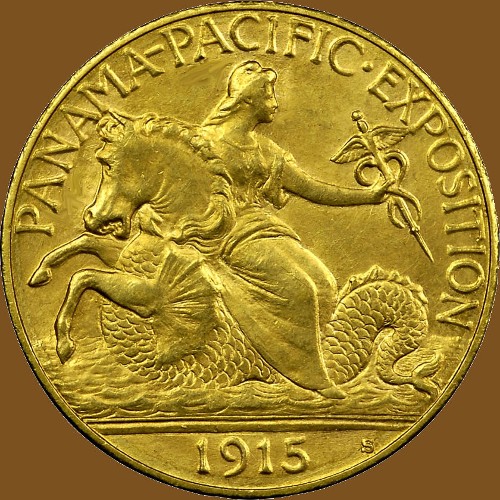 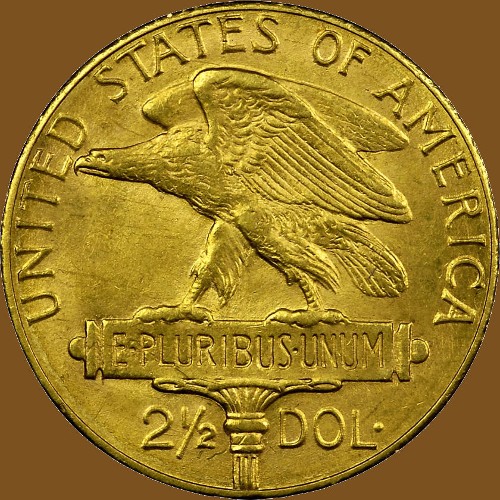 Collecting history one coin or medal at a time! (c) commems. All rights reserved.
|
|
Moderator
United States
194606 Posts |
Quote:
Next in line is the 1915 Panama-Pacific International Exposition Gold Quarter Eagle ($2.50)... Wonderful! |
|
Moderator
United States
105310 Posts |
|
|
Bedrock of the Community
United States
78273 Posts |
Nice one, commems! Errers and Varietys.
|
|
CCF Master Historian of USA Commemoratives
United States
12497 Posts |
One more design from the 1915 Panama-Pacific International Exposition ("Pan-Pac") coin program - one design, two varieties... As with the other two gold coins of the Pan-Pac series, the Gold Quintuple Eagles ($50) incorporate allegorical elements on each side. On the obverse of each variety is seen a left-facing portrait of Minerva - the Roman goddess of Wisdom. Over time, Minerva began also to be worshiped as the goddess of War. As such, it is common to see her depicted wearing a feather-crested helmet as was done on the Pan-Pac $50 coins. Minerva is generally considered a parallel to Athena of Greek mythology. On the reverse, an owl is presented perched on a pine tree branch with multiple pine cones. The owl's meaning as a sign of Wisdom and Knowledge dates to Greek mythology. Pine cones have also long had symbolic meaning attached to them, Enlightenment and Fertility are among the most common assigned meanings. On the coin, the "fertility" symbolism is in regards to the prosperity to be found in America and the American West. Note: These are not my coins - they are still on my "Maybe someday" list.Panama-Pacific International Exposition Gold Quintuple Eagle - Round Variety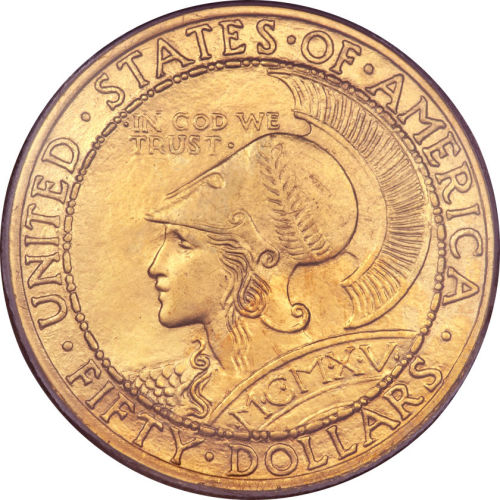 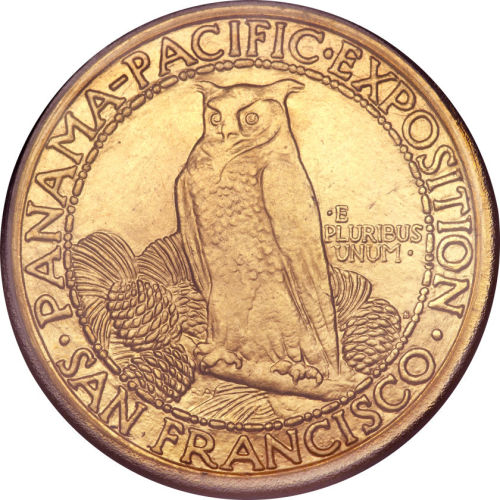 Panama-Pacific International Exposion Gold Quintuple Eagle - Octagonal Variety Panama-Pacific International Exposion Gold Quintuple Eagle - Octagonal Variety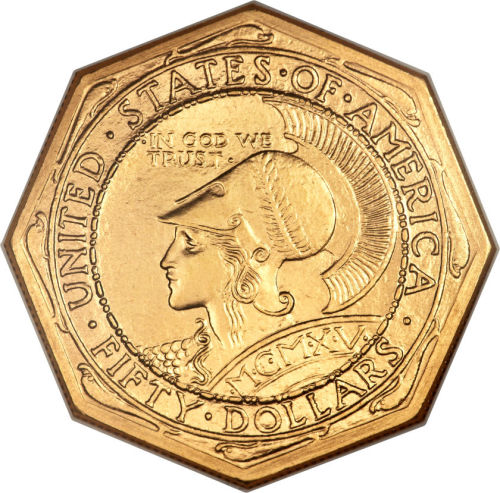 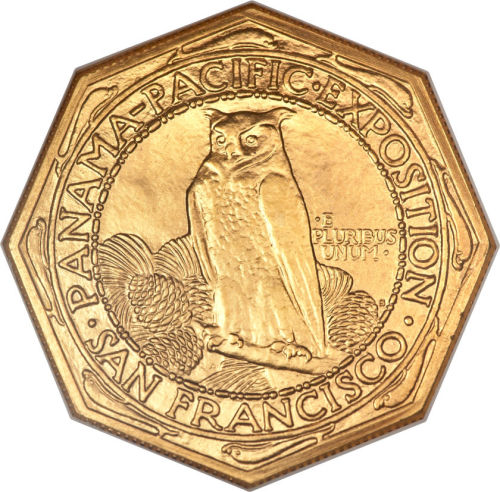 (Image Credit: Images of both varieties courtesy of Heritage Auctions (Image Credit: Images of both varieties courtesy of Heritage Auctions). Collecting history one coin or medal at a time! (c) commems. All rights reserved.
|
|
Moderator
United States
194606 Posts |
Excellent examples! Hopefully someday they will join your collection.  |
| |
Replies: 860 / Views: 49,723 |







 First Page
 Previous Page


 Posted 11/18/2025 7:04 pm





