| Author |
 Replies: 5,897 / Views: 447,664 Replies: 5,897 / Views: 447,664 |
|
|
|
Bedrock of the Community
 United States
26726 Posts |
Very interesting token, daltonista! Quote:
the halfpennies were "...produced initially ... Wow, I had never really considered the challenges of minting coins 200 years ago, especially in Australia. Sam Peek must have really wanted to produce these tokens! Inordinately fascinated by bits of metal with strange markings and figures
|
|
Bedrock of the Community
United States
27948 Posts |
An interesting example and information, daltonista.
My American Silver Eagle collection http://goccf.com/t/448125My random silver coin collection http://goccf.com/t/449270My MS-70 silver coin collection https://goccf.com/t/490829My dragon silver coin collection https://goccf.com/t/490859My silver Libertad collection https://goccf.com/t/491087 |
|
Pillar of the Community
United States
2307 Posts |
Hondo, that is one weird coin...  At first, I thought it was Don Quixote, Man of La Mancha! 
|
|
Pillar of the Community
United States
5029 Posts |
|
|
Moderator
United States
192555 Posts |
Outstanding!  |
|
Pillar of the Community
United States
1073 Posts |
Thanks, guys! I've been imagining the production of "sawn planchets" would have required some pretty sophisticated equipment, like something along these lines, perhaps?
No wonder they look so doggy!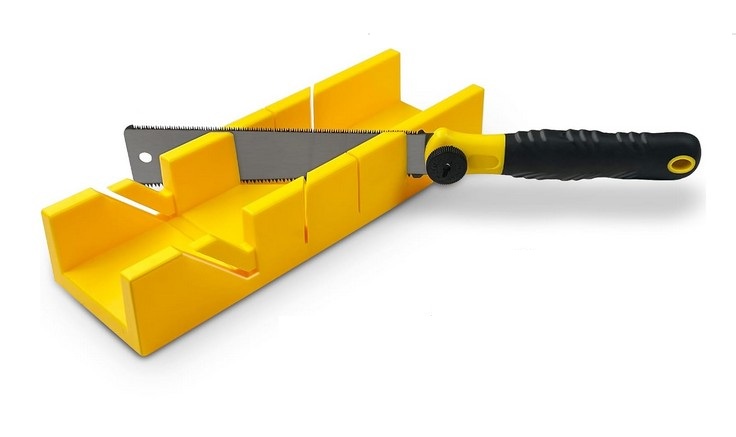
"If everything seems to be under control, you're just not going fast enough."
--- Mario Andretti
|
|
Bedrock of the Community
United States
76846 Posts |
Nice addition, daltonista! Errers and Varietys.
|
|
Bedrock of the Community
United States
26726 Posts |
Quote:
I've been imagining the production of "sawn planchets" would have required some pretty sophisticated equipment This thought has been nagging at me since you posted this, daltonista. I recalled an illustration of an early mint but could not find it online. Finally found it in my copy of The Coins of Colonial Mexico (1536-1821) and The Empire of Iturbide (1821-1823), revised by Dr. George W. Vogt (1970). It was the giant shears used to clip planchets from coin stock that I remembered. 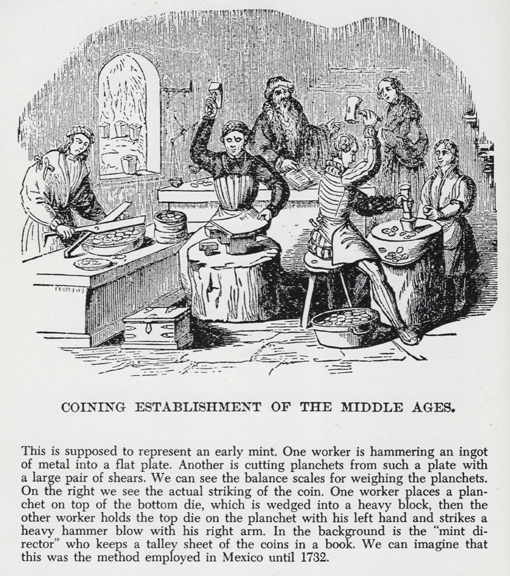 Inordinately fascinated by bits of metal with strange markings and figures
|
|
Pillar of the Community
United States
1073 Posts |
That's fascinating, Hondo. This is where we'd be without Boulton & Watt's contributions to the technology of minting.
"If everything seems to be under control, you're just not going fast enough."
--- Mario Andretti
|
|
Moderator
United States
192555 Posts |
Very interesting and thank you for sharing! |
|
Pillar of the Community
 United States
2020 Posts |
Part of an auction lot. 2.5" OD. Commemorative Medal; Grok translation shown below: 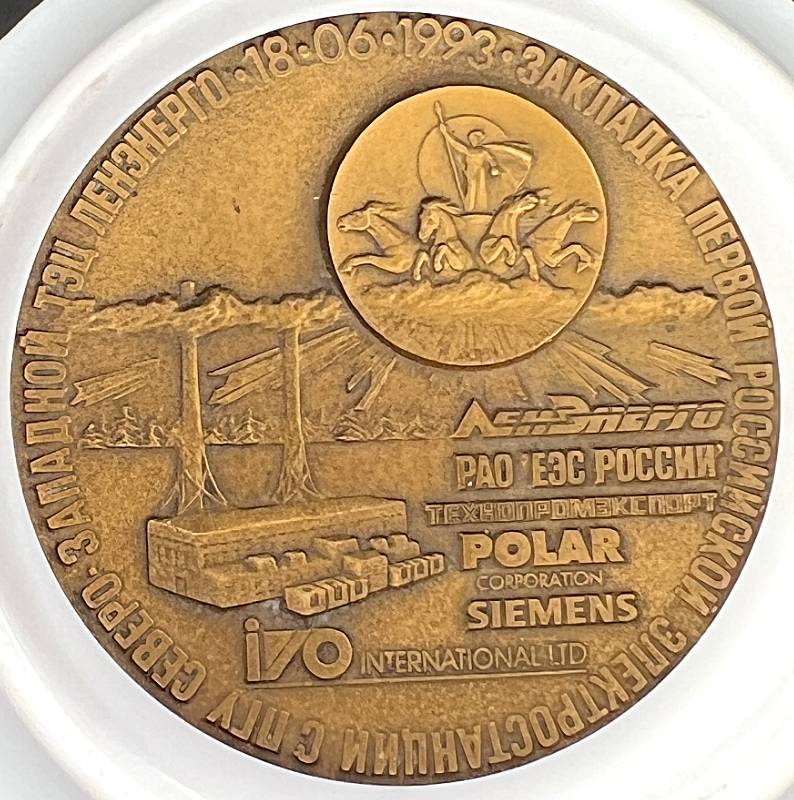 Quote:
Here is the English translation of the text on the medal:
Top (around the edge):
18-06-1993
Left side (vertical):
North-Western CHPP (Combined Heat and Power Plant)
Center (below the image):
AsEnergo
RAO "UES of Russia" (Unified Energy System of Russia)
Technopromexport
POLAR CORPORATION, SIEMENS, IVO International LTD
Bottom (around the edge):
Penza Region According to Grok: Quote:
History of Severo-Zapadnaya CHPP
Based on the provided medal and related context, "Severo-Zapadnaya CHPP" or North-Western Combined Heat and Power Plant) refers to a pioneering energy project in the Penza Region of Russia. The medal commemorates the ceremonial laying of the foundation (zakladka) on June 18, 1993, for what was described as the first Russian power plant equipped with an atmospheric pressure gas-and-steam installation (or IPGN)—a technology referring to a combined cycle gas turbine (CCGT) system operating at atmospheric pressure in key components, enabling high-efficiency cogeneration of electricity and heat. This marked a significant milestone in post-Soviet Russia's energy modernization, emphasizing efficiency and reduced emissions through binary gas-steam cycles.
However, historical records indicate that the project faced typical post-Soviet economic challenges, including funding delays and restructuring. It did not advance to full construction as initially planned, and no operational Severo-Zapadnaya CHPP exists in the Penza Region today. See the next post for AI's take on the symbolic imagery in the circle " Even a clock that's stopped is right twice a day. "
Edited by cptbilly
11/05/2025 8:00 pm
|
|
Pillar of the Community
United States
2020 Posts |
Symbol Inside the Circle on the Medal: Quote:
The circular emblem on the obverse of the medal (the side with the date "18.06.1993" and the inscription about the foundation laying) depicts a mythological scene inspired by Russian folklore, specifically a variant of the legendary figure known as the Kikimora or a water spirit rider. Here's a breakdown based on the design elements:
Central Figure: A heroic, dynamic female figure (possibly personifying Progress or the Spirit of the North) stands triumphantly, holding a torch aloft in her right hand. She wears flowing robes and appears to be in motion, symbolizing enlightenment, advancement, and the harnessing of energy—fitting for a power plant groundbreaking.
Surrounding Elements: She rides a chariot or sleigh pulled by four rearing horses (or sea horses/mermaids in a stylized aquatic form, blending land and water motifs). The horses are depicted in mid-leap, with arched necks and dynamic poses, evoking power and speed. Below the chariot, there are waves or flowing water (represented by curved lines), suggesting the "water-gas" theme of the IPGN (combined-cycle) technology, where steam and gas cycles mimic natural flows. The entire composition is framed against a radiating sun or energy burst at the base, tying into themes of light, heat, and industrial dawn. AI also offered this: Quote:
This design draws from Russian/Slavic mythology:
The three-horse chariot echoes ancient Slavic depictions of the goddess Mara or Morana (goddess of winter and rebirth), who was sometimes shown riding waves on a sleigh drawn by three horses. In folklore, this motif appears in tales of water spirits guiding forces of nature.It may also reference the Kikimora, a mischievous swamp spirit in Russian lore, reimagined here as a benevolent force taming chaotic elements (waves, horses) to represent controlled energy production.
The torch bearer evokes Prometheus (fire-bringer) but localized to Russian symbolism, similar to emblems on Soviet-era energy medals where mythology celebrated industrialization.
This custom emblem was likely commissioned for the 1993 ceremony to blend national pride with the project's innovative tech, distinguishing it from standard state awards. It's not a direct copy of official Soviet/Russian orders (e.g., no hammer-sickle or double-headed eagle) but a bespoke artistic element for RAO EES Russia and regional pride in Penza. Comparable designs appear in late-Soviet table medals for energy milestones, often using folklore to humanize technical achievements. Medal Reverse: 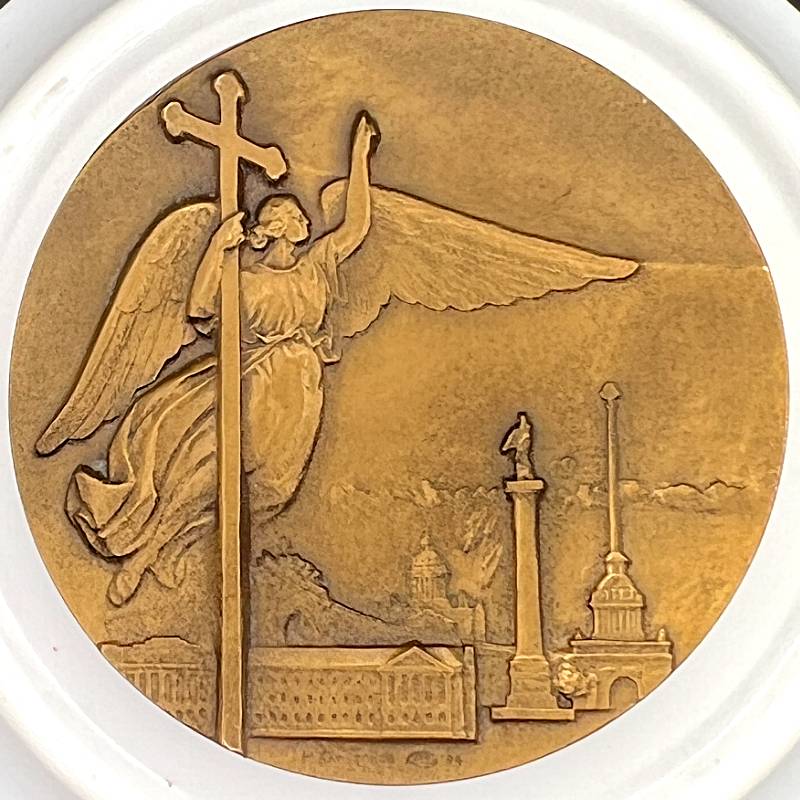 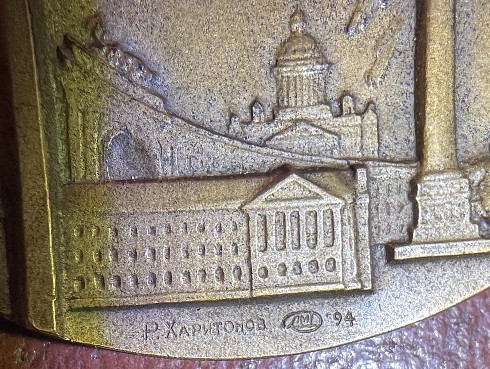 According to Grok: Quote:
The reverse features a reissue of a historical design featuring "The Angel of Victory" with her left arm raised in a gesture of triumph or benediction while grasping a large Orthodox cross in her right hand. The angel symbolizes divine protection, faith, and Russian resilence. "The [reverse of the] medallion-- struck at the Leningrad Mint -- is a 1994 reissue of a historical design, engraved by Roman Kharitonov." How this medal found its way to Sparks, NV, might be a better story. . . Edited by cptbilly
11/05/2025 9:45 pm
|
|
Bedrock of the Community
United States
27948 Posts |
Excellent medal and description, cptbilly.
|
|
Bedrock of the Community
United States
26726 Posts |
Very interesting medal, cptbilly! And thank you for including the AI translation and interpretation.
Inordinately fascinated by bits of metal with strange markings and figures
|
|
Moderator
United States
102274 Posts |
outstanding medal, Thanks for all that additional information too |
| |
Replies: 5,897 / Views: 447,664 |








 First Page
 Previous Page


 Posted 10/30/2025 11:56 pm


