|
This page may contain links that result in small commissions to keep this free site up and running.

Welcome Guest! Registering and/or logging in will remove the anchor (bottom) ads. It's Free!
To participate in the forum you must log in or register. | Author |
 Replies: 638 / Views: 59,819 Replies: 638 / Views: 59,819 |
|
|
|
Pillar of the Community
 United Kingdom
1168 Posts |
Quote:
Two very nice additions! Thanks, @erafjel There hasn't been an animal coin for a while, so here is a stag from Hierokaisareia in Lydia. Also known as Hierocaesarea, Hierocaesareia, Hierakome and Hieracome. I hadn't heard of Hierokaisareia before and most searches didn't turn up much information about the city it's self, though it is commonly thought that Hieracome (Holy Village) was renamed Hierocaesarea (Holy Emperor City) in gratitude for the five year tax rebate granted by Tiberius after the 17 AD earthquake, being one of the twelve badly damaged cities. Extract from academia edu "Earthquakes in Asia Minor, the Cura Provinciae of Tiberius and the Cities" "When the emperor Tiberius learned of the earthquake in Asia, he immediately sent a member of the Roman Senate to this region to report the extent of the catastrophe and coordinate support. He elected the propraetor Marcus Ateius and supplied him with quite an impressive amount of money. Sardis, which had suffered most, was given 100,000 sestertii (25,000 denarii) from the emperor's private chest, and Magnesia on the Sipylus, too, received substantial aid. We do not know any more details on the exact sums given to the other cities. Certainly, Ateius would have evaluated the damages in the region and would have supplied money to clear the debris and rebuild infrastructure such as streets, bridges, water supplies, and public buildings. Communities and citizens were exempted from taxes for five years, which laid the foundation for a quick recovery of the economic situation in this region. Having granted this privilege for such a long period is also a telling testimony of the degree of damage to these cities." 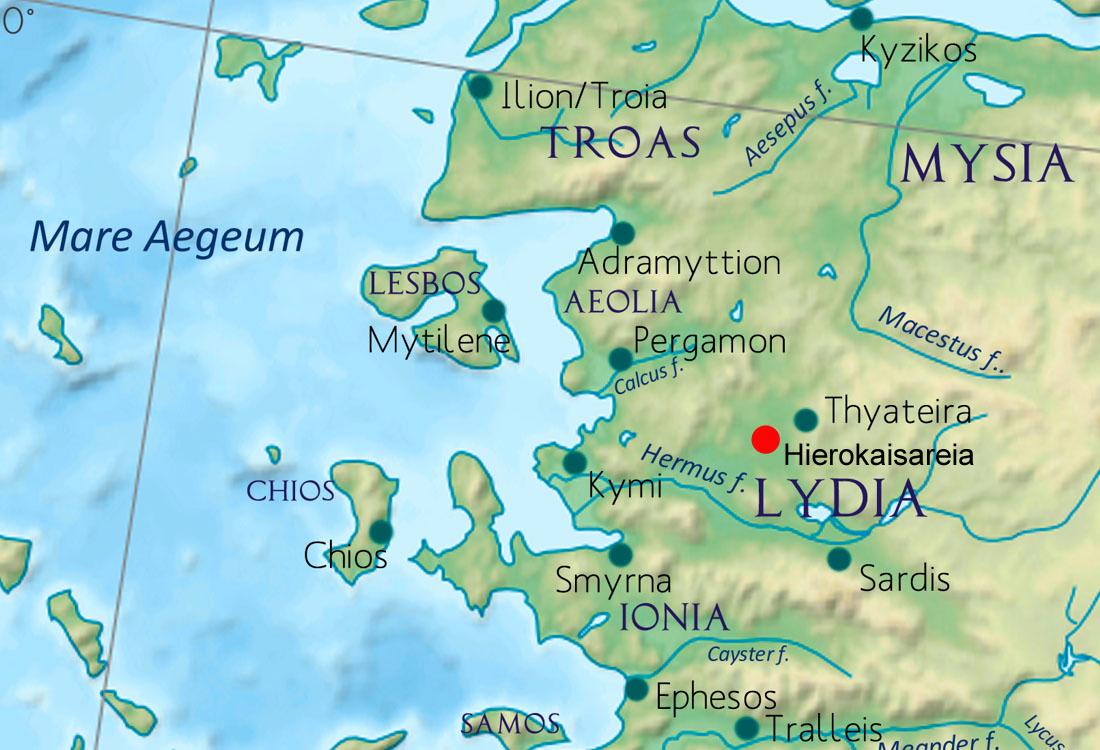 On his web site, Oner Kaya wrote: "This city is now located between Beyoba and Sazoba. Since there are no archaeological research or scientific excavations, we do not have enough information about the ancient city. We only have information obtained from inscriptions read by local and foreign scientists on the surface. I hope one day scientific excavations begin here, Hierokaesareia, an important city from the Persian period, and information that illuminates its period will be reached." In a paper by Professor Hasan Malay he mentions the Greek inscription on a marble block found in 1976 in Sazoba village of Manisa's Akhisar district. A location close to the villages of Beyoba and Sazoba and within the borders of the ancient Hierokaisareia (Holy Emperor City), formerly known as Hierakome (Holy Village). The reason why Hierokaisareia in the Lydia region was called a sacred city was the temple built here for the Goddess Artemis Persike (= Anahita or Anaitis). It is possible to see depictions of Artemis Persike on many coins of the city of Hierokaisareia. "It is noteworthy that the votive owners mentioned in this inscription, which is still preserved in the Manisa Museum, are mostly women and the dedicated slaves are mostly girls. It is possible to explain this as Artemis being a more popular goddess among women. Additionally, the presence of three Roman citizen women (i.e., Terentia Sosilla, Publicia Saturna and Octavia Ventusa) among the votaries should be interpreted as the acceptance of this Persian cult by immigrants in Lydia." 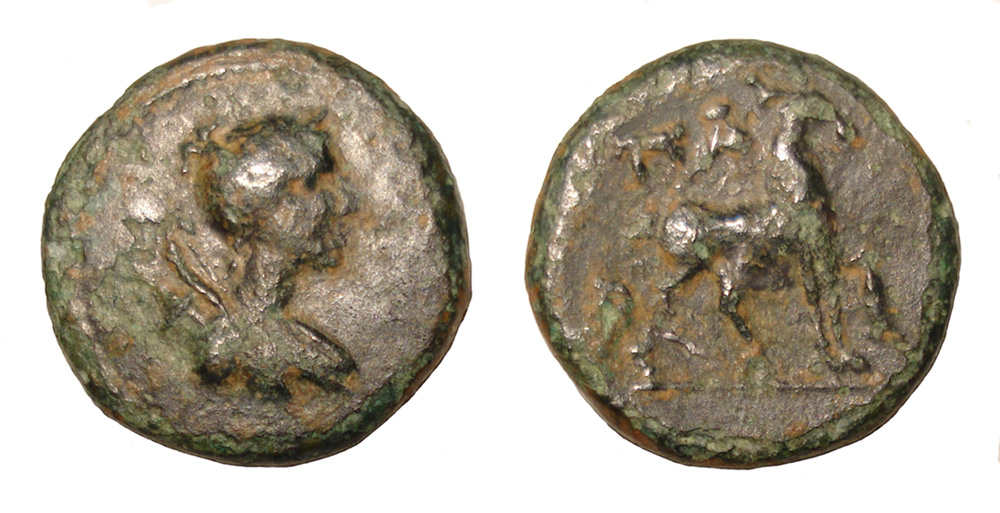 Hierokaisareia - Lydia. Pseudo-autonomous issue. Late 1st & early 2nd centuries AD. Obverse: Draped bust of Artemis Persica right, with bow and quiver over shoulder. Obverse Inscription: ΠΕΡΣΙΚΗ. Reverse: Stag standing right. Reverse Inscription: ΙΕΡΟΚΑΙCΑ-ΡΕΩΝ. Metal: Bronze. Diameter: 15 mm. Weight: 2.7 gr. Reference: RPC III 1854; BMC 6. Edited by Novicius
03/08/2024 1:37 pm
|
|
Pillar of the Community
United States
7067 Posts |
Interesting write-up, Jim - and a worthy addition to the zoo. Like you, I wasn't really aware of this city before. (Although I do see, in a quick search here at CCF, that I once speculated an OP's coin may have been from there.) Thanks for sharing the info.
Edited by Kamnaskires
03/08/2024 2:17 pm
|
|
Pillar of the Community
United Kingdom
1168 Posts |
Thanks, Bob. To me, Hieracome / Hierokaisareia is another of those oddities where there are numerous coins attributed to the city, but so little apparently known about the place. Very odd.  |
|
Pillar of the Community
United Kingdom
1168 Posts |
There aren't many Hadrian Nikopolis coins with the boar's head prow reverse, and I was lucky to find this one. It reminded me of how careful one had to be with language on a ship. Seafarers can be a superstitious lot, for instance a woman on board is said to bring bad luck and the same goes for a man of the cloth. Some fishermen think that saying the word "rabbit" is unlucky, but enjoy rabbit stew, and when it is brought on board with the stores it is labelled "tibbar". Similarly the word pig is not spoken, but the animal may be referred to as a gruffer. Whistling on a ship was not allowed, especially on the bridge, in case it "whistled up a storm". The exception to this rule was the cook, who had to whistle while stoning plums to ensure that he was not eating any and getting more than his fair share! Apparently the ancient seafarers were also just as superstitious, and this Hadrian coin shows a boar's head prow on the reverse of the coin which symbolised acute vision and ferocity. Some ships had eyes painted on the bows also to symbolise acute vision. Roman vessels would often sport a carving of a centurion representing valour in battle, the Phoenicians used horses to represent speed and the Egyptians favoured holy birds. 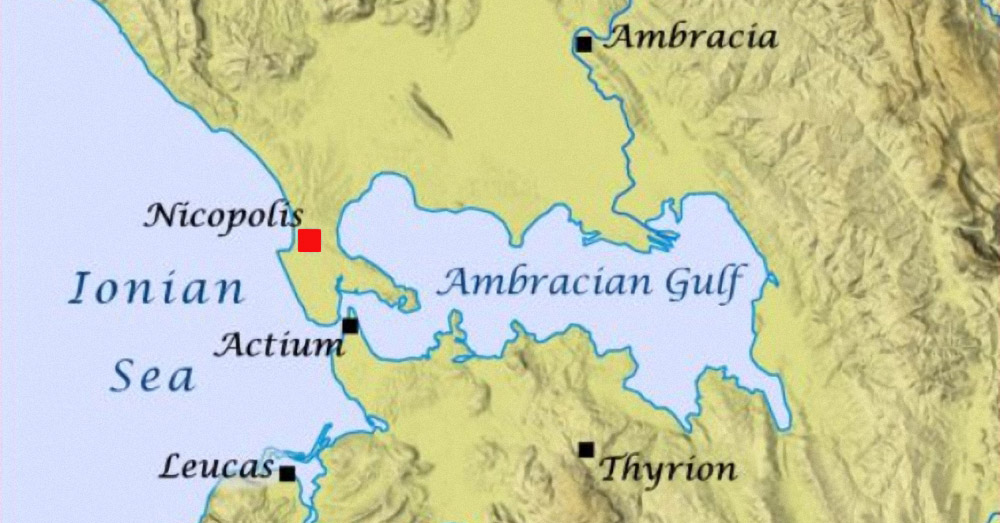 Nikopolis Description - Extract from UNESCO site: History: The city of Nikopolis was founded following the victory of Gaius Julius Caesar Octavianus (Augustus) in the naval battle of Actium in 31 BC. The city is associated with the effort to establish Roman dominion and the whole process of "Romanizing" Greece. The province of Nikopolis extended southwards from the mountains of Cassopeia to the province of Roman Patras, and northwards from the river Acheloos to Leucas (present-day Lefkada). Augustus Caesar granted the city substantial political and economic privileges and adorned it with magnificent monuments, while also reviving the Actium Games. The name of King Herod I of Judea and those of many Roman officials such as Germanicus, Nero and Hadrian are associated with donations to Nikopolis. Nikopolis was the capital of Epirus and Acarnania during the first three centuries of the Roman Empire. Built at the crossroads of commercial land and sea routes, it was the centre of Greek culture and a meeting point between the eastern and western worlds. It was the seat of Epictetus' school of philosophy, while a Jewish community lived within the city. Between the 3rd and 5th century AD the city underwent a period of relative decline and stagnation, while from the mid-5th century AD Nikopolis became the administrative, artistic, spiritual and religious centre of the area with a Christian character. According to tradition, the Church of Nikopolis was founded by Paul the Apostle. During the early Christian period the city experienced a major economic and spiritual boom, a fact demonstrated by the fortification programme instigated by Justinian and the plethora of monuments which adorned the city. The administrative reorganization of the Byzantine Empire in the 9th century and the transfer of the capital of the Theme of Nikopolis from Nikopolis to Nafpaktos led to the city's decline and abandonment, which was completed during the 13th century. 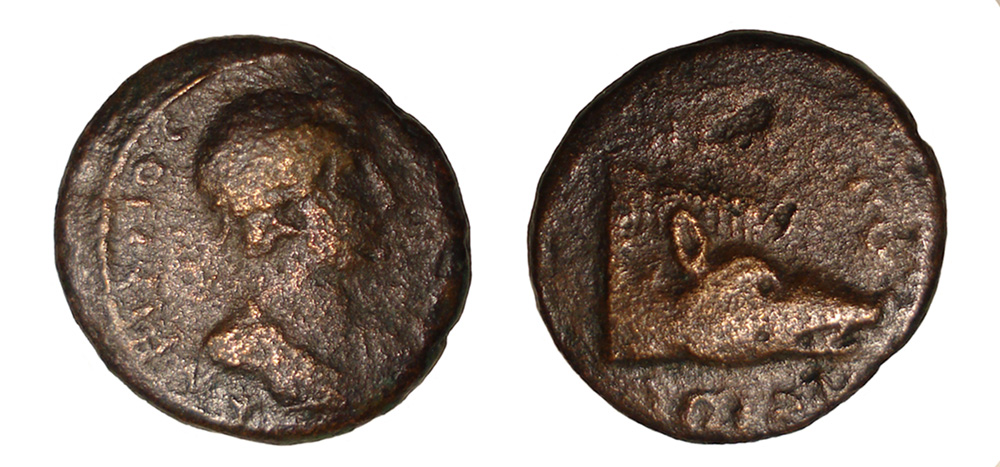 Hadrian (Augustus), Epirus, Nicopolis Obverse: Laureate cuirassed bust of Hadrian right. Obverse legend: AΔPIANOC [KAICAP]. Reverse: Boar's head prow right. Reverse legend: NEIKOΠOΛEωC. Bronze. Diameter: 17 mm. Weight: 3.56 gr. Reference: RPC III 511; Oikonomidou Hadrian 3-6; Calomino 65, 79 https://rpc.ashmus.ox.ac.uk/coins/3/511Edited by Novicius
04/11/2024 07:49 am
|
|
Pillar of the Community
 Sweden
2124 Posts |
Interesting write-up, Novicius. Have not heard of boar's head prows before.
|
|
Pillar of the Community
United States
2349 Posts |
Nice coin. There were several ancient cities named Nicopolis. The one in Epirus is thought by some scholars to be the Biblical Nicopolos Titus 3:12.
Edited by livingwater
04/11/2024 12:36 pm
|
|
Pillar of the Community
United States
7067 Posts |
A great post, Jim. You have the best write-ups. Quote:
Whistling on a ship was not allowed, especially on the bridge... So, apparently then, Steamboat Willie (Mickey Mouse) shouldn't have been whistling in that early animation. Well, that was quite a faux pas. Nice coin with a strongly rendered boar's head prow. It's held up well. Edited by Kamnaskires
04/11/2024 12:54 pm
|
|
Pillar of the Community
United Kingdom
1168 Posts |
Thanks for the kind comments guys. Quote:
Have not heard of boar's head prows before. I have not heard much about these prows either, @erafjel. This is the first coin I've seen where it is actually mentioned. Probably the precursor to the later day ship's figureheads.  Quote:
The one in Epirus is thought by some scholars to be the Biblical Nicopolos Titus 3:12. An interesting point, @livingwater. I'll add this to the file on the coin, thank you. Quote:
So, apparently then, Steamboat Willie (Mickey Mouse) shouldn't have been whistling in that early animation. Definitely not, Bob. If he had been with one captain I sailed with he would have gotten a real dressing down!  |
|
Pillar of the Community
United Kingdom
1168 Posts |
|
|
Pillar of the Community
United Kingdom
1168 Posts |
As has happened in the recent past (plough and bird coins), another two coins from different cities with near identical reverses came along. This time it was cockerels from Cales and Teanum Sidicinum in Campania. Both had Athena on the obverse and a cockerel and star on the reverse. Apart from the city names there are no other distinguishing marks. 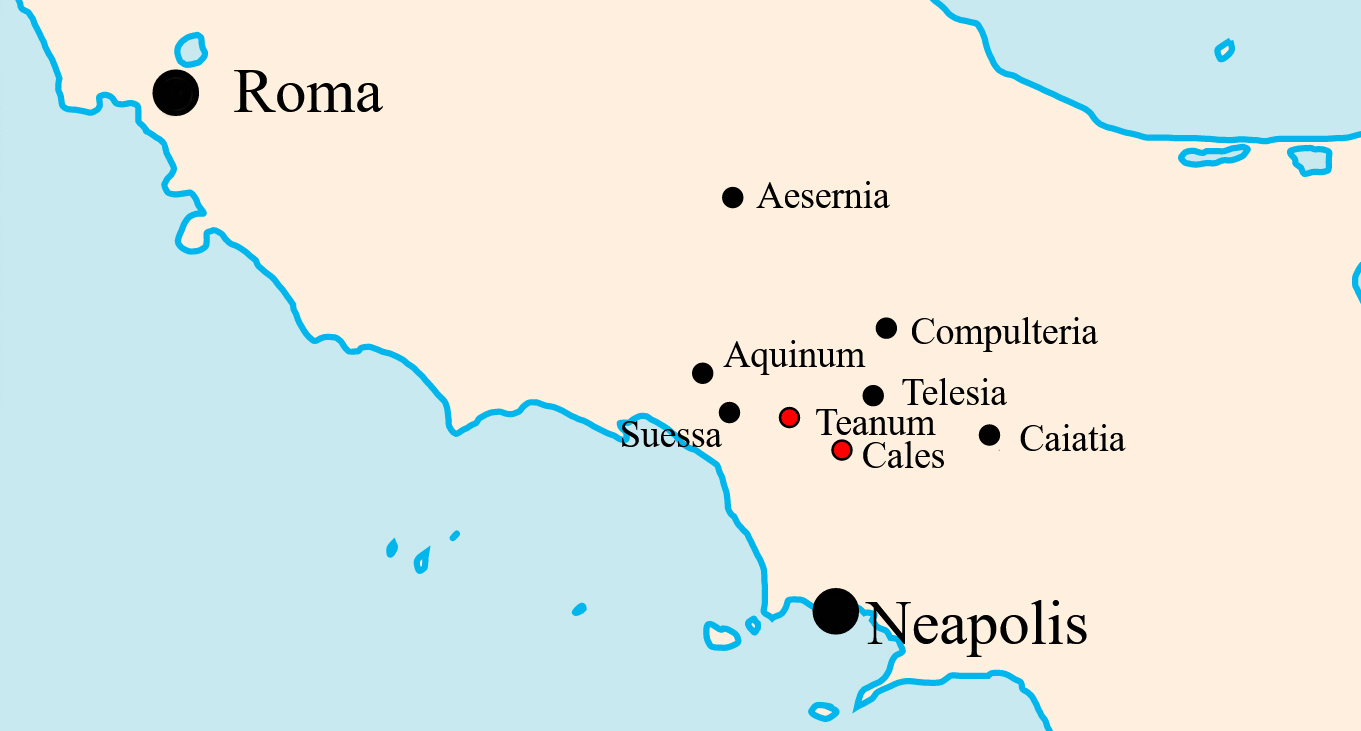 Extract from The Princeton Encyclopedia of Classical Sites: CALES, Campania, Italy. A city on the Via Latina. While older settlements are attested in the area on the basis of archaeological data, the city and its present site seem to date to the late 7th c. B.C., i.e., to the period of Etruscan hegemony which would coincide with what we already know from the necropolis. It remained the city of the Ausones until the siege by the Romans in 334 B.C. Following this it was reduced to a Latin colony, the first in Campania. During the Late Republican period, when it reappeared as a municipium, the city was the seat of the quaestor of Campania. In the Late Empire, it was practically destroyed by the Vandals under Genseric, and in the Longobard period a fortress was built on the site. The city occupied a long, narrow plain, nearly surrounded by streams that cut deep into the tufa. At its highest point, to the N, there was a citadel. In the centre of the settlement, crossed by the Via Latina, was the forum and some of the major public buildings. From the forum, the two sections of the major street, intersected by cross-streets, ran N-S, according to a plan well-attested elsewhere in Etruscan-Italic environs. The fortifications, built over some of the structures preserved from the 4th c. B.C. or even earlier, underwent important restorations in the age of Sulla. This is particularly true in the vicinity of the gates, to some of which access is gained over steep, narrow slopes in the tufa bank. Among the most notable buildings recognizable today are: the theatre, in the area of the forum, of Late Hellenistic date and enlarged in the age of Sulla; the central baths and a terraced sanctuary of the Sullan period; a temple dating from the beginning of the Imperial period, not far from which were discovered votive offerings and some terracotta facings belonging to a sanctuary of the archaic period. North of the settlement are the Late Republican amphitheatre (rebuilt 2d c. A.D.), and a monumental bath building of the first half of the 2d c. of the Empire. On the outskirts, in the S section, an important votive dumping area of the Hellenistic period has been partially explored. 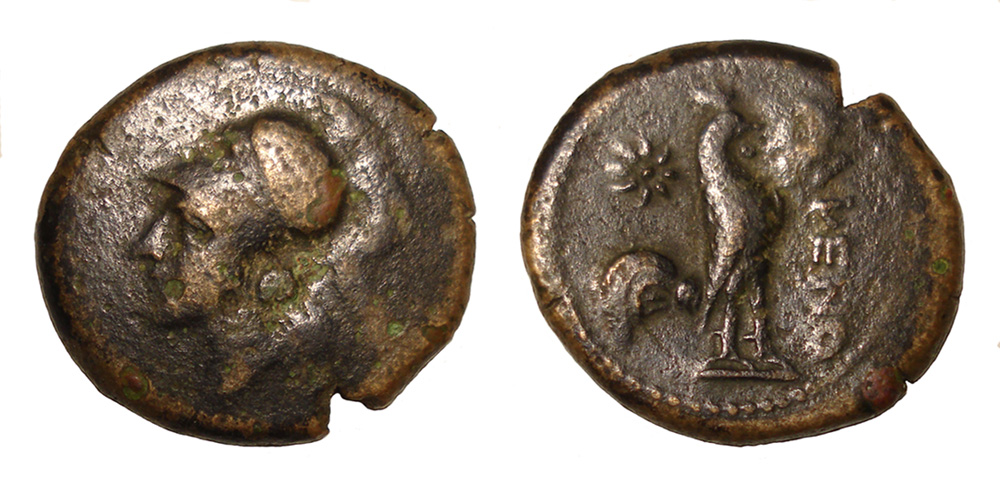 Cales, Campania. circa after 268 BC. Obverse: Head of Athena left, wearing crested Corinthian helmet. Reverse: Cockerel standing right, star in upper left field. Reverse legend: CALENO. Bronze. Diameter: 20 mm. Weight: 6.19 gr. Reference: S-548; SNG ANS 188-195; SNG Cop 322-324; HN Italy 435. Ex-J.A. Spranger collection (Sotheby's 12th May 1983, Lot 89) Extract from The Princeton Encyclopedia of Classical Sites: TEANUM SIDICINUM (Teano) Italy. An ancient city in N Campania of about the same size as the present town. Although there have been discovered in the area tombs of the 7th c. B.C., we have for the first time in the period of the Samnite wars our first evidence of the Sidicini. In the Hellenistic period, to judge from literary notices, archaeological data, and coinage, which began toward the end of the 4th c., Teanum was one of the most important centres of central Campania. In fact, it was the most outstanding site on the Via Latina. The settlement was reduced to the area of the citadel in the high Middle Ages. A sanctuary complex in the area of Loreto on the banks of the Savone (Safo) has yielded architectural and votive terracottas of the last ten years of the 6th c. and much votive material of the 5th and 4th c. After the establishment of the city, which apparently occurred in the last third of the 4th c. to judge from archaeological finds, the sanctuary was significantly enlarged and equipped with a terrace; gradually buildings rose in the area until the period of Sulla. Among the most interesting structures thus far uncovered are four temples with podia of the 3d c. and first half of the 2d c. The monumental works of the late 2d c. were enlarged in the Sullan period. Some small molded temples of the 3d c. and 2d c. are of particular interest among the votive offerings and a sculpture group from the Augustan age. From Wikipedia: The ancient Teanum Sidicinum was the capital of the Oscan tribe of the Sidicini, which drove the Aurunci from Roccamonfina. They probably submitted to Rome in 334 BC and their troops were grouped with those of Campania in the Roman army. Thus the garrison of Regium, which in 280 attacked the citizens, consisted of one cohort of Sidicini and two of Campanians. Like Cales, Teanum continued to have the right of coinage, and, like Suessa and Cales, remained faithful to Rome in both the Hannibalic and the Social wars. Its position gave it some military importance, and it was apparently made a colony by Claudius, not by Augustus. Strabo speaks of it as the most important town on the Via Latina, joined by a branch road from Suessa, of which remains still exist, and which continued east to Alife. 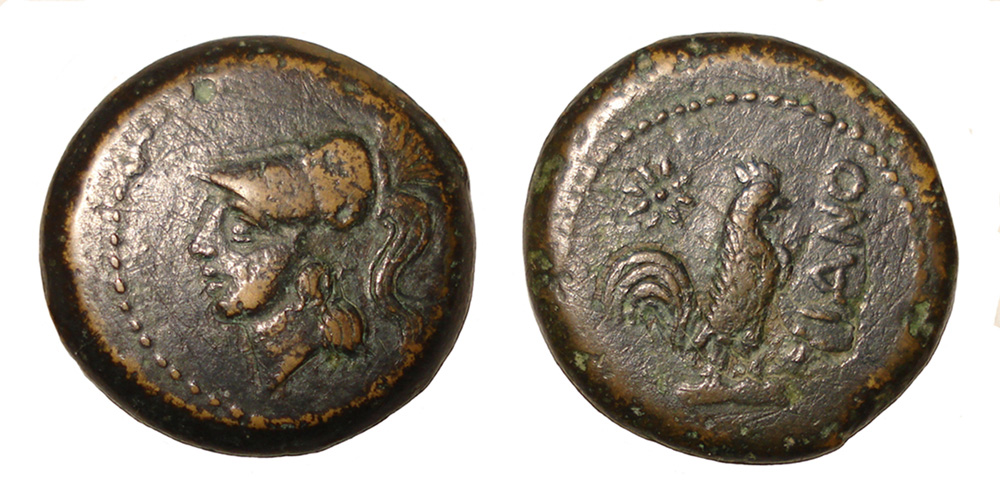 Teanum Sidicinum, Campania. (Tiano) circa 265-240 BC. Obverse: head of Athena left, wearing crested Corinthian helmet. Reverse: Cockerel standing right, star in upper left field. Reverse legend: TIANO. Bronze. Diameter: 20 mm. Weight: 7.49 gr. Reference: S-566; SNG Cop. 594; SNG ANS 625 ff; Historia Numorum Italy, 435. ex-J.A. Spranger collection (Sotheby's, 12th May 1983, Lot 89) |
|
Pillar of the Community
Sweden
2124 Posts |
Interesting coinage. It made me think of the rooster on modern French coins. I wonder if this Italic rooster had any symbolic meaning, or was it just a denomination mark?
|
|
Pillar of the Community
United Kingdom
1168 Posts |
Quote:
Interesting coinage. It made me think of the rooster on modern French coins. Indeed, @erafjel, and this brief extract from the France Diplomacy web site gives an interesting background to the rooster: The Latin word "gallus" means both "rooster" and "inhabitant of Gaul". Certain ancient coins bore a rooster, but the animal was not used as the emblem of the tribes of Gaul. Gradually the figure of the rooster became the most widely shared representation of the French people. In the Middle Ages, the Gallic Rooster was widely used as a religious symbol, the sign of hope and faith. It was during the Renaissance that the rooster began to be associated with the emerging French nation. Quote:
I wonder if this Italic rooster had any symbolic meaning, or was it just a denomination mark? My first coin with a cockerel/rooster reverse was from Dardanos in Troas: Situated on the Hellespont, south of Abydos, Dardanos was an Aiolian colony. The modern name of the Hellespont (Dardanelles) is derived from this city. Dardanos used the cockerel as its symbol on its early coinage, perhaps because of that animal's relation to the sunrise or because of a lost myth connecting it with the Dardanians, an ancient people who supposedly lived in this area and were closely connected to the Trojans (Tros was the grandson of their eponymous founder, Dardanos). An extract from the Getty Edu web site - Roosters and Mercury: Ancient Sources and Archaeological Finds: In the Greek and Roman worlds, the figure of the rooster was frequently associated with gods such as Asclepius, Minerva, and Mars, and represented different aspects of their personalities or spheres of influence, such as healing, readiness, and pugnacity. Nevertheless, the god most often portrayed with a rooster is Mercury, a central character in trade and communication: he was not only the divine messenger but also represented the means and ways of communication. Mercury was the connection between different levels of existence, as they were understood at the time: divine, mortal, and afterlife. In other words, he was an entity at the limits in every sense. No one was more suited to this role: he was born at dawn, between night and day; he was a thief and a gambler, but also a merchant and a gifted musician; excess and moderation in a single god. Probably for these reasons, he was also the chaperone of souls, and the rooster is one of his totemic animals: it is fierce and smart, and, above all, it too knows the borderlines, because it announces the rising sun with its voice, obliterating darkness. There is also an article on the Royal College of Physicians of Edinburgh web site - College Symbolism: Cockerels. An extract states: The cockcrow heralds the dawn and Apollo's light. In Greece cocks were symbols of virility and were often used in cockfighting and as sacrifices. Associated with Greek deities, and sacred to them, were various animals. Aphrodite, for example, the fertility goddess of sexual desire, was associated with lustful animals - rabbit, ram, goat and partridge. Athens was devoted to Athene, the great goddess of war and wisdom, whose chief attribute was the Little Owl (Athene noctua), but who also had a cock and a snake. Her gigantic gold and ivory statue by Pheidias in the Parthenon showed a snake at her feet. Cocks and snakes were also sacred to Apollo and Asklepios. At Epidauros the Asklepieion was sited below a temple of Apollo, and Athene, too, was worshipped there. At Olympia the museum holds a bronze shield-band of about 600 BC showing a cock upon an altar. It also has an ancient terra-cotta figure of Zeus abducting Ganymede to be his beloved cup-bearer: the boy carries a rooster. Cocks appear on Attic pottery of the mid-sixth century BC. They are still symbolic in Greece, as we are reminded by Lawrence Durrell's account of the poet Katsimbalis arousing them at night from the Acropolis by uttering a wild 'cock-crow': 'From the distance silvery clear in the darkness a cock drowsily answered - then another, then another . until all over Athens like bugles they were calling and calling . the whole night was alive with cock-crows - all Athens, all Attica, all Greece.' --------------------------------------------------------------------------- There is a lot of symbolism connected to the cockerel/rooster, but I have not found the connection between Athena and the cockerel on the Cales and Teanum Sidicinum coinage as yet. |
|
Pillar of the Community
Sweden
2124 Posts |
Quote:
There is a lot of symbolism connected to the cockerel/rooster, Apparently!  Lots of symbolism associated with that bird, did not know about all those connections! |
|
Pillar of the Community
United Kingdom
1168 Posts |
Interesting animal coins can be a bit like buses, you don't see one for ages then two come along together. These two coins were acquired within days of each other, both are from Arpi in Apulia, they each have a bull obverse and a horse reverse and both came from the same collection. Originally named Argos Hippion, the city would later become Argyrippa (Argyripa) then Arpi. The added attraction was that it was a city that I had never heard of before, and apparently this issue was minted in name of Poullos who was probably the father of the Dazos who defected to Hannibal during the First Punic War. 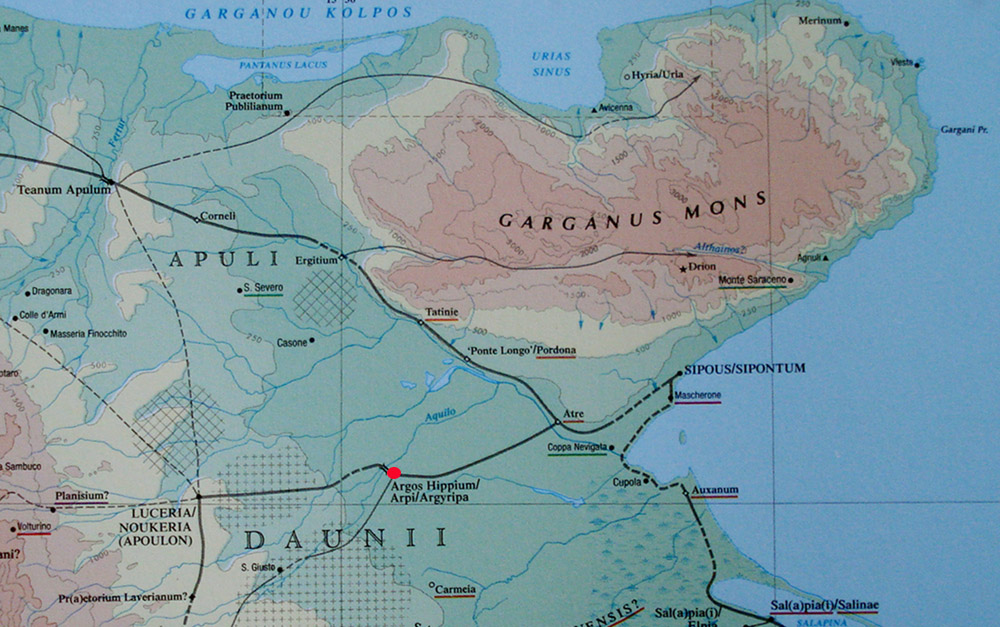 There is a brief mention of Arpi in this extract from Hansen & Nielsen 2004-Lexique Poleis: "In C7 the Rhodians, already active in the colonisation of Sicily, joined with Kos in a settlement of Elpiai on the coast of northern Apulia, but there is no indication that it ever flourished or contributed significantly to any links with the local Daunians, who were evidently less receptive than their Messapian neighbours to the south. A late tradition attributes its foundation to Diomedes, along with Kanousion and Arpi, for which it served as a port, and a similar tradition existed for Sipous or Sipontion near Manfredonia,whose name was said to derive from the Greek word for cuttlefish (sepia)." A bit more information was gleaned from The Princeton Encyclopedia of Classical Sites: "Argos Hippion or Argyrippa (Arpi) Apulia, Italy. A city whose name (Strab. 5.1.9; 6.3.9; Ptol. 3.1.72; Plin. HN 3.104), gave rise to the legend of its foundation by the Argive King Diomede. One of the most important cities of the Daunii, who were Illyrian in origin, it is in the heart of the Tavoliere, ca. 20 km E of Luceria and 30 km from Sipontum, its outlet to the sea. During the period of the city's greatest expansion, Sipontum was included in its territory (Livy 34.45; Dio. 20.3). The city played an important role in the struggle between Greeks and Italici and between Oscans and Latins for supremacy in Italy. In order to save its territory from the Sabelli during the second Samnite war, it concluded a treaty of alliance with Rome in 326 B.C. (Livy 9.13). This contributed to a flourishing period in the city's history, largely datable to the 3d c. B.C. and documented by an immense coinage in silver and bronze. The coins bore a legend in Greek and images of Greek deities, including Zeus, Athena, Persephone, and Ares. During the Pyrrhic war the city was still allied to Rome, but in the second Punic war it surrendered to Hannibal, who wintered there at the end of 215 B.C. Two years later Fabius Maximus occupied its territory, reducing its importance as a result of the loss of its outlet to the sea, where in 194 B.C. the Romans built the colony of Sipontum (Polyb. 3.118; Livy 22.61; App., Hann. 31). It had lost all importance by the Imperial age." "Two inscriptions from nearby Vaccarella belong perhaps to Luceria (CIL IX, 934, 935). The site of the ancient city is easily recognizable a few km N of Foggia. Extensive excavation during the last few years has brought to light the remains of numerous buildings of the Hellenistic-Roman age, pit tombs from the 6th-5th c. B.C. and grotto tombs from the 4th-3d c. B.C. The material found is preserved in the museums at Foggia and Taranto." 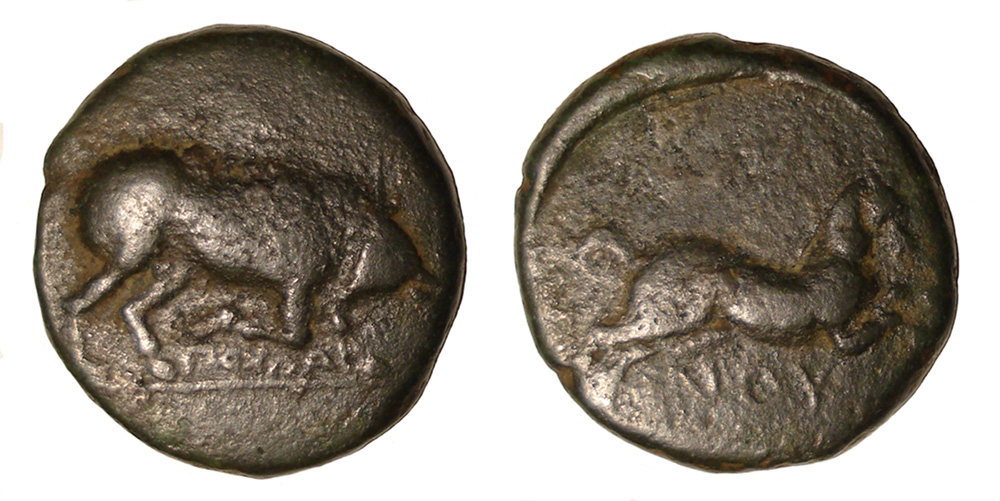 Italy, Apulia, Arpi. c.275-250 BC. Obverse: Bull butting right, ΠOYΛΛO below. Reverse: A[PΠ]ANOY, horse prancing right. Bronze. Diameter: 20 mm. Weight: 8.47 gr. Reference: S-570. ex J.A. Spranger collection (Sotheby's 12.5.1983, Lot 89) 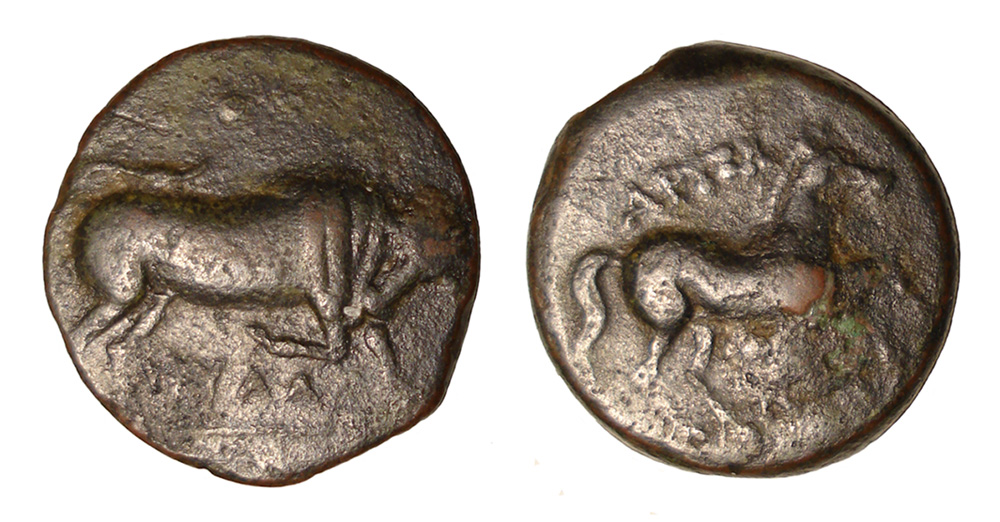 Italy, Apulia, Arpi. c.275-250 BC. Obverse: Bull butting right, ΠOYΛΛO below. Reverse: APΠANOY, horse prancing right. Bronze. Diameter: 19 mm. Weight: 6.10 gr. Reference: S-570; BMC 6; HN Italy 645. ex J.A. Spranger collection (Sotheby's 12.5.1983, Lot 89) Edited by Novicius
04/30/2024 11:41 am
|
|
Pillar of the Community
United States
7067 Posts |
Great info and coins, Jim. Enjoyed the update.
|
| |
Replies: 638 / Views: 59,819 |
To participate in the forum you must log in or register.
Disclaimer: While a tremendous amount of effort goes into ensuring the accuracy of the information contained in this site, Coin Community assumes no liability for errors. Copyright 2005 - 2026 Coin Community Family- all rights reserved worldwide. Use of any images or content on this website without prior written permission of Coin Community or the original lender is strictly prohibited.
Contact Us | Advertise Here | Privacy Policy / Terms of Use
|
| Coin Community Forum |
© 2005 - 2026 Coin Community Forums |
| It took 0.5 seconds to rattle this change. |
 |
|
| |
| |






 First Page
 Previous Page


 Posted 03/08/2024 2:13 pm


