|
This page may contain links that result in small commissions to keep this free site up and running.

Welcome Guest! Registering and/or logging in will remove the anchor (bottom) ads and the security checks. It's Free!
To participate in the forum you must log in or register. | Author |
 Replies: 89 / Views: 9,067 Replies: 89 / Views: 9,067 |
|
|
|
Valued Member
United States
177 Posts |
The Gatling gun is a rapid-firing multiple-barrel firearm invented in 1861 by Richard Jordan Gatling. It is an early machine gun and a forerunner of the modern electric motor-driven rotary cannon. By 1893, the Gatling was adapted to take the new .30 Army smokeless cartridge. The new M1893 guns featured six barrels, later increased to ten barrels, and were capable of a maximum (initial) rate of fire of 800-900 rounds per minute, though 600 rpm was recommended for continuous fire.  [6] Dr. Gatling later used examples of the M1893 powered by electric motor and belt to drive the crank.[7] Tests demonstrated the electric Gatling could fire bursts of up to 1,500 rpm. This rate of fire was not match until much later in time(world war2) For more info : https://en.wikipedia.org/wiki/Gatling_gun |
|
Valued Member
United States
177 Posts |
The Gatlin gun eventually lead to some of the most incredible weapons we ever had in the US arsenal... The Evolution of Puff, the Magic Dragon Plane The mighty dragon Puff evolved from very humble beginnings. The predecessor of the first fixed-wing gunship used in Southeast Asia was the WWII twin-engined C-47 (DC-3) "Gooney Bird," which was first brought to Vietnam as a transport and cargo ship in November 1961. Shortly after their arrival, many C-47s were outfitted as "flare ships" and designated FC-47 ("F" for flare) to drop huge parachute flares over enemy positions during night attacks. In November 1963, FC-47s flung more than seven thousand flares over enemy positions. Due to increased night activity by the Viet Cong (VC) in 1963, it soon became apparent that a better night air effort was necessary. After much deliberation, and because of the diligence and persistence of several young Air Force Officers, the modern concept of the fixed-wing gunship was accepted. The effectiveness of such a gunship was dependent upon its ability to direct concentrated fire on enemy positions in near proximity to friendly forces. The chosen craft also had to have enough power and cargo space to carry the necessary armament and heavy loads of ordnance. The fixed-wing Lockheed AC-130 gunship started as a "Gooney Bird" and became the terror of the skies during the Vietnam War. The flying maneuver that was necessary for this type of precision fire mission was to circle the enemy position in a tightly banked "pylon turn" while firing from side-mounted guns. This would allow the craft to sustain continuous fire on a relatively small area. A cargo or transport-type craft was needed for the huge amounts of munitions required, and it had to be propeller driven, because jet aircraft were much too fast for the precision maneuvers necessary. The C-47 was chosen as the test plane. The armament chosen for the gunships was the General Electric rotary-barreled M-134 machine gun, known as the "minigun," which could fire either fifty or a hundred rounds of 7.62-mm ammunition per second. Initially three miniguns per ship would be fixed-mounted in a side-firing configuration. Positioning the aircraft at the proper altitude and angle was the only means of aiming the weapons. Using this armament, a C-47 flying at three thousand feet in a tight circle could place a bullet in every square yard of a football-field-sized area (five thousand square yards) in approximately 17 seconds. to read more go here: https://warfarehistorynetwork.com/2...heed-ac-130/ |
|
Valued Member
United States
177 Posts |
M61 Vulcan One scary piece of armament.... Each of the cannon's six barrels fires once in turn during each revolution of the barrel cluster. The multiple barrels provide both a very high rate of fire — around 100 rounds per second—and contribute to prolonged weapon life by minimizing barrel erosion and heat generation. The average time between jams or failures is in excess of 10,000 rounds, making it an extremely reliable weapon.[citation needed] The success of the Vulcan Project and its progeny, the very-high-speed Gatling gun, has led to guns of the same configuration being referred to as "Vulcan cannon", which can sometimes confuse nomenclature on the subject.[citation needed] Most aircraft versions of the M61 are hydraulically driven and electrically primed. The gun rotor, barrel assembly and ammunition feed system are rotated by a hydraulic drive motor through a system of flexible drive shafts. The round is fired by an electric priming system where an electric current from a firing lead passes through the firing pin to the primer as each round is rotated into the firing position.[9] The self-powered version, the GAU-4 (called M130 in Army service), is gas-operated, tapping gun gas from three of the six barrels to operate the gun gas-driven mechanism. The self-powered Vulcan weighs about 4.5 kilograms (10 lb) more than its electric counterpart, but requires no external power source to operate, except for an electric, inertia starter to initiate gun rotation, allowing the first rounds to be chambered and fired.[9] The initial M61 used linked ammunition, but the ejection of spent links created considerable (and ultimately insuperable) problems. The original weapon was soon replaced by the M61A1, with a linkless feed system. Depending on the application, the feed system can be either single-ended (ejecting spent cases and unfired rounds) or double-ended (returning casings back to the magazine). A disadvantage of the M61 is that the bulk of the weapon, its feed system, and ammunition drum make it difficult to fit it into a densely packed airframe.[10] The feed system must be custom-designed for each application, adding 140 to 180 kg (300 to 400 lb) to the complete weapon. Most aircraft installations are double-ended, because the ejection of empty cartridges can cause a foreign-object damage hazard for jet engines and because the retention of spent cases assists in maintaining the center of gravity of the aircraft. The first aircraft to carry the M61A1 was the C model of the F-104, starting in 1959.[citation needed] A lighter version of the Vulcan developed for use on the F-22 Raptor, designated M61A2, is mechanically the same as the M61A1, but with thinner barrels to reduce overall weight to 92 kilograms (202 lb). The rotor and housing have also been modified to remove any piece of metal not absolutely needed for operation and replaces some metal components with lighter-weight materials. The F/A-18E/F Super Hornet also uses this version.[11] The Vulcan's rate of fire is typically 6,000 rounds per minute, although some versions (such as that of the AMX and the F-106 Delta Dart) are limited to a lower rate, and others (A-7 Corsair) have a selectable rate of fire of either 4,000 or 6,000 rounds per minute. The M61A2's lighter barrels allow a somewhat higher rate of fire, up to 6,600 rounds per minute.[12] read more here! https://en.wikipedia.org/wiki/M61_Vulcan |
|
Pillar of the Community
 United States
5727 Posts |
This notice of a new book publication appeared in the New York Daily Tribune on October 4, 1892. Arthur Conan Doyle (who had not yet been knighted) originally published a series of short stories about Sherlock Holmes in the Strand magazine in 1891, and they were so well received that he published the first collection of them in London in a book called "Adventures of Sherlock Holmes." This little book review was probably the first time Sherlock Holmes was mentioned in print in America, and he subsequently became one of the most iconic literary figures ever. 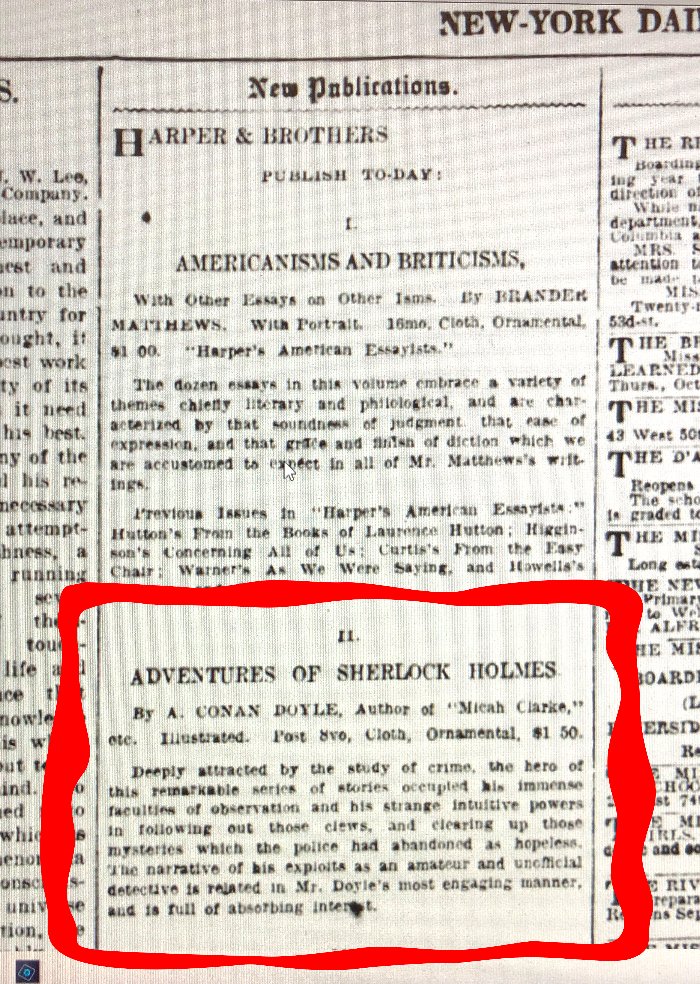 |
|
Bedrock of the Community
Canada
10061 Posts |
There are some very interesting reads in this tread.  |
|
Pillar of the Community
 United States
1390 Posts |
@Sir Derrin. Keep the event between the years 1891 through 1893 for consideration.
Edited by DoctorBurnzy
02/09/2022 12:19 pm
|
|
Pillar of the Community
United States
1390 Posts |
@mcshilling. I have a spreadsheet going to keep track as I expect more to answer and more subsequent entries from existing members who have previously submitted.
|
|
Bedrock of the Community
United States
10284 Posts |
I will make one more entry.Wilhelm II, born Friedrich Wilhelm Viktor Albert, was the last German Emperor (Kaiser) and King of Prussia, ruling the German Empire and the Kingdom of Prussia from 15 June 1888 to 9 1918. He was the eldest grandchild of Queen Victoria of the United Kingdom and related to many monarchs and princes of Europe, most notably, King George V of the United Kingdom and Emperor Nicholas II of Russia. The story of The Kaiser and of WWI are just too long to condense here in a post. I will say that these Kings, Queens, Czars and Emperors, seem to me, to have all sent many a soldier to death over some jealous family issues. THISAppeared in an 1892 Harpers Weekly pg 955I don't know who the author is and can't nail it down to a date but I think the whole year of weekly issues were compiled and paged together. I used to love to read old Harpers Weekly issues in an antique shop I was a dealer at during slow customer days while watching the shop. 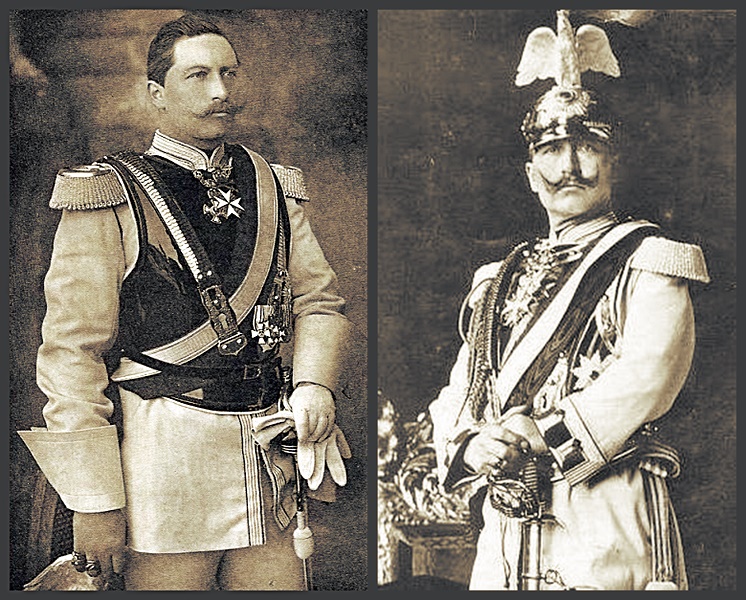 (I hunted down some images that appear to show his left arm) Our obscure factQuote:
Time and again I have seen it stated in print and heard it remarked that one of the great cares that make life a burden to the Emperor is his constant endeavor to conceal his disfigured and withered left hand from observation. During the hour I was in attendance upon the Kaiser I found that just the opposite was the fact. Mr. Russell and myself exhausted every conceivable scheme to induce his Majesty to assume a position which would hide his deformity. He frustrated them all, in a kindly manner, as if he saw through our little game, and took special delight in spoiling it. The left hand of the Kaiser is not deformed so as to be unsightly. It is small and apparently weak, like that of a child. The arm is at least four inches shorter than the right arm, but its upper part seems well built. It is not true that the Emperor is obliged to lift and carry his left arm with his right hand when, perchance, he wants the left to rest on his sword, or sit on his hip while on horseback. The left hand works quite naturally, and the Emperor uses it freely. A medal I have depicting the Kaiser as a pig being spanked in the World War I era.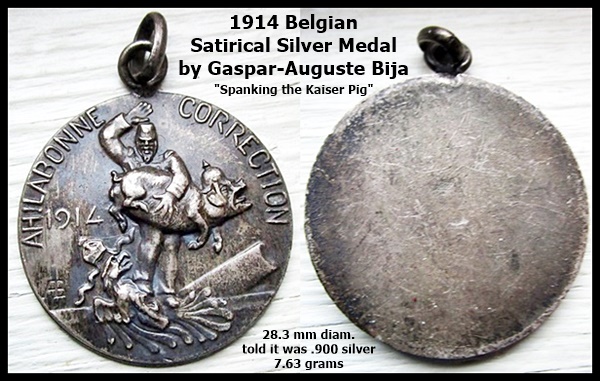 I have seen a very similar medal with different wording for Liege Belgium and DePOSe stamped on the reverse and I have seen one of these with DePOSe stamped on the reverse. This one reads Ah! La Bonne Correction 1914 without DePOSe stamped on the reverse. This translates in French to English to "Ah! The correct correction" or maybe better yet to mean "This spanking serves the Kaiser well". Postcards and a picture showing the Kaiser 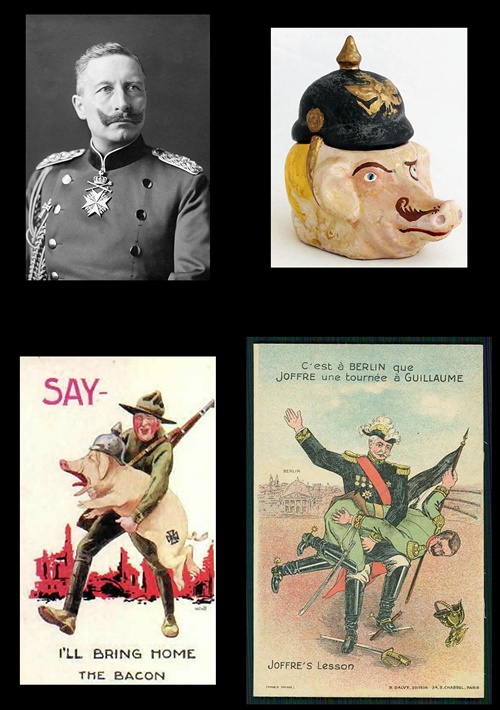
|
|
Pillar of the Community
United States
7398 Posts |
On June 2, 1891, Beadle's Half Dime Library, a weekly publication of the dime novel company Beadle & Adams, published the first in a series of four "Silverblade" novels by Joseph Badger. 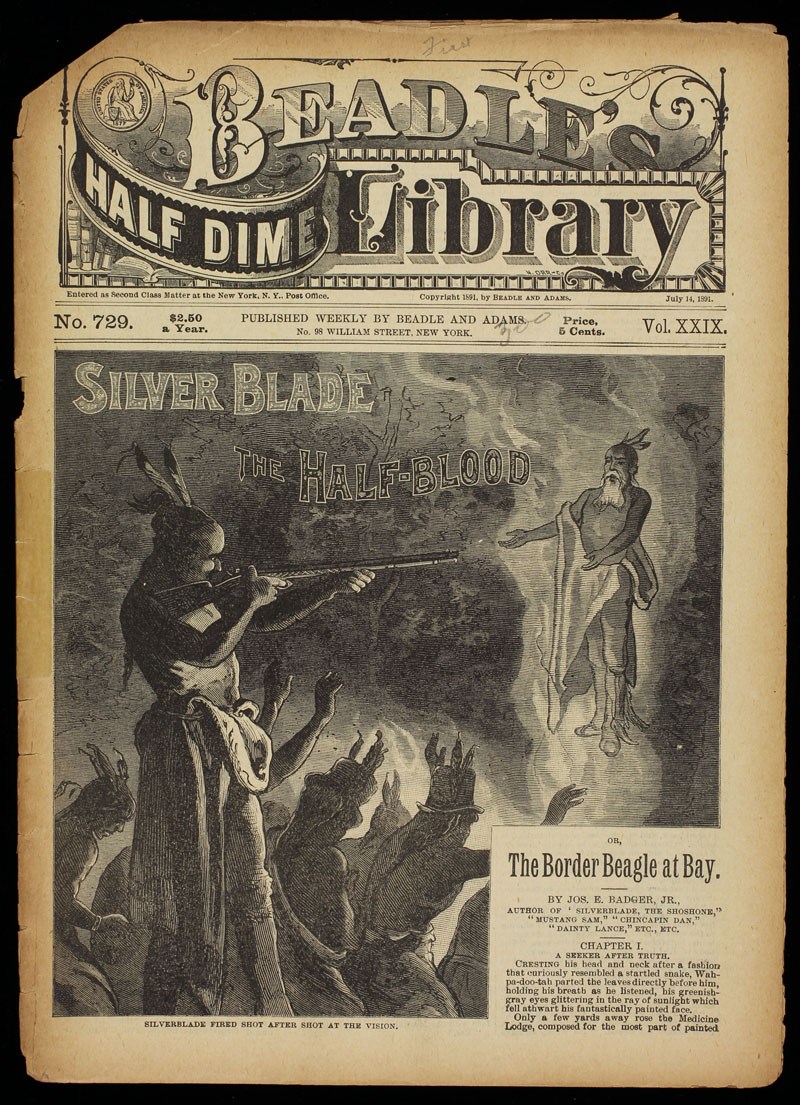 "Badger was a regular writer for the company, and published over 200 dime novels with them over the course of his career. In many ways, his "Silverblade" novels were typical of other dime novels published by the firm including Deadwood Dick, Buffalo Bill, and Pawnee Bill. The Silverblade series included recurring plot devices with plenty of action and suspense and were very popular when first published.What makes these four novels exceptional is Badger's fictionalization of recent history. In the Silverblade stories, the plot revolves around a half-blood Shoshone named Silverblade and his experience in the Ghost Dance. Throughout the previous year, news coverage of the Ghost Dance and the associated violence in South Dakota was extensive, and Badger, writing only months later, most likely drew upon this coverage in his depictions of historical events and figures. While the stories are fictional, they fairly accurately depict the historical events of the Ghost Dance as they were understood by the American public at the time. Therefore, although these stories are historically erroneous, they do provide an accurate picture of how the Ghost Dance was popularly understood and described by newspapers in 1890." "Badger was a regular writer for the company, and published over 200 dime novels with them over the course of his career. In many ways, his "Silverblade" novels were typical of other dime novels published by the firm including Deadwood Dick, Buffalo Bill, and Pawnee Bill. The Silverblade series included recurring plot devices with plenty of action and suspense and were very popular when first published.What makes these four novels exceptional is Badger's fictionalization of recent history. In the Silverblade stories, the plot revolves around a half-blood Shoshone named Silverblade and his experience in the Ghost Dance. Throughout the previous year, news coverage of the Ghost Dance and the associated violence in South Dakota was extensive, and Badger, writing only months later, most likely drew upon this coverage in his depictions of historical events and figures. While the stories are fictional, they fairly accurately depict the historical events of the Ghost Dance as they were understood by the American public at the time. Therefore, although these stories are historically erroneous, they do provide an accurate picture of how the Ghost Dance was popularly understood and described by newspapers in 1890." |
|
Pillar of the Community
United States
587 Posts |
1892 was the year of the Homestead Strike in Homestead, PA near Pittsburgh (without the h at the time).
The workers barricaded themselves inside the steel works so that Henry Frick couldn't bring in new worker's that would accept a lower wage. Frick hired the Pinkertons to take back the steel mill in a conflict.
|
|
Pillar of the Community
United States
608 Posts |
|
|
Pillar of the Community
United States
1390 Posts |
Only a few more days to go before I pick my ten. Get your entries in.
|
|
Pillar of the Community
United States
7398 Posts |
|
|
Pillar of the Community
United States
587 Posts |
Grover Cleveland was re-elected to a nonconsecutive term in 1892, and he was re-inaugurated in 1893.
|
|
Valued Member
United States
177 Posts |
Sorry about the out of date Post... My dyslexia kicked in! The Panic of 1893 At the time of this depression, the United States had never before seen a sink in the economy of this magnitude. Argentina was a main investor in wheat crops. In 1893 when crops failed to produce their quota an Argentinian bank, Baring Brothers, sold all of their investments, which caused a mass withdrawal of gold from the U.S. treasury. Additionally; there was a military takeover of the Buenos Aires government in the same year, which ended further investments. New mines of silver rapidly came about, meaning the price of silver declined suddenly. Railroads were very popular at the time, and soon many people found that they were spending more many than receiving from them. As people realized financial crisis was on the way, they hurried to withdraw their money from banks, which caused bank runs. The Panic of 1893 caused stock prices to fall, 600 banks to close, and 15,000 businesses to close. The economy of the United States began to recover in 1897. 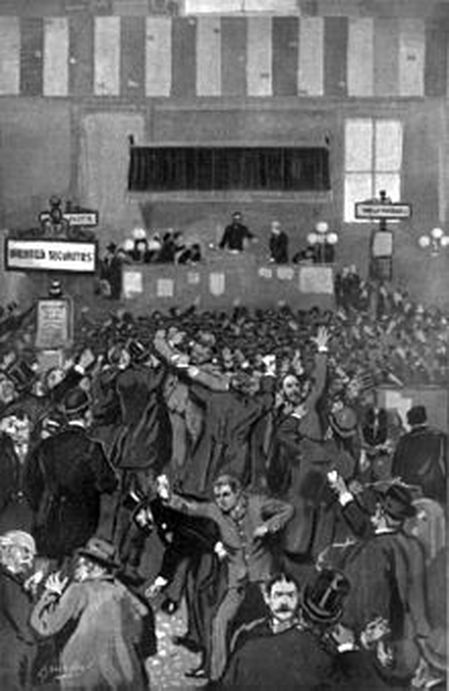 |
| |
Replies: 89 / Views: 9,067 |
To participate in the forum you must log in or register.
Disclaimer: While a tremendous amount of effort goes into ensuring the accuracy of the information contained in this site, Coin Community assumes no liability for errors. Copyright 2005 - 2026 Coin Community Family- all rights reserved worldwide. Use of any images or content on this website without prior written permission of Coin Community or the original lender is strictly prohibited.
Contact Us | Advertise Here | Privacy Policy / Terms of Use
|
| Coin Community Forum |
© 2005 - 2026 Coin Community Forums |
| It took 1.38 seconds to rattle this change. |
 |
|
| |
| |




 First Page
 Previous Page


 Posted 02/08/2022 8:50 pm


