First Page
 Previous Page


 Posted 02/28/2022 5:33 pm


I have one more story to share - one that has a personal component:
In about 1892 a small beetle native to Central or South America made its way across the Mexican border in the vicinity of Brownsville, Texas and spread rapidly across the cotton growing regions. By the 1920s Anthonomus grandis, the boll weevil, was causing more economic damage than any agricultural pest in U.S. history. The boll weevil feeds on cotton pollen but does its damage by laying eggs on cotton flower buds, called "squares," or on the young developing cotton boll. Cotton buds are surrounded by three or sometimes four bracts that provide the beetle with a platform. The infected bud or boll stops developing and often falls off as the beetle larvae eat it, and so damages the cotton crop. The destruction of cotton fields by the boll weevil spread from Texas across the South and Southwest so that by the Great Depression, cotton farmers had already suffered from many years of devastatingly poor harvests.
Today the adaptable nature of humans faced with adversity is making life tough for the boll weevil. An eradication program started in the 1970s is coming close to driving the boll weevil out of the U.S. By using a variety of strategies throughout the year, such as pheromone traps in the spring, hand picking of infected cotton buds during the growing season, plowing under the cotton stalks after harvest, and low levels of pesticides when the insect is short of food in the fall, boll weevils have been eradicated in all states except Texas. In many areas cotton can now be grown with little or no application of pesticides. The southern part of Texas, where the boll weevil first crossed into the U.S., is the last stand of the boll weevil north of the border. The eradication program is now being used in northern Mexico, benefiting both Mexican farmers and farmers in the U.S. by continuing to expand the boll-weevil-free areas.
My late father was one of the USDA-APHIS agents who initially developed this eradication methodology and the resulting program. The program was first instituted in our home state of North Carolina in the 1970s. I also had a part in the program. During my summer vacations while in college, I worked for the USDA scouting cotton fields in SE North Carolina, baiting the pheromone traps and collecting population data on the weevils.
For further reading:
https://www.cotton.org/tech/pest/bo...ication2.cfm

Boll Weevil Monument, Enterprise, Alabama
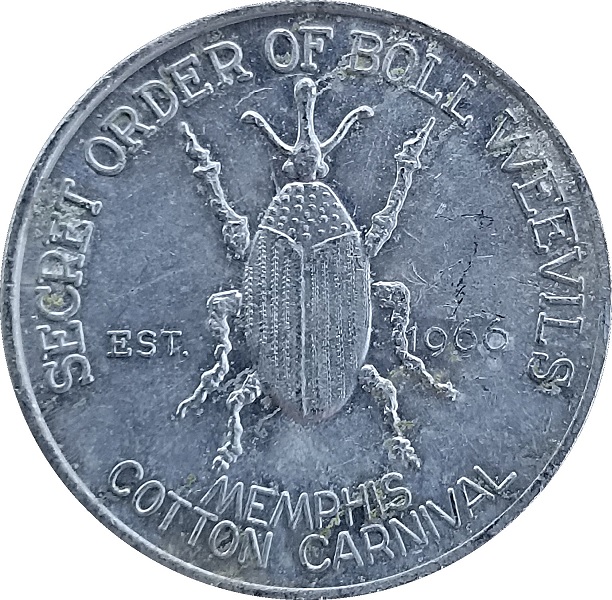
Edited for further info.
In about 1892 a small beetle native to Central or South America made its way across the Mexican border in the vicinity of Brownsville, Texas and spread rapidly across the cotton growing regions. By the 1920s Anthonomus grandis, the boll weevil, was causing more economic damage than any agricultural pest in U.S. history. The boll weevil feeds on cotton pollen but does its damage by laying eggs on cotton flower buds, called "squares," or on the young developing cotton boll. Cotton buds are surrounded by three or sometimes four bracts that provide the beetle with a platform. The infected bud or boll stops developing and often falls off as the beetle larvae eat it, and so damages the cotton crop. The destruction of cotton fields by the boll weevil spread from Texas across the South and Southwest so that by the Great Depression, cotton farmers had already suffered from many years of devastatingly poor harvests.
Today the adaptable nature of humans faced with adversity is making life tough for the boll weevil. An eradication program started in the 1970s is coming close to driving the boll weevil out of the U.S. By using a variety of strategies throughout the year, such as pheromone traps in the spring, hand picking of infected cotton buds during the growing season, plowing under the cotton stalks after harvest, and low levels of pesticides when the insect is short of food in the fall, boll weevils have been eradicated in all states except Texas. In many areas cotton can now be grown with little or no application of pesticides. The southern part of Texas, where the boll weevil first crossed into the U.S., is the last stand of the boll weevil north of the border. The eradication program is now being used in northern Mexico, benefiting both Mexican farmers and farmers in the U.S. by continuing to expand the boll-weevil-free areas.
My late father was one of the USDA-APHIS agents who initially developed this eradication methodology and the resulting program. The program was first instituted in our home state of North Carolina in the 1970s. I also had a part in the program. During my summer vacations while in college, I worked for the USDA scouting cotton fields in SE North Carolina, baiting the pheromone traps and collecting population data on the weevils.
For further reading:
https://www.cotton.org/tech/pest/bo...ication2.cfm
Boll Weevil Monument, Enterprise, Alabama
Edited for further info.
"Nummi rari mira sunt, si sumptus ferre potes." - Christophorus filius Scotiae
Edited by Bump111
02/28/2022 5:41 pm
02/28/2022 5:41 pm